


What Is a Memecoin Prop Firm?
A memecoin prop firm is a proprietary trading firm that gives traders access to a funded or simulated trading account where memecoins can be traded under predefined rules. Instead of putting a large amount of personal capital at risk, traders typically pay for an evaluation, meet the firm’s trading requirements, and can then become eligible for profit payouts.
Memecoins differ from many other crypto assets because their price movements can be driven heavily by market sentiment, social activity, sudden changes in demand, and short lived momentum. This can create sharp moves in both directions within a short period. As a result, the trading conditions offered by a prop firm can have a significant effect on how a trader manages risk and positions.
How Memecoin Prop Trading Works
The basic process is similar to other crypto prop trading models. A trader selects an account, pays the applicable challenge or evaluation fee, and trades within a set of rules. These rules can include a profit target, daily loss limit, maximum drawdown, leverage restrictions, position limits, and requirements around the number or type of trading days.
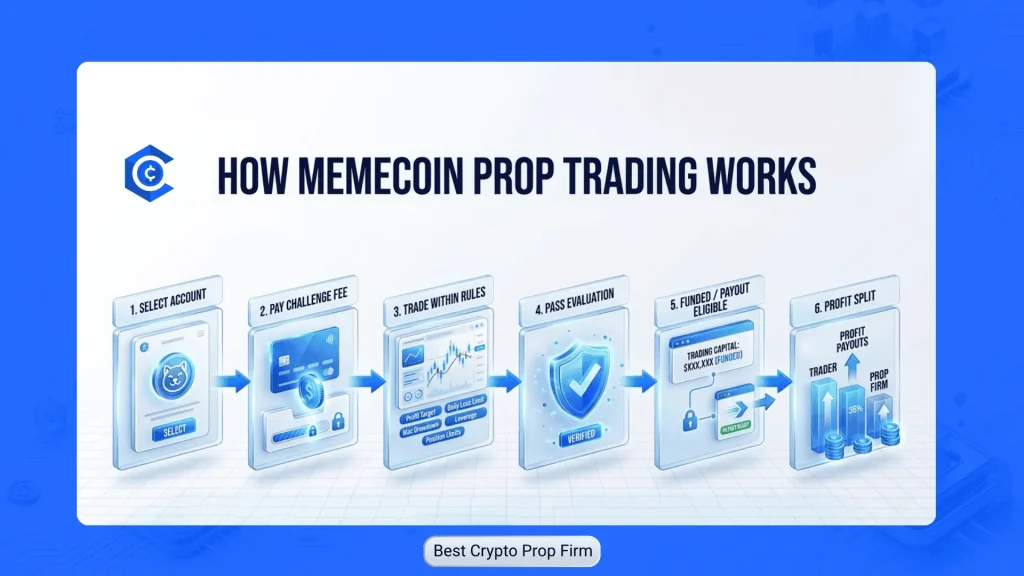
Once the trader meets the firm’s evaluation conditions without violating its risk rules, the account may progress to a funded or payout eligible stage, depending on the firm’s model. The trader then receives a share of eligible profits according to the firm’s profit split and payout terms.
For memecoin traders, however, the details behind those rules matter more than the account’s advertised size. A $100,000 account with restrictive position limits or low memecoin leverage may provide less practical trading flexibility than the headline account size suggests.
Memecoin Prop Firm vs Traditional Crypto Prop Firm
A crypto prop firm may offer a broad range of cryptocurrencies, including Bitcoin, Ethereum, major altcoins, and memecoins. A memecoin focused trader needs to look beyond the number of assets available and examine the specific conditions attached to meme coins.
For example, a firm may offer high leverage on major cryptocurrencies but reduce leverage for more volatile altcoins and memecoins. It may also restrict certain markets, limit position sizes, prohibit short selling, or impose different holding conditions.
The comparison should therefore include more than the challenge price. Leverage, maximum position size, drawdown rules, short selling availability, overnight or weekend holding restrictions, payout conditions, and profit split can all affect how useful an account is for memecoin trading.
Why Memecoin Trading Requires Different Account Conditions
The main reason is volatility. A memecoin can experience a much larger percentage move over a short period than a trader might expect from a more established crypto asset. Sudden price movements can therefore bring a position close to a daily loss limit or maximum drawdown much faster.
Liquidity is another consideration. Some memecoins have significantly less market depth than major cryptocurrencies. During fast market conditions, this can increase the difference between the expected entry or exit price and the actual execution price.
Sudden price movements also make position sizing and leverage particularly important. A high leverage limit may look attractive, but using the maximum available leverage on a volatile memecoin can expose a trader to the firm’s loss limits very quickly. Similarly, a firm may advertise a large funded account while applying maximum position or margin limits that reduce the amount of capital that can actually be deployed in a single trade.
This is why the challenge price alone is not enough when comparing memecoin prop firms. Traders should look at the complete account conditions and how those conditions interact with their trading style.
For example, CoinProp offers memecoin trading through its crypto trading environment, with TradingView integration and direct Bybit market data. During the challenge, there is no consistency rule, while the account also has fixed drawdown limits, specific leverage for altcoins and memecoins, and defined profit sharing and payout terms. These conditions can be more relevant to a memecoin trader than the account’s advertised capital size alone.
Ultimately, the right comparison is not simply which prop firm offers the cheapest challenge or largest account. It is which firm’s trading conditions are compatible with the way you intend to trade memecoins.
What to Look for in a Memecoin Prop Firm
Choosing a memecoin prop firm requires more than checking the challenge price or advertised account size. Memecoins can differ significantly in liquidity, volatility, and available trading pairs, while prop firms can apply different leverage, position, and exposure limits to these markets.
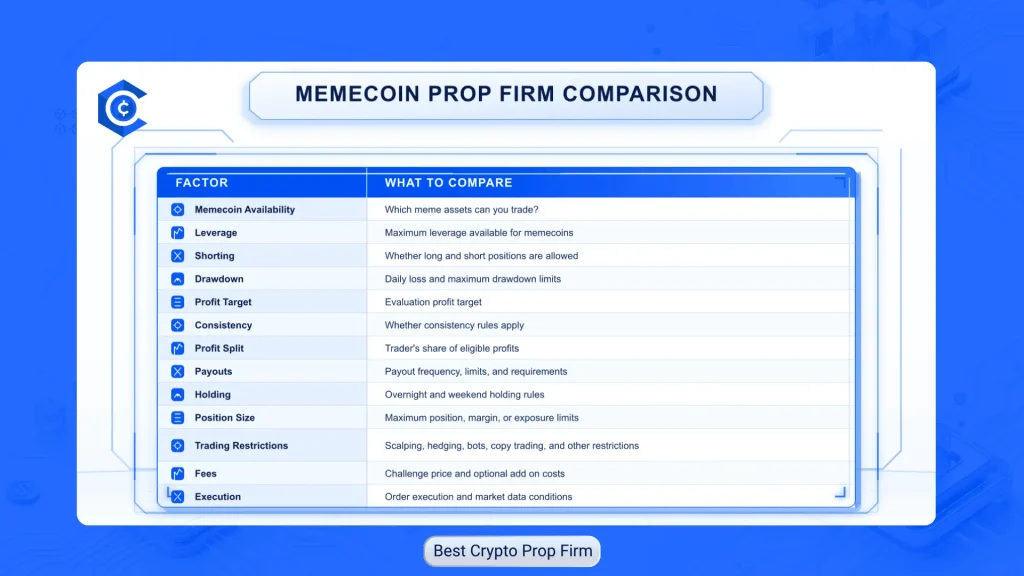
Before choosing an account, traders should check whether the memecoins they actually want to trade are available and whether the firm’s conditions allow them to use their preferred strategy without running into unexpected restrictions.
Memecoin Availability
The first question is simple: which memecoins can you actually trade?
A prop firm may advertise hundreds of crypto assets, but that does not necessarily mean every popular memecoin is available under the same trading conditions. Traders should check the firm’s current market list and confirm whether specific assets such as DOGE, SHIB, PEPE, BONK, WIF, FLOKI, or other meme coins are supported.
Availability also needs to be considered alongside the trading environment. Check whether the asset is offered as a perpetual contract or another instrument, what market data is used, and whether the same execution and account rules apply to memecoins as to other cryptocurrencies.
The number of available assets alone is therefore not enough. The relevant question is whether the firm offers the memecoins you want to trade under conditions that fit your strategy.
Leverage for Memecoin Trading
Leverage determines how much market exposure a trader can control relative to the margin allocated to a position. For memecoins, the available leverage can be particularly important because relatively small price movements can produce large changes in unrealized profit or loss when leverage is used.
Not every crypto prop firm applies the same leverage across all assets. A firm might offer higher leverage for BTC and ETH while applying lower limits to altcoins and memecoins because of their higher volatility.
When comparing memecoin leverage, check:
- The maximum leverage available specifically for memecoins
- Whether leverage differs between major cryptocurrencies and meme coins
- Whether different memecoins have different leverage limits
- Whether leverage can change based on market conditions
- Whether the firm imposes a separate maximum margin or exposure limit
Higher leverage is not automatically more useful. If a trader reaches the account’s daily loss or maximum drawdown limit after a relatively small adverse move, having more leverage may simply increase the risk of breaching the account rules.
For that reason, leverage should always be considered together with position sizing, drawdown limits, and the trader’s actual risk per trade.
Maximum Position Size and Margin Limits
Leverage is only one part of the equation. A prop firm can advertise 2x, 5x, or even higher leverage while applying separate restrictions on how much of the account can actually be allocated to a single position.
For example, a firm could have a maximum margin requirement, maximum position size, or maximum exposure per asset. These restrictions can significantly reduce the practical buying power available to a trader.
Consider a simple example. A trader has a $100,000 account and a stated 5x leverage limit. The headline figure suggests up to $500,000 in market exposure. But if the firm also limits the amount of margin that can be used on a single position, the trader may not be able to deploy that full exposure on one memecoin.
This is why traders should look at effective buying power, not just the advertised leverage.
Before opening an account, check whether the firm has:
- Maximum position size per trade
- Maximum margin allowed on a position
- Maximum exposure to one asset
- Different limits for memecoins and other cryptocurrencies
- Restrictions on combining multiple positions in the same asset
- Rules that change the maximum position as account equity changes
These limits can have a direct impact on strategy. A scalper entering several short term positions, for example, may be affected differently from a trader holding one larger directional position.
For memecoin traders, the goal is not simply to find the highest leverage. It is to understand how leverage, position limits, margin requirements, and drawdown rules work together before deciding whether an account provides enough practical flexibility for the intended trading strategy.
Can You Short Memecoins With a Prop Firm?
Yes, some prop firms allow traders to take both long and short positions on memecoins, but this is not a universal rule. Short selling availability depends on the markets offered by the firm and its specific trading rules.
This matters because memecoin markets can move sharply in both directions. A trader who can only take long positions may be unable to use a strategy designed to capture downward moves. Before choosing a memecoin prop firm, check whether short positions are permitted on the specific meme coins you intend to trade.
Long vs Short Memecoin Trading
Long and short positions allow traders to approach memecoin volatility in different ways.
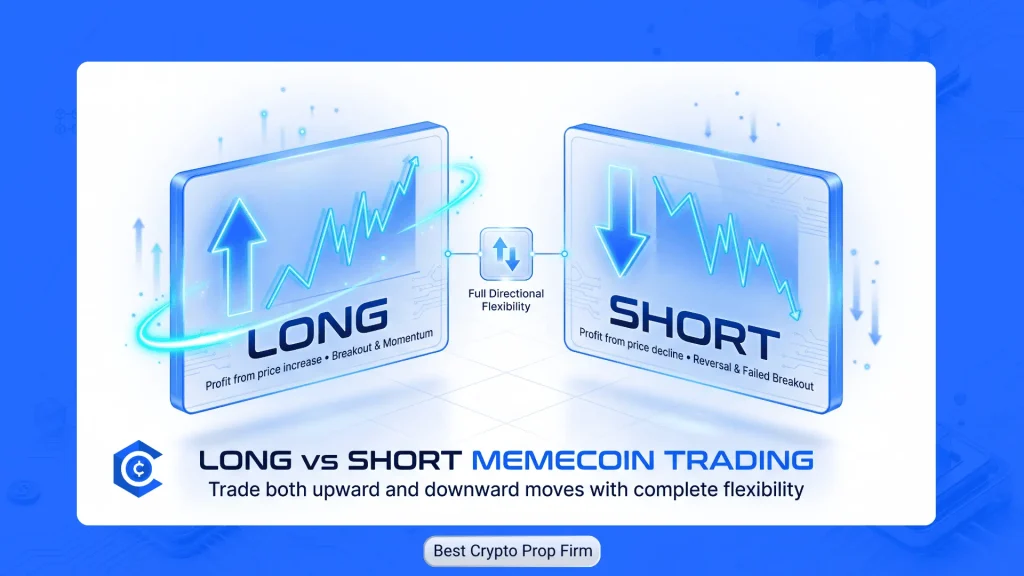
A long position seeks to profit from an increase in the price of a memecoin. This is particularly relevant when a coin is experiencing strong upward momentum or a breakout.
A short position seeks to profit from a decline in price. For example, a trader may look for a failed breakout, momentum reversal, or sharp move that appears to be losing strength.
Having access to both directions gives traders more flexibility. Instead of being limited to bullish setups, they can potentially trade both upward and downward market moves according to their strategy and the firm’s rules.
Are Short Positions Allowed?
Not every prop firm treats short selling the same way. Some firms allow both long and short positions across their supported perpetual markets, while others may restrict certain assets or trading methods.
The important point is to check the specific trading rules and market list rather than assuming that every cryptocurrency account supports shorting every available memecoin.
Before starting a challenge, check:
- Whether short positions are allowed
- Whether shorting is available on all memecoins or only selected assets
- Whether there are separate restrictions on short positions
- Whether hedging rules affect long and short positions
- Whether position size or margin limits apply differently to certain markets
If shorting is not allowed, a trader whose strategy depends on bearish setups may have significantly fewer opportunities.
Short Selling Restrictions on Memecoins
Even when a prop firm allows short selling, additional restrictions may apply. These can include limits on specific assets, maximum position sizes, margin requirements, or restrictions on particular trading techniques.
For example, a firm might make a large selection of crypto markets available while applying different conditions to smaller or more volatile memecoins. Another firm may allow shorting generally but prohibit certain forms of hedging or simultaneous long and short exposure.
Traders should therefore review the firm’s rules for:
- Short selling availability
- Maximum position size
- Maximum margin or exposure
- Hedging
- Holding periods
- Trading during highly volatile market conditions
- Specific restricted assets
These details can matter more for memecoin traders because sudden price movements can quickly change the risk profile of a short position.
Why Shorting Memecoins Can Be Different
Memecoin shorting can behave differently from shorting more established cryptocurrencies because price movements can be particularly fast and sentiment driven. A coin that has fallen sharply can also experience a rapid reversal, creating substantial risk for an oversized short position.
This makes position sizing especially important. A trader should consider not only whether shorting is technically permitted, but also whether the firm’s leverage, drawdown, and position limits provide enough room to manage a fast adverse move.
For traders who use breakout, momentum, reversal, or mean reversion strategies, the ability to trade both directions can also affect which setups are available. A long only account may work for a strategy focused exclusively on bullish momentum, while a trader who actively looks for both bullish and bearish setups may need a firm that permits short positions on the relevant memecoins.
CoinProp, for example, provides access to crypto perpetual markets where traders can take directional positions under its account rules. When comparing CoinProp or any other memecoin prop firm, the important question is not simply whether the platform supports shorting, but whether the specific memecoins, leverage, position limits, and risk rules match the way you intend to trade.
Memecoin Prop Firm Trading Restrictions
Trading restrictions can be just as important as leverage and drawdown when choosing a memecoin prop firm. A firm may offer a wide range of meme coins but still restrict certain trading styles, holding periods, hedging methods, or automated strategies.
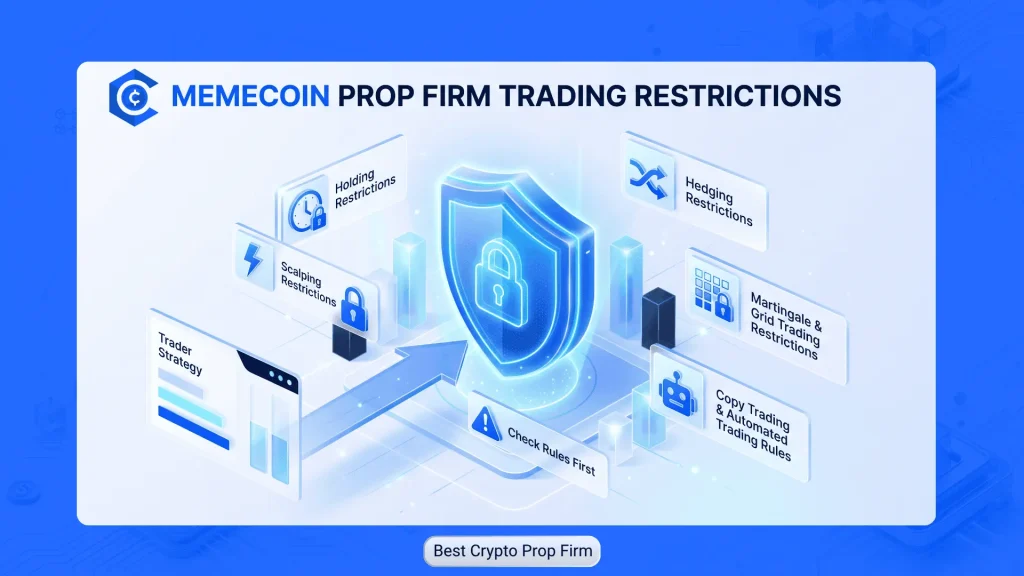
These rules can have a direct impact on how a trader manages volatile positions. Before paying for an evaluation, read the firm’s trading rules carefully and check whether your intended strategy is explicitly permitted.
Holding Restrictions
Some prop firms place restrictions on how long traders can keep positions open. These rules may include overnight holding, weekend holding, or restrictions around specific market events.
For memecoin traders, holding rules can be particularly relevant because meme coins can move significantly while a trader is away from the screen. A strategy based on multi day momentum or swing trading may therefore require different account conditions from a strategy that closes every position before the end of a trading session.
Check whether the firm allows:
- Overnight positions
- Weekend positions
- Holding through major market events
- Positions to remain open during periods of extreme volatility
- Positions to remain open when market liquidity changes
It is also important to understand whether a restriction applies to all crypto markets or only specific assets.
Scalping Restrictions
Scalping can be useful for traders who want to capture short term movements in highly volatile markets, but not every prop firm treats short term trading in the same way.
Some firms allow scalping without a minimum holding period, while others may restrict extremely short duration trades or certain execution patterns.
Before choosing an account, check whether the rules specify:
- A minimum holding time
- A minimum distance between opening and closing a position
- A maximum number of trades
- Restrictions on rapid order placement
- Restrictions on high frequency execution
- Rules against strategies that attempt to exploit execution delays or price discrepancies
A firm that allows scalping generally may still have other rules that affect how a high frequency strategy can be implemented. Traders should therefore read the complete trading policy rather than relying on a statement such as “scalping allowed.”
Hedging Restrictions
Hedging rules determine whether a trader can hold opposing positions, such as a long and short position on the same memecoin at the same time.
Some prop firms permit hedging, while others prohibit it. There may also be restrictions on using multiple accounts to create offsetting positions.
This matters because a trader using a hedging strategy needs to know exactly how the firm treats:
- Long and short positions on the same asset
- Opposing positions across different accounts
- Partial hedges
- Simultaneous positions on correlated memecoins
If hedging is prohibited, a strategy that relies on temporarily offsetting exposure may not be suitable for that account.
Martingale and Grid Trading Restrictions
Memecoin traders may also use strategies such as martingale, grid trading, averaging down, or position stacking. These approaches can involve adding to a position as the market moves, so the firm’s position size and drawdown rules become especially important.
Prop firms do not necessarily have the same policy toward these strategies. Some may explicitly prohibit martingale or similar practices, while others may permit them as long as the trader remains within the account’s risk limits.
Before using one of these approaches, check whether the firm allows:
- Martingale strategies
- Grid systems
- Averaging down
- Adding to losing positions
- Position stacking
- Increasing position size after a loss
Even when a strategy is technically allowed, the account’s maximum drawdown, daily loss limit, and position size restrictions can make it impractical.
For example, repeatedly adding to a losing memecoin position can increase exposure quickly during a sharp move. A trader may therefore reach the account’s loss limit before the market reverses.
Copy Trading and Automated Trading Rules
Automated and copied trading strategies can introduce another layer of restrictions. A prop firm may allow some forms of automation while prohibiting certain types of copy trading, account mirroring, or third party execution.
Traders using EAs, trading bots, automated systems, signal services, or multiple account strategies should check the firm’s rules before starting an evaluation.
Important questions include:
- Are trading bots allowed?
- Are EAs or automated execution systems permitted?
- Is copy trading allowed?
- Can trades be copied between accounts belonging to the same trader?
- Are third party signals permitted?
- Are account mirroring services restricted?
- Are multiple account strategies allowed?
- Are there restrictions on identical trades across multiple accounts?
These rules can be particularly important for traders who manage several accounts or use an automated system to trade fast moving memecoin markets.
Why Trading Restrictions Matter for Memecoin Traders
A prop firm’s advertised leverage or account size does not tell the whole story. Trading restrictions determine how that capital can actually be used.
A trader focused on short term memecoin scalping needs different conditions from a swing trader who holds positions overnight. Likewise, a trader who relies on short selling, grid trading, or automated execution needs to confirm that those methods are allowed before choosing an account.
The key is to match the firm’s rules with your actual trading style. A memecoin prop firm is only practical if its restrictions allow you to execute your strategy while staying within its risk and payout requirements.
Memecoin Drawdown and Risk Limits
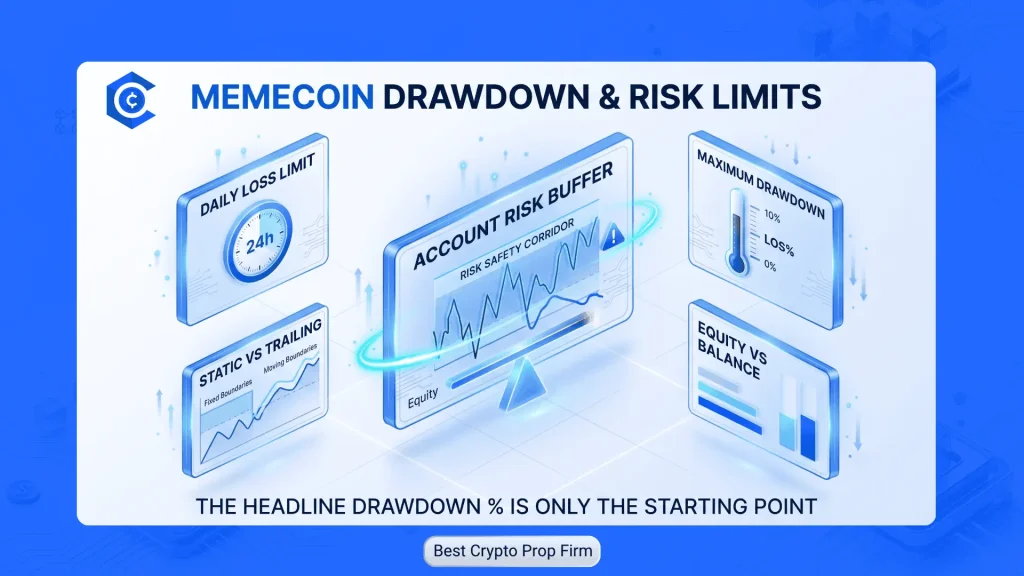
Drawdown rules are among the most important conditions to check when choosing a memecoin prop firm. Meme coins can experience unusually fast price movements, so a position that appears manageable at entry can move against the trader quickly and consume a significant portion of the account’s allowed loss.
The headline drawdown percentage is only the starting point. Traders should also understand whether the firm uses a daily loss limit, maximum drawdown, static or trailing drawdown, and whether these limits are calculated from balance, equity, or another reference point.
Daily Loss Limits
A daily loss limit defines the maximum amount an account can lose within a trading day before the account is considered to have violated its risk rules.
For example, if a $100,000 account has a 3% daily loss limit, the nominal daily loss allowance would be $3,000. However, the actual calculation depends on the firm’s rules.
A trader should check:
- Whether the limit is based on starting of day balance or equity
- When the trading day resets
- Whether realized and unrealized PnL both count
- Whether commissions and trading fees are included
- Whether open positions can cause a breach
- What happens when the account reaches the limit during a live position
These details become particularly important when trading volatile memecoins. A sudden move can push an open position through the daily loss threshold before a trader has time to manually close it.
For this reason, the account’s daily loss limit should be considered when determining position size and risk per trade, rather than only after a trade has been opened.
Maximum Drawdown
Maximum drawdown is the total amount an account can lose before the account fails or trading access is terminated.
Suppose a $100,000 account has a 6% maximum drawdown. Depending on how the firm calculates drawdown, the account may have a $6,000 loss allowance. But the exact rule matters more than the percentage itself.
Traders should determine:
- Whether drawdown is calculated from the initial account balance
- Whether it is based on the current equity
- Whether profits increase the allowable drawdown
- Whether unrealized losses count
- Whether the drawdown level can move upward
- Whether fees are included in the calculation
For memecoin trading, a fixed maximum drawdown can be particularly relevant because the trader needs enough room to absorb normal volatility without allowing one position to threaten the entire account.
Static vs Trailing Drawdown
One of the most important distinctions is whether the maximum drawdown is static or trailing.
With a static drawdown, the loss threshold remains fixed relative to the initial account conditions. If the account starts at $100,000 and has a 6% static maximum drawdown, the threshold generally remains at $94,000, subject to the firm’s exact calculation method.
A trailing drawdown can move as the account reaches new equity or balance highs. This means that profitable trading can cause the loss threshold to move higher as well.
For a memecoin trader, the difference can materially affect risk management.
With a static drawdown, profits may create more practical room above the fixed loss threshold. With a trailing model, part of the newly generated profit may effectively become part of the reference used to calculate the drawdown.
Neither model should be evaluated in isolation. The trader needs to understand when the threshold moves, what causes it to move, and whether it follows balance or equity.
Equity vs Balance Based Drawdown
Another important detail is whether drawdown is calculated using equity or balance.
Balance generally reflects realized PnL after closed trades. Equity also includes the unrealized profit or loss of open positions.
This distinction matters when trading volatile memecoins.
Imagine a trader has a $100,000 account and an open memecoin position that is temporarily down $2,500. If the firm’s drawdown calculation uses equity, that unrealized loss may immediately affect the account’s available drawdown. If the calculation is based only on balance, the treatment may be different until the position is closed.
The same principle applies to profitable open positions. A firm may use equity based calculations that cause the drawdown reference to change while a position is still open.
Before trading, confirm:
- Balance or equity is used
- Unrealized PnL is included
- Realized PnL is included
- Commissions and fees affect the calculation
- The drawdown threshold is recalculated during open positions
- The daily loss and maximum drawdown use the same methodology
This is especially important for memecoin strategies that keep positions open through large intraday fluctuations.
What Happens When a Memecoin Gaps or Moves Quickly?
Memecoins can move sharply within seconds, particularly during periods of intense market activity. In a fast move, the price at which a trader expects to exit may differ from the actual execution price.
This creates an important question for prop firm traders: what happens if the market moves through the account’s loss limit before the position can be closed?
The answer depends on the firm’s execution environment and risk rules. A trader should understand whether the firm’s loss limits are monitored using real time equity, executed prices, or another calculation method.
Consider a trader with a position that is close to the daily loss limit. A sudden memecoin move could create a larger than expected unrealized loss before the trader exits. If the firm’s rules use equity based limits, the account could potentially breach its loss threshold during that move.
This is why traders should not treat the maximum permitted loss as the amount they should risk on a single trade. The account’s drawdown is a survival limit, not a recommended trade risk.
Position sizing should leave enough room for:
- Normal market volatility
- Execution differences
- Slippage
- Sudden price movements
- Multiple losing trades
- Temporary adverse moves
For memecoin trading, this becomes even more important when leverage is involved. Higher leverage can increase exposure without increasing the account’s drawdown allowance, meaning the same fixed loss limit can be reached with a smaller percentage move in the underlying position.
Ultimately, the most useful way to compare memecoin prop firms is to look at the entire risk framework rather than one headline percentage. Daily loss limits, maximum drawdown, drawdown methodology, leverage, position limits, and execution conditions all work together to determine how much risk a trader can realistically take.
Memecoin Prop Firm Profit Targets
Profit targets are a central part of most prop firm evaluations, but the target percentage alone does not tell traders how difficult or flexible an account may be. A 10% target, for example, can have very different implications depending on the drawdown limit, consistency requirements, minimum trading days, and whether traders can complete the evaluation in a single session.
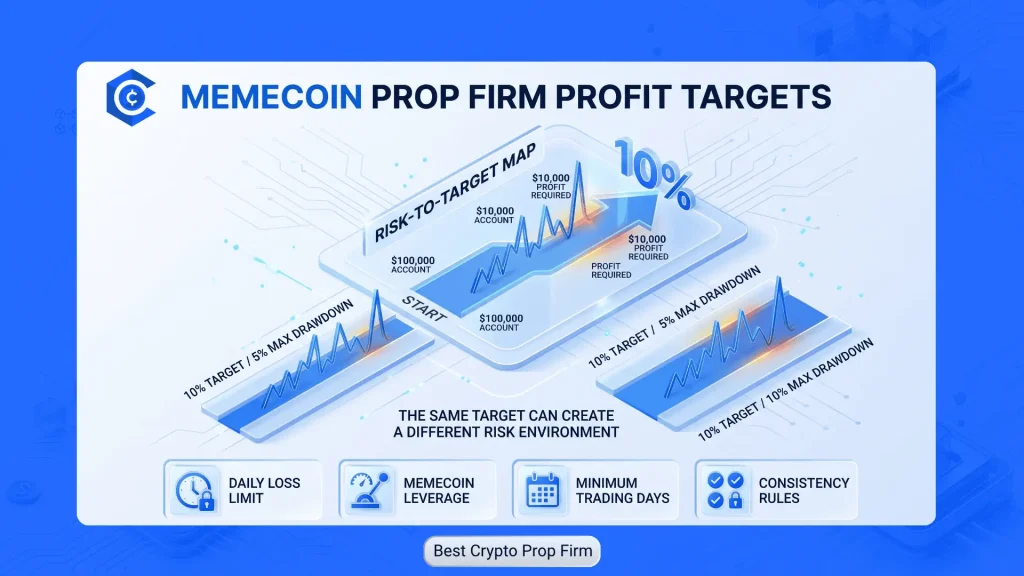
For memecoin traders, these conditions can have an even greater impact because the market can produce large moves in relatively short periods.
Evaluation Profit Targets
An evaluation profit target is the amount of profit a trader must generate before progressing to the next stage of the prop firm’s account model.
For example, a $100,000 account with a 10% profit target would require $10,000 in profit. However, traders should consider that target alongside the account’s maximum drawdown.
A 10% target with a 5% maximum drawdown creates a very different risk environment from a 10% target with a 10% maximum drawdown. The trader needs to generate the required return while staying within the permitted loss.
This is particularly relevant for memecoin trading. Large price movements may make a high target appear achievable quickly, but attempting to reach it through oversized positions can also bring the account close to its drawdown limit.
When comparing profit targets, check:
- Target percentage
- Number of evaluation stages
- Maximum drawdown
- Daily loss limit
- Leverage available on memecoins
- Whether profits can be generated from any supported market
- Whether additional consistency rules apply
The target should therefore be viewed as part of the firm’s complete risk to target structure, rather than as an isolated percentage.
Are There Consistency Rules?
A consistency rule limits how much of an evaluation’s total profit can come from a single trading day, trade, or other defined period, depending on the firm’s methodology.
For example, a firm might require profits to be distributed across multiple trading days rather than allowing one unusually profitable memecoin trade to account for most of the required return.
This can significantly affect strategy.
A trader who normally waits for a high conviction memecoin breakout may generate a large percentage of the target in one move. If a consistency rule applies, that result may not be enough to complete the evaluation immediately.
Before choosing an account, check:
- Whether a consistency rule exists
- What percentage or formula is used
- Whether the rule applies during evaluation, funded trading, or both
- Whether the largest winning day affects eligibility
- Whether the rule changes the amount that can be withdrawn
For traders who prefer concentrated, high volatility opportunities, the presence or absence of a consistency rule can be particularly important.
Minimum Trading Days
Some prop firms require traders to complete a minimum number of trading days before they can pass an evaluation or request a payout.
This means that reaching the profit target may not be enough on its own.
For example, a trader could theoretically reach a 10% target from one strong memecoin move, but a minimum trading day requirement could require additional sessions before the evaluation is considered complete.
Minimum trading days can therefore influence strategy. Traders may need to distribute their activity over several sessions rather than attempting to complete the challenge through one concentrated trade.
Check whether the firm defines a trading day by:
- Opening a position
- Closing a position
- Achieving a minimum amount of profit
- Trading for a minimum period
The exact definition can vary between firms.
Maximum Trading Days
A maximum trading day or time limit determines how long a trader has to complete the evaluation.
Some firms impose a fixed deadline, while others provide an unlimited evaluation period.
For memecoin traders, this difference can matter because a strategy may depend on waiting for specific market conditions rather than trading every day.
A trader using a selective breakout or swing strategy may prefer an evaluation without a strict time limit. Conversely, a trader who actively trades short term volatility may be less affected by a fixed deadline.
When comparing accounts, check whether the firm has:
- A fixed number of calendar days
- A fixed number of trading days
- An unlimited evaluation period
- Rules for extending the evaluation
- Any inactivity requirements
Can You Pass a Memecoin Challenge in One Session?
Whether a trader can pass a challenge in one session depends on the firm’s rules.
If the firm has no minimum trading day requirement, no consistency rule, and no maximum time requirement, a trader may be able to reach the profit target in a single trading session, assuming the target is reached without violating any other account rules.
This can be particularly relevant for memecoin traders because a strong volatility event can produce significant price movement within a short period.
However, the ability to pass quickly does not mean that taking maximum risk is appropriate. Trying to reach the target in one trade by using excessive leverage can bring the account close to its daily loss or maximum drawdown limit just as quickly.
The key distinction is between being allowed to pass in one session and needing to pass in one session. A flexible account allows a trader to choose the pace that fits their strategy rather than forcing them to increase risk simply because of a time constraint.
For example, a memecoin trader who prefers to wait for a specific setup may value an account with no time limit and no consistency requirement. Another trader focused on short term volatility may be more comfortable with a defined evaluation period.
When comparing memecoin prop firms, look at the profit target, consistency rules, minimum trading days, and maximum trading period together. These conditions determine not only how much profit must be generated, but also how much freedom the trader has in deciding when and how to pursue that target.
Memecoin Prop Firm Profit Split
The profit split determines how much of the eligible trading profit a trader can keep after reaching the prop firm’s payout conditions. A firm may advertise an 80%, 90%, or higher profit split, but the percentage alone does not show how much a trader can actually withdraw.
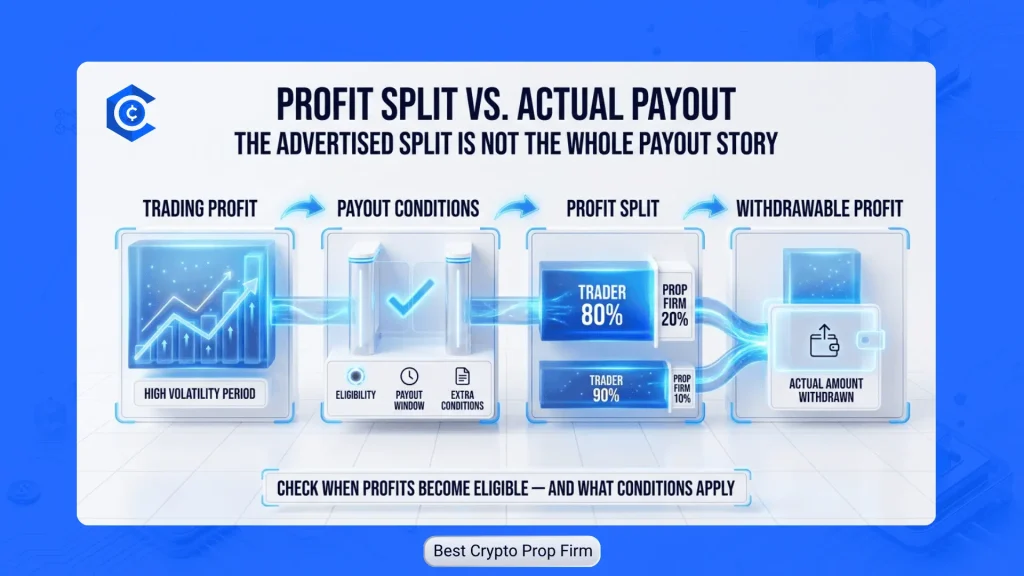
For memecoin traders, payout terms can be particularly important because strategies may produce profits unevenly. A trader might generate substantial returns during a short period of high volatility and then need to understand how much of those profits can be withdrawn, when they become eligible, and whether any additional conditions apply.
What Is a Typical Profit Split?
A profit split represents the percentage of eligible profits allocated to the trader.
For example, with an 80% profit split, a trader would generally receive $800 from $1,000 of eligible profit, while the remaining $200 would go to the prop firm, subject to the firm’s specific payout rules.
Profit splits can vary between firms and may also depend on:
- The account type
- Evaluation or funded stage
- Payout history
- Scaling level
- Optional account add ons
- Profit sharing upgrades
A higher advertised split can look attractive, but traders should always check the conditions attached to that percentage.
When Can You Withdraw Your Profits?
Profit split and payout eligibility are two different things.
A trader may be entitled to a certain percentage of profits but still need to satisfy specific requirements before requesting a withdrawal. These can include a minimum number of funded trading days, a payout schedule, a minimum withdrawal amount, or other account conditions.
For memecoin traders, payout timing can be especially relevant when profits are generated during short periods of strong market volatility.
Check:
- How soon the first payout can be requested
- Whether payouts are on demand or scheduled
- Whether a minimum number of funded trading days is required
- Whether profits must remain in the account
- How long payout processing takes
- Which payout methods are available
A trader should also check whether the rules change after the first payout.
Are There Minimum Profit Requirements?
Some prop firms require traders to reach a minimum amount of profit before requesting a payout.
For example, a firm could require the account to generate a certain dollar amount or percentage of profit before a withdrawal becomes available.
This can affect smaller accounts and traders who use conservative risk management. A trader may be profitable but still need to continue trading until the minimum payout threshold is reached.
The important distinction is between:
profit split → how much of the eligible profit belongs to the trader
And
minimum payout requirement → how much profit must be available before a withdrawal can be requested.
These are separate conditions and should be evaluated separately.
Is There a Maximum Payout?
Some prop firms impose a maximum payout per request, per trading period, or per account. Others may limit the total amount that can be withdrawn before an account reaches a particular scaling level.
This can be especially relevant for memecoin traders because a single period of extreme volatility can potentially produce a large amount of profit.
When comparing firms, check whether there is:
- A maximum payout per request
- A daily or weekly payout limit
- A maximum total withdrawal
- A payout cap during early funded stages
- A maximum profit amount that can be withdrawn while scaling
A high profit split does not necessarily mean that the trader can withdraw an unlimited amount.
For example, a hypothetical 90% profit split with a strict payout cap may result in a different practical outcome from an 80% split with fewer withdrawal restrictions.
Do Profit Splits Change as You Scale?
Some prop firms change the trader’s profit share as the account grows or reaches higher scaling levels.
A trader might start with a standard profit split and become eligible for a higher percentage after meeting specific performance or account growth conditions.
Scaling rules can therefore affect the long term economics of a memecoin prop account. Traders should check whether:
- The profit split increases at higher account sizes
- The account can be scaled after profitable performance
- The payout percentage changes after scaling
- The higher split requires an additional fee
- The trader’s payout conditions change as the account grows
For example, CoinProp offers an 80% default profit split, with the option to increase the split up to 95% through its available account options. Traders should still consider the applicable payout conditions alongside the headline percentage.
Profit Split Is Only One Part of the Payout Structure
A 90% profit split does not automatically mean better payout conditions than an 80% split.
The actual amount a trader can receive depends on the complete payout structure. A firm with a high split may also have a payout cap, minimum withdrawal requirement, limited payout frequency, or additional funded account conditions.
When comparing a memecoin prop firm, look at these factors together:
- Profit split — What percentage of eligible profits does the trader receive?
- Payout frequency — How often can profits be withdrawn?
- Minimum payout — Is there a minimum amount required?
- Payout cap — Is there a maximum amount that can be withdrawn?
- Funded account rules — Are there additional trading requirements after passing?
- Consistency rules — Can unusually large winning days affect payout eligibility?
- Scaling — Does the profit split or payout structure change as the account grows?
- Payout fees — Are there any fees associated with withdrawing profits?
This broader view is particularly important for memecoin traders. A strategy can generate substantial profits during a high volatility period, but the payout rules determine how much of those profits can actually be realized and withdrawn.
Therefore, when comparing the best memecoin prop firms, don’t stop at the percentage shown next to “profit split.” Compare the profit split, payout timing, withdrawal limits, minimum requirements, and funded account conditions as one complete payout structure.
Memecoin Prop Firm Payout Rules
A prop firm’s profit split tells you how profits are divided, but payout rules determine when and how those profits can actually be withdrawn. This distinction is especially important for memecoin traders, whose results can sometimes come from a small number of high volatility trades.
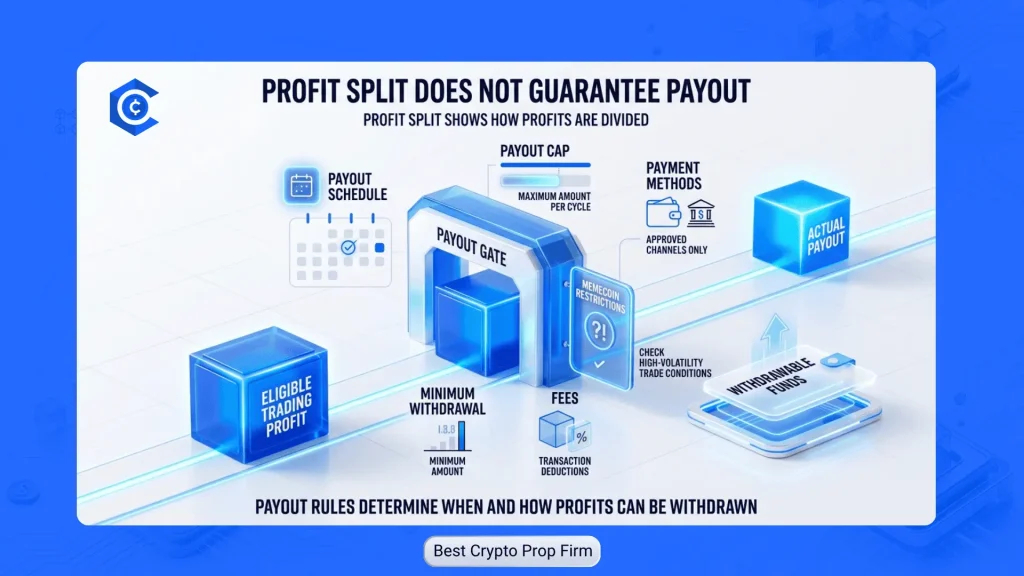
Before choosing a memecoin prop firm, traders should check the payout schedule, minimum withdrawal requirements, payout caps, fees, and payment methods. They should also verify whether profits generated from memecoins are subject to any additional restrictions.
How Soon Can You Withdraw Profits?
Payout eligibility can vary significantly between prop firms. Some firms require traders to complete a minimum number of funded trading days before requesting their first withdrawal, while others may allow payouts sooner after specific conditions are met.
The important point is that passing an evaluation does not necessarily mean profits can be withdrawn immediately.
Check:
- When the first payout becomes available
- Whether a minimum number of funded trading days is required
- Whether there is a waiting period between payouts
- Whether profits must remain in the account for a certain period
- Whether the conditions change after the first withdrawal
For a memecoin trader, payout timing can matter because a profitable period may occur during a short burst of market volatility. Understanding when those profits become withdrawable helps traders evaluate the account beyond its advertised profit split.
On Demand vs Scheduled Payouts
Prop firms generally use either scheduled payout windows or more flexible payout systems.
With a scheduled payout, traders can request or receive profits only during specific periods. An on demand model can provide more flexibility by allowing an eligible trader to request a payout whenever the account meets the firm’s requirements.
When comparing these models, check whether:
- Payout requests can be submitted at any time
- There are fixed payout dates
- A minimum number of days must pass between withdrawals
- The account must maintain a minimum balance after a payout
- New profits become eligible immediately or only during the next payout period
For traders who use memecoin strategies, flexible payouts can be relevant when profits are generated irregularly rather than through a consistent daily return.
Payout Caps
A payout cap limits the amount of profit a trader can withdraw during a defined period or from a particular account.
For example, a firm could allow a high profit split but limit the maximum amount that can be withdrawn during each payout cycle. This means the headline profit split does not necessarily represent the maximum amount a trader can receive.
Check whether the firm has:
- A maximum payout per request
- A daily, weekly, or monthly payout limit
- A maximum payout during the initial funded stage
- Account specific withdrawal limits
- Different payout caps at different scaling levels
This is particularly relevant when trading volatile memecoins because a strong market move can produce profits much faster than a trader’s payout schedule allows them to withdraw.
Minimum Withdrawal Amounts
Some prop firms require traders to reach a minimum profit amount before submitting a payout request.
A minimum withdrawal can affect how smaller accounts are managed. A trader may have a profitable account but still need to generate additional eligible profit before a payout can be requested.
Check whether the minimum applies to:
- The total account profit
- The trader’s share after the profit split
- Each individual withdrawal
- The first payout only or every payout
Also check whether the account must maintain a minimum balance after the withdrawal.
Payout Fees
Payout fees can reduce the amount a trader ultimately receives.
Some firms cover processing costs, while others may deduct a transaction or withdrawal fee. The fee may also depend on the payment method or network used.
For crypto payouts, traders should check:
- Whether the prop firm charges a withdrawal fee
- Whether network fees are deducted
- Which blockchain networks are supported
- Whether the fee is fixed or variable
- Whether the trader receives the stated profit split before or after applicable fees
Even relatively small fees can become more relevant when a trader makes frequent withdrawals.
Payout Methods
The available payout method can also influence the practical value of a prop firm’s payout structure.
Crypto prop firms may offer cryptocurrency based payouts, while others may support additional payment methods. Traders should check the exact assets, networks, and processing conditions available to them.
For crypto payouts, verify:
- Which cryptocurrency is used
- Which blockchain network is supported
- Whether the trader can choose between networks
- Whether the transaction can be independently verified
- Whether there are additional conversion or processing fees
For example, CoinProp offers USDC payouts through Ethereum and Arbitrum, with on chain transaction information that allows eligible payouts to be verified on the relevant blockchain explorer.
Do Memecoin Profits Have Different Withdrawal Rules?
Not necessarily. In many cases, payout rules apply to the account’s eligible trading profits regardless of which supported cryptocurrency generated them. However, traders should never assume that all memecoin profits are treated identically without checking the firm’s rules.
A prop firm may impose additional restrictions on particular assets, trading methods, or unusually volatile markets. Possible conditions could include restrictions on specific memecoins, position sizes, holding periods, or strategies used to generate the profit.
The key questions are:
- Are profits from all supported memecoins eligible for payout?
- Are specific meme coins excluded?
- Are profits from certain trading strategies restricted?
- Are there additional conditions for highly volatile assets?
- Does the firm distinguish between different crypto markets when calculating eligible profit?
If no asset specific restriction exists, profits generated from eligible memecoin trades would generally be treated according to the account’s standard payout rules. But this should be confirmed from the firm’s current terms rather than assumed.
What to Check Before Choosing a Memecoin Prop Firm
Before evaluating a prop firm for memecoin trading, review the complete payout structure:
Profit split → payout eligibility → minimum withdrawal → payout frequency → payout cap → fees → payment method
Looking at only the profit split can give an incomplete picture. A firm offering a 90% split may have different practical payout conditions from one offering 80%, depending on withdrawal limits and eligibility requirements.
For memecoin traders, the important question is therefore not simply “How much of my profit do I keep?” but “How much of my eligible profit can I actually withdraw, when can I withdraw it, and what conditions apply?”
Can You Hold Memecoins Overnight in a Crypto Prop Firm?
Whether you can hold memecoin positions overnight depends on the prop firm’s trading rules. Unlike traditional markets that close each day, crypto markets operate 24/7, so an overnight position in a crypto prop firm generally means keeping a position open while the trader is away from the market rather than holding through a daily market close.
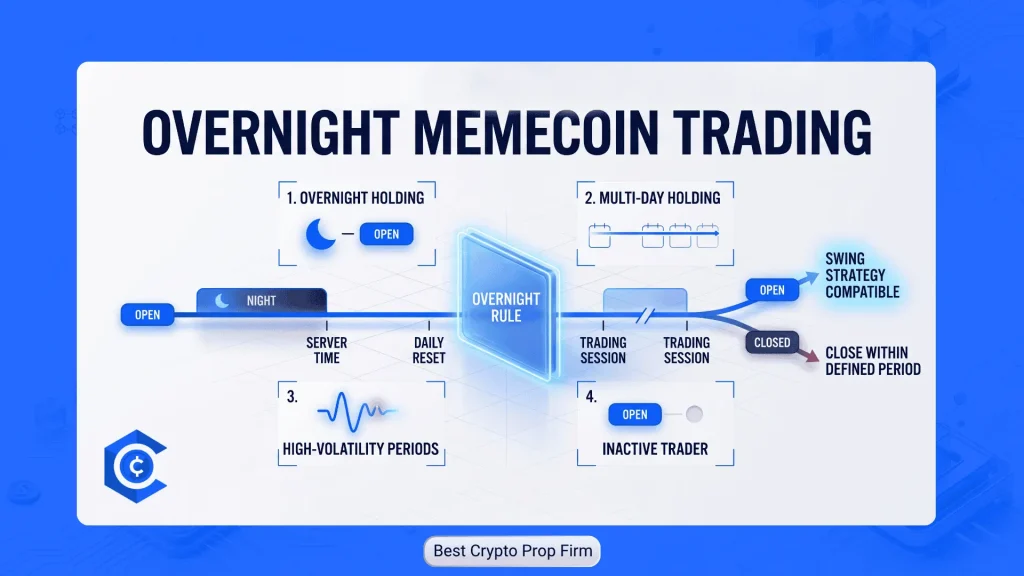
For memecoin traders, overnight and weekend rules can be particularly important because these assets can experience significant price movements while the trader is not actively monitoring the position.
Overnight Memecoin Trading
Some crypto prop firms allow traders to keep memecoin positions open overnight, while others may impose restrictions on holding positions beyond certain periods.
Before opening an overnight position, check whether the firm allows:
- Positions to remain open overnight
- Positions to remain open for multiple days
- Open positions during periods of high volatility
- Positions to remain open when the trader is inactive
The exact definition of “overnight” can also vary. Since crypto markets operate continuously, a firm’s rule may refer to a specific server time period, daily reset, or trading session rather than an actual market close.
This distinction is important for swing traders. A strategy that depends on holding a memecoin position for several days may not be compatible with an account that requires positions to be closed within a defined period.
Weekend Memecoin Trading
Crypto markets continue trading during weekends, and memecoins can remain highly active outside traditional market hours.
Some prop firms allow weekend holding and trading, while others may impose specific restrictions. Traders should therefore check whether positions can remain open through Saturday and Sunday and whether any special conditions apply.
Weekend trading rules can matter for strategies based on:
- Multi day momentum
- Breakouts
- Swing trading
- Mean reversion
- Longer term directional positions
A trader should also consider liquidity and volatility. Weekend conditions can differ from those during the busiest market periods, and a sudden move in a memecoin can affect an account’s unrealized PnL and drawdown even when the trader is not actively managing the position.
Funding Fees and Overnight Costs
For crypto perpetual futures, funding fees are different from the traditional swap or overnight financing charges commonly associated with forex and CFD trading.
A perpetual futures contract does not have a fixed expiration date. Funding payments are used by exchanges to help keep the perpetual contract’s price aligned with the underlying market. Depending on the market and funding rate, traders may either pay or receive funding.
This is why calling every overnight cost a swap fee can be misleading when discussing crypto perpetual trading.
A swap free crypto prop firm generally refers to an account structure that does not charge traditional swap or overnight financing fees. That does not automatically mean that perpetual futures trading has no funding related costs. Traders should check how the specific prop firm handles funding and whether those costs are passed through to the trader.
When comparing accounts, check:
- Whether traditional swap fees apply
- Whether perpetual funding fees apply
- Whether funding is passed through to the trader
- Whether funding is incorporated into the trading environment
- Whether the firm’s terms distinguish between different markets
This distinction is particularly important for traders who hold memecoin perpetual positions for extended periods.
Why Overnight Rules Matter for Memecoin Traders
Overnight holding can change the risk profile of a memecoin position. A trader who closes positions before becoming inactive has more direct control over exposure, while a trader who holds overnight remains exposed to price movements that can occur without active management.
For a prop firm account, this matters because an overnight move can affect:
- Daily loss limits
- Maximum drawdown
- Unrealized PnL
- Margin usage
- Position size
- Potential slippage when closing the trade
For example, a memecoin can experience a sharp move while a trader is asleep. If the position is large relative to the account’s drawdown allowance, the resulting unrealized loss could put the account at risk even if the trader expected the broader setup to remain valid.
That does not make overnight trading inherently unsuitable. It simply means the trader needs to understand the firm’s holding rules, drawdown methodology, leverage, position limits, and funding treatment before using an overnight strategy.
For traders specifically looking for swap free crypto prop firms, it is also important to distinguish between the absence of traditional swap charges and the treatment of perpetual futures funding. The two concepts are related to holding costs but are not the same thing.
Best Strategies for Memecoin Prop Trading
There is no single best strategy for memecoin prop trading. Memecoins can move quickly, experience sharp reversals, and behave differently depending on liquidity, market sentiment, and current trading activity. A strategy that works well in one market condition may perform poorly in another.
The better approach is to choose a trading style that fits both the memecoin market and the rules of the prop firm account. Scalping, breakout trading, momentum trading, pullbacks, range trading, mean reversion, and event driven setups can all be used, but each comes with different risk considerations.
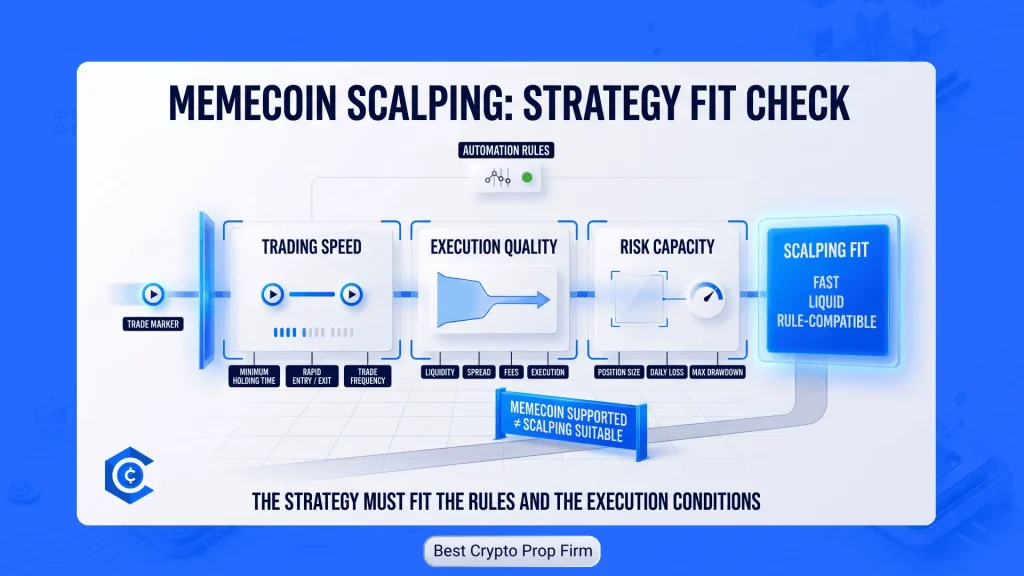
Memecoin Scalping
Memecoin scalping focuses on capturing relatively small price movements over short periods. It can fit traders who prefer active trading and do not want to hold positions for extended periods.
Because memecoins can move rapidly, scalping requires careful attention to execution, spread, liquidity, and position size. A sudden price movement can turn a small expected gain into a loss quickly, particularly when entering or exiting a less liquid market.
Prop firm rules also matter. Before using a scalping strategy, check whether the firm imposes minimum holding times, restrictions on rapid trading, limits on trade frequency, or rules against exploiting execution delays.
Breakout Trading
Breakout trading attempts to capture a move when price breaks out of an established range, resistance level, support level, or other defined market structure.
Memecoins can experience sharp increases in volume and volatility around breakouts, which can create significant price movement. However, not every breakout continues. False breakouts and fast reversals are also common considerations.
Traders using this approach may look for confirmation through factors such as increased volume, price structure, or a sustained move beyond the breakout area rather than entering solely because price briefly moved through a level.
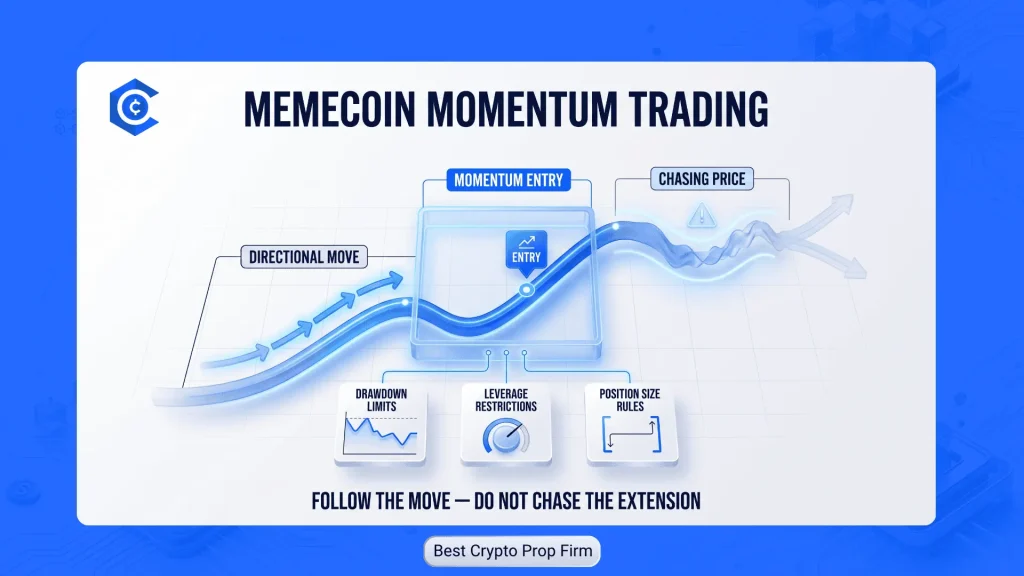
Momentum Trading
Momentum trading focuses on established directional price movement. Instead of trying to predict a reversal, the trader attempts to participate while a strong move is already developing.
This approach can be relevant to memecoins when buying or selling activity creates a sustained directional move. Momentum can change quickly, however, especially when market participation is driven by sentiment or social attention.
Risk management is particularly important because entering after a large move can increase the risk of chasing price. A momentum setup should therefore be evaluated together with the account’s drawdown limits, leverage restrictions, and position size rules.
Pullback Trading
Pullback trading looks for an entry after a temporary retracement within a broader directional move.
For memecoin traders, this can provide an alternative to chasing a sharp pump. Instead of entering after an extended move, a trader may wait for price to retrace toward a previously identified support or resistance area before considering an entry.
A pullback does not necessarily mean the original trend will continue. Memecoins can reverse completely after what initially appears to be a temporary retracement, so position sizing and invalidation levels remain important.
Range Trading
Range trading can fit memecoins that have moved from a period of high volatility into a more defined consolidation range.
The basic approach is to identify areas where price has repeatedly found support and resistance and then look for setups around those boundaries. The strategy becomes less relevant when price breaks decisively out of the range and enters a strong directional move.
For prop firm accounts, traders also need to consider whether the potential range is large enough to justify the trade after spreads, fees, and execution conditions are taken into account.
Mean Reversion
Mean reversion is based on the idea that an unusually extended price movement may eventually move back toward a previous average, range, or reference level.
This can be particularly risky with memecoins because an asset that appears overextended can continue moving much further than expected. A sharp rally or sell off does not necessarily mean an immediate reversal is due.
For that reason, mean reversion requires more than simply selling after a large pump or buying after a large decline. The setup should have a defined invalidation point and position size appropriate for the prop firm’s drawdown limits.
Event Driven Memecoin Trading
Event driven trading focuses on price movements associated with identifiable events or developments. In the memecoin market, these can include exchange listings, token announcements, ecosystem developments, or significant social media driven attention.
These events can create unusually high volatility and rapid changes in liquidity. The market may also react before the event becomes widely known, while the initial move can reverse quickly after the announcement.
Traders using an event driven approach should therefore distinguish between having a defined trading setup and simply reacting to news or social media activity. Prop firm rules should also be checked for restrictions around major announcements, holding positions through specific events, automated trading, or unusually volatile market conditions.
Choosing a Strategy for a Memecoin Prop Account
The most suitable strategy depends on the trader’s style, the market conditions, and the specific account rules. A scalper may prioritize execution conditions and holding time rules, while a swing oriented trader may care more about overnight and weekend restrictions.
The key is to match the strategy to the account rather than forcing a strategy onto an account with incompatible rules. Before trading memecoins with funded capital, review the firm’s leverage, drawdown, position size, holding, short selling, and payout conditions alongside the strategy itself.
Risk Management in Memecoin Prop Firm Trading
Risk management becomes especially important when trading memecoins with a prop firm account. Memecoins can move sharply within a short period, while a prop firm account typically has fixed daily loss and maximum drawdown limits.
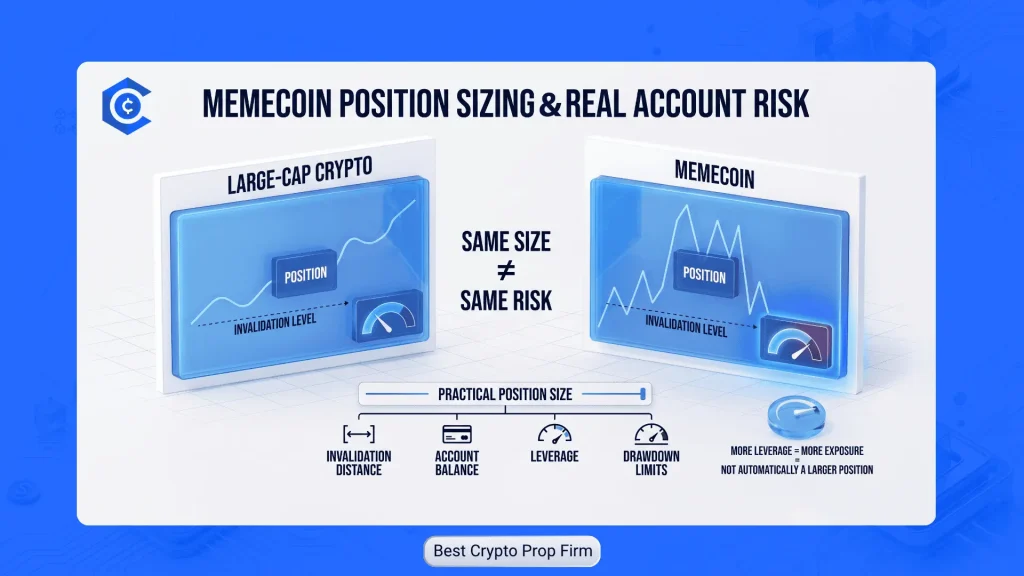
This means a trade does not need to be large enough to capture an entire memecoin move. It needs to be sized so that an unexpected reversal, volatility spike, or execution difference does not put the account’s drawdown limits at risk.
In a prop firm account, surviving a volatile memecoin move can matter more than capturing the entire move.
Position Sizing
Position sizing determines how much exposure a trader takes on in a memecoin position. With highly volatile assets, the same position size that may be reasonable for a large cap cryptocurrency can create significantly more account risk when applied to a memecoin.
Position size should therefore be considered alongside the distance to the trade’s invalidation level, the account balance, leverage, and the firm’s daily and maximum drawdown limits.
Higher leverage can increase the amount of market exposure available, but it does not necessarily make a larger position appropriate. The practical question is how much the position could lose if the market moves against it.
Stop Loss Placement
A stop loss can help define where a trade is no longer valid and limit the amount of capital exposed to a single setup.
With memecoins, placing a stop too close to the entry can result in the position being closed by normal market noise. Placing it too far away, however, can create excessive account risk.
Stop placement should therefore reflect the market structure and volatility of the specific memecoin rather than using the same fixed percentage for every asset.
Traders should also account for the possibility that fast markets can produce slippage, meaning the actual exit price may differ from the intended stop price.
Risk Per Trade
Risk per trade refers to how much of the account a trader is prepared to lose if a setup fails.
There is no universal percentage that works for every trader or prop firm account. The appropriate level depends on the account’s drawdown rules, strategy, trading frequency, volatility, and overall risk plan.
For a prop firm account, the important distinction is between risk on a single trade and the firm’s maximum permitted loss. The account’s daily loss limit is not a target for how much a trader should risk.
For example, if an account has a 3% daily loss limit, treating that 3% as acceptable risk on one memecoin trade can leave very little room for another position, slippage, or a second losing trade.
Avoiding Oversized Positions
Large positions can make a memecoin trade highly sensitive to relatively small price movements.
A position may appear manageable based on the account’s available leverage, but the resulting exposure can become significant when the underlying asset is capable of moving several percentage points quickly.
Oversizing can also make it harder to follow a trading plan. A trader who is already close to a drawdown limit may be more likely to close a position too early, move a stop, or make additional trades to recover a loss.
The amount of leverage available should therefore be treated as a maximum capability, not as a recommended position size.
Managing Slippage
Slippage occurs when an order is executed at a different price from the price expected by the trader. It can become more important during sudden memecoin volatility, particularly when liquidity changes rapidly.
A strategy that appears profitable under normal execution conditions may behave differently during a sharp price move.
Traders can account for this by avoiding unnecessarily large positions, considering market liquidity, understanding the firm’s execution model, and leaving sufficient room between their normal trading risk and the account’s drawdown limits.
This is particularly important around sudden news, exchange listings, and social media driven moves, when trading activity can increase rapidly.
Avoiding Revenge Trading After a Large Move
A large memecoin move can create strong psychological pressure, particularly after a trader misses a breakout or takes a loss immediately before a major price move.
Trying to recover a missed opportunity through a larger position can quickly turn one missed trade into a series of higher risk decisions.
Revenge trading can be especially damaging in a prop firm account because repeated losses can consume the daily loss allowance or move the account closer to its maximum drawdown.
A missed move is therefore not necessarily a trading loss. Once the setup has passed, waiting for the next valid opportunity can be part of risk management.
Protecting the Daily Loss Limit
The daily loss limit is one of the most important risk constraints in a prop firm account. A trader can have a profitable strategy and still lose the account if a series of memecoin trades pushes the account beyond its permitted daily loss.
Protection starts with knowing exactly how the firm calculates the limit. Traders should check whether unrealized losses, realized PnL, trading fees, and open positions are included, as well as when the daily limit resets.
It is also useful to establish a personal trading stop below the firm’s maximum loss threshold. This creates a buffer for volatility, slippage, and unexpected execution differences rather than treating the firm’s limit as the point at which risk management begins.
For memecoin trading, protecting the daily loss limit is not simply about stopping after a certain number of losing trades. It is about controlling exposure before volatility has the opportunity to turn a manageable position into an account level problem.
Risk Management Matters More Than Maximum Exposure
Memecoin prop trading can provide access to substantial market exposure, but available exposure and sensible exposure are not the same thing.
Leverage, position size, stop placement, volatility, slippage, and drawdown limits all interact. A strategy that looks attractive on a chart can still be unsuitable for a prop firm account if one adverse move can consume a large portion of the available drawdown.
The objective is not to capture every memecoin move. It is to build a risk framework that allows the trader to remain within the account rules while taking only the setups that fit the strategy.
For prop firm traders, preserving the account can be just as important as finding the next opportunity.
Best Memecoin Prop Firm Comparison
Comparing memecoin prop firms requires more than looking at account prices or the advertised profit split. The trading conditions that matter most for memecoins include asset availability, leverage, drawdown limits, position sizing, short selling rules, holding restrictions, and payout conditions.
A firm may offer a low cost challenge but impose restrictions that make a particular memecoin trading style difficult to use. Another may offer a higher profit split but have tighter payout conditions or position limits.
The following criteria provide a more practical way to compare memecoin prop firms.
| Factor | What to Compare |
| Memecoin Availability | Which meme assets can you trade? |
| Leverage | Maximum leverage available for memecoins |
| Shorting | Whether long and short positions are allowed |
| Drawdown | Daily loss and maximum drawdown limits |
| Profit Target | Evaluation profit target |
| Consistency | Whether consistency rules apply |
| Profit Split | Trader’s share of eligible profits |
| Payouts | Payout frequency, limits, and requirements |
| Holding | Overnight and weekend holding rules |
| Position Size | Maximum position, margin, or exposure limits |
| Trading Restrictions | Scalping, hedging, bots, copy trading, and other restrictions |
| Fees | Challenge price and optional add on costs |
| Execution | Order execution and market data conditions |
Memecoin Availability
The first question is whether the firm actually supports the meme coins you want to trade.
A large number of available crypto markets does not necessarily mean that every memecoin is tradable under the same conditions. Check the firm’s current market list and determine whether the assets you trade most frequently are available on the account type you are considering.
It is also worth checking whether the same execution and market data conditions apply across different assets.
Leverage and Position Limits
Leverage should be compared together with position size and margin restrictions.
A firm may advertise relatively high leverage, but maximum margin or position limits can determine how much exposure a trader can actually take. For volatile memecoins, this distinction can have a significant effect on strategy.
Rather than asking only how much leverage an account provides, compare the combination of leverage, maximum position size, margin limits, and drawdown.
Shorting Availability
Short selling can be important for traders who want to trade both upward and downward market moves.
However, shorting may not be available for every asset or account type. Some firms may also impose restrictions on hedging, simultaneous positions, or specific trading methods.
If shorting is part of your strategy, verify the firm’s rules for the specific memecoins you intend to trade rather than assuming that all supported assets can be traded in both directions.
Drawdown and Risk Rules
Drawdown conditions can have a larger practical impact on memecoin trading than the headline account size.
Compare the daily loss limit, maximum drawdown, and whether drawdown is static or trailing. Also check whether the calculation is based on balance or equity and whether unrealized losses are included.
A firm with a larger nominal account is not necessarily giving a trader more usable risk capacity. The amount of drawdown available before a rule violation is often more relevant.
Profit Targets and Consistency Rules
Evaluation targets should be considered alongside the account’s drawdown limits and other challenge requirements.
For example, a lower profit target may appear easier to reach, but additional consistency rules or minimum trading day requirements can change how a trader needs to approach the evaluation.
For memecoin strategies that rely on occasional high volatility opportunities, it is particularly important to check whether profits can be concentrated in a small number of trades or trading days without violating consistency requirements.
Profit Split and Payout Conditions
A high advertised profit split does not tell the entire story.
Compare the trader’s share of eligible profits with the actual payout conditions, including the first withdrawal requirement, minimum funded trading days, payout frequency, payout caps, and any fees.
The practical question is not simply how high the profit split is, but how much of eligible trading profits can be withdrawn and under what conditions.
Holding Rules
Memecoin traders should check whether positions can remain open overnight or over weekends.
This matters particularly for swing and event driven strategies, where the intended setup may require holding a position while the trader is away from the screen.
Also check whether the firm’s definition of overnight holding is based on a specific server time cutoff and whether weekend positions are treated differently.
Position Size and Exposure
Position size restrictions can materially change how a memecoin strategy works.
Two firms may offer the same account size and leverage but provide very different practical exposure if one imposes stricter limits on margin or individual positions.
For volatile assets, excessive exposure can also make it difficult to remain within the firm’s daily loss and maximum drawdown limits.
Trading Restrictions
A strategy may be technically possible but prohibited by the firm’s trading rules.
Before choosing an account, check for restrictions involving:
- Scalping and rapid trade execution
- Hedging
- Martingale or aggressive averaging
- Grid strategies
- Automated trading and bots
- Copy trading
- Multiple account trading
- Trading around major events
These rules should be evaluated against the actual strategy you intend to use, not treated as generic terms and conditions.
Fees and Add On Costs
The advertised challenge price is only one part of the cost.
Some prop firms offer optional add ons that change drawdown, profit splits, payout conditions, or other account parameters. These costs should be evaluated together with the resulting account conditions.
For a meaningful comparison, look at the base challenge fee, optional add ons, and the specific rules those fees change rather than comparing entry prices alone.
Execution and Market Data
Execution conditions are particularly relevant when trading volatile memecoins.
Compare the firm’s order execution model, supported market data, available trading platform, and how prices are sourced. Rapid price movements can make execution quality and liquidity important considerations when entering or exiting positions.
This is especially relevant to scalpers and breakout traders, where relatively small execution differences can affect the outcome of a trade.
Comparing Selected Memecoin Prop Firms
Once these criteria are established, selected firms can be reviewed using the same framework.
The goal is not simply to produce a list of firms ranked from first to last. Instead, each firm can be evaluated according to the conditions that matter for memecoin trading, making it easier to see which account structures fit different trading styles.
A useful comparison should therefore show the actual differences in memecoin availability, leverage, drawdown, shorting, position limits, trading restrictions, profit conditions, payouts, fees, and execution.
This approach also makes it easier to distinguish between a prop firm that looks attractive based on its headline offer and one whose detailed trading conditions actually fit a particular memecoin strategy.
Best Memecoin Prop Firm for Different Trading Styles
The best memecoin prop firm for one trading style may not have the same conditions that another trader needs. Scalpers, swing traders, short sellers, and traders who focus on high volatility moves can have very different requirements.
Instead of choosing a firm based only on its headline account size or profit split, compare the trading conditions that directly affect your strategy.
Best Memecoin Prop Firm for Scalpers
Scalpers generally need fast execution, sufficient liquidity, and rules that do not restrict short term trading activity.
When comparing prop firms for memecoin scalping, look at:
- Minimum holding time requirements
- Restrictions on rapid entries and exits
- Trade frequency limitations
- Execution conditions
- Spread and fee structure
- Maximum position size
- Daily loss and maximum drawdown
- Rules around automated or high frequency trading
A firm may support memecoin trading but still be unsuitable for a particular scalping approach if its rules restrict rapid trading or its execution conditions do not fit the strategy.
Best Memecoin Prop Firm for Swing Traders
Swing traders typically hold positions longer and may need account conditions that allow them to remain in the market through periods when they are not actively monitoring their trades.
Important factors include:
- Overnight holding rules
- Weekend holding rules
- Maximum drawdown
- Trailing versus static drawdown
- Leverage and position limits
- Stop loss requirements
- Payout conditions
- Restrictions around major market events
For swing trading, a firm with fewer restrictions on holding positions can provide more flexibility. However, holding a volatile memecoin for longer also exposes the account to larger potential price movements, so drawdown and position sizing remain critical.
Best Memecoin Prop Firm for Short Sellers
Traders who focus on shorting memecoins need to verify that short positions are actually permitted for the assets they want to trade.
The comparison should include:
- Whether short selling is allowed
- Which memecoins can be shorted
- Available leverage for short positions
- Position and margin limits
- Hedging restrictions
- Overnight and weekend rules
- Execution conditions during sharp sell offs
Shorting a memecoin can involve particularly fast reversals. A position that moves in the trader’s favor can quickly reverse as market sentiment changes, making drawdown limits and position sizing especially important.
Best Memecoin Prop Firm for High Volatility Trading
Some traders specifically look for large price movements rather than trying to avoid them. For this style, the key question is whether the firm’s account conditions allow the trader to manage volatility without creating excessive account level risk.
Compare:
- Memecoin market selection
- Available leverage
- Maximum position size
- Daily loss limit
- Maximum drawdown
- Static versus trailing drawdown
- Execution and market data conditions
- Trading restrictions during major events
- Slippage and liquidity considerations
Higher volatility can create more trading opportunities, but it can also increase the speed at which an account approaches its drawdown limits. More leverage does not automatically make an account better suited to high volatility trading.
Best Memecoin Prop Firm for Low Cost Entry
For traders focused on minimizing the initial cost, the challenge fee is an important consideration, but it should not be the only one.
Compare the total entry cost with:
- Account size
- Profit target
- Daily loss limit
- Maximum drawdown
- Profit split
- Payout requirements
- Activation fees
- Optional add ons
- Trading restrictions
A cheaper challenge can have less favorable conditions for a particular strategy, while a slightly more expensive account may provide rules that better match the trader’s needs.
The more useful comparison is therefore cost relative to account conditions, rather than price alone.
Choosing Based on Trading Style
The right comparison depends on how you actually trade memecoins.
A scalper may prioritize execution and short term trading rules. A swing trader may place more weight on overnight and weekend holding. A short seller needs clear directional trading and asset specific shorting rules, while a high volatility trader may focus heavily on drawdown and position limits.
For every trading style, the same principle applies: compare the firm’s actual account conditions with the way you intend to trade. The goal is not to find a universally best memecoin prop firm, but to identify an account structure that fits your strategy, risk tolerance, and trading schedule.
How to Choose a Memecoin Prop Firm
Choosing a memecoin prop firm starts with the trading conditions, not the advertised account size or challenge price. Before buying an evaluation, use the following checklist to determine whether the account actually fits your trading style and risk management approach.
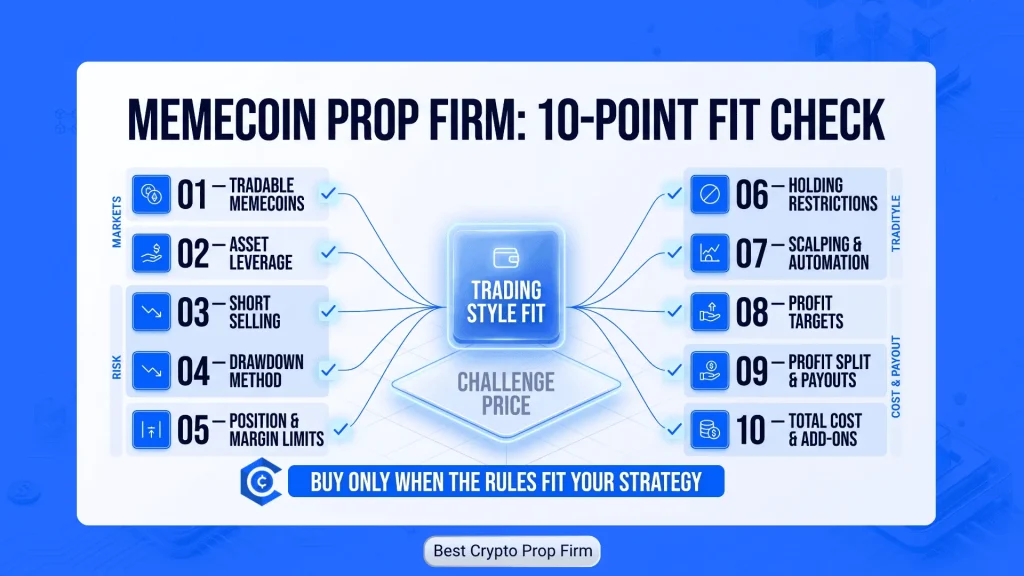
1. Check Which Memecoins Are Actually Tradable
Do not assume that a firm offering hundreds of crypto markets supports every memecoin you want to trade.
Check the current market list and confirm that the specific assets you trade, such as DOGE, SHIB, PEPE, BONK, or other meme coins, are available on the account you are considering.
2. Check Leverage for Those Assets
Leverage can vary between asset categories. Confirm the leverage available for the specific memecoins you intend to trade rather than relying on the firm’s general leverage figure.
Also consider leverage together with position size and margin restrictions. Higher leverage does not automatically mean more usable trading capacity.
3. Confirm Whether Short Selling Is Allowed
If shorting is part of your strategy, verify that short positions are permitted for the specific memecoins you want to trade.
Also check whether the firm has restrictions on hedging, simultaneous long and short positions, or other directional trading practices.
4. Read How Drawdown Is Calculated
Do not look only at the headline daily loss and maximum drawdown percentages.
Check whether the limits are based on balance or equity, whether unrealized PnL counts, when the daily limit resets, and whether the maximum drawdown is static or trailing.
Understanding the calculation can be just as important as the percentage itself.
5. Check Position and Margin Limits
Find out how much exposure you can actually take.
A firm may offer substantial leverage but still restrict maximum position size, margin usage, or total exposure. These limits can materially affect how you trade volatile memecoins.
6. Review Holding Restrictions
Check whether you can hold memecoin positions overnight or over weekends.
This is particularly important for swing and event driven traders. Also review any rules around major announcements or specific periods of market volatility.
7. Check Scalping and Automated Trading Rules
If you use scalping, bots, EAs, copy trading, or other automated methods, read the firm’s rules before opening an account.
Look for minimum holding times, trade frequency restrictions, prohibited execution methods, automation policies, and rules concerning account mirroring or multiple accounts.
8. Compare Profit Targets and Consistency Rules
Look at the evaluation target together with the consistency requirements and trading day rules.
A challenge with a relatively low profit target may still require a specific distribution of profits across trading days or impose minimum trading day requirements that affect your strategy.
9. Review Profit Split and Payout Limits
A high profit split is only one part of the payout structure.
Check when you become eligible to withdraw, whether a minimum number of funded trading days is required, how frequently you can request payouts, whether payout caps apply, and whether any withdrawal fees are charged.
10. Calculate the Total Cost, Including Add Ons
Start with the challenge price, then add any optional features or account upgrades that you would actually need.
An add on may change the drawdown, profit split, or other account conditions, so compare the additional fee with the specific benefit it provides.
The goal is to understand the total cost of the account and the conditions you receive in return, rather than comparing challenge prices in isolation.
Final Checklist
Before choosing a memecoin prop firm, you should be able to answer these questions clearly:
- Can I trade the memecoins I actually want?
- What leverage and position limits apply to them?
- Can I take both long and short positions?
- How exactly is drawdown calculated?
- Can I hold positions overnight or over weekends?
- Are my scalping, automated, or other trading methods permitted?
- What are the profit target and consistency requirements?
- When and how can I withdraw profits?
- What is the real cost after relevant add ons?
If any of these answers are unclear, the advertised account size or challenge price should not be the only factor guiding the decision.
Common Mistakes When Choosing a Memecoin Prop Firm
Choosing a memecoin prop firm based on one attractive feature can lead to problems later. A low challenge price, high leverage, or large profit split may look appealing on its own, but the complete account conditions determine how usable the account actually is.
Here are some of the most common mistakes to avoid.
Choosing Based Only on the Challenge Price
A low challenge price does not necessarily mean a lower overall cost or better trading conditions.
The account may have tighter drawdown limits, additional fees, lower profit splits, payout restrictions, or trading rules that do not fit your strategy.
Compare the challenge fee with the account size, drawdown, profit target, payout conditions, and any add ons before making a decision.
Ignoring Leverage Restrictions
A firm’s headline leverage figure may not apply equally to every asset.
Memecoins can have lower leverage limits than major cryptocurrencies, so check the leverage available for the specific assets you plan to trade.
Also remember that higher leverage increases potential exposure; it does not automatically make a strategy more effective or reduce risk.
Assuming Every Crypto Prop Firm Allows Shorting
Supporting crypto trading does not automatically mean that every firm allows short positions on every asset.
If short selling is part of your strategy, verify whether the specific memecoins you want to trade can be shorted and whether any additional restrictions apply.
Also check the firm’s hedging rules, as some firms may treat simultaneous long and short positions differently.
Ignoring Position Limits
Leverage alone does not tell you how much exposure you can actually take.
A prop firm may impose maximum position sizes, margin limits, or other exposure restrictions. These limits can become particularly important when trading volatile memecoins.
Always compare leverage with the actual position and margin rules to understand your practical trading capacity.
Overlooking Payout Rules
Passing an evaluation does not necessarily mean profits can be withdrawn immediately.
Check the firm’s funded trading requirements, first payout conditions, minimum trading days, payout frequency, minimum withdrawal amount, caps, and fees.
The payout process is part of the account’s trading conditions and should be evaluated before purchasing the challenge.
Treating a High Profit Split as the Only Important Factor
A high profit split can look attractive, but it does not tell you how accessible those profits are.
A higher percentage may come with different payout requirements, account restrictions, add on costs, or withdrawal limits.
Compare the profit split with the complete payout structure and account rules rather than treating the percentage as a standalone measure.
Using Excessive Leverage on Volatile Memecoins
One of the biggest risks is using the maximum available leverage simply because it is available.
Memecoins can experience rapid price movements, and a highly leveraged position can consume a significant portion of the account’s drawdown allowance during a relatively small adverse move.
Leverage should therefore be considered alongside position size, stop placement, volatility, and the firm’s daily and maximum drawdown limits.
What to Check Before Choosing
Before opening a memecoin prop account, avoid making the decision based on a single headline feature. Check the asset list, leverage, shorting rules, drawdown, position limits, holding conditions, trading restrictions, profit split, payouts, and total cost together.
The goal is to find an account whose conditions match the way you actually trade, rather than choosing the account with the most attractive number on the sales page.
FAQ
What Is a Memecoin Prop Firm?
A memecoin prop firm is a proprietary trading firm that provides traders with access to a funded or simulated trading account where memecoins can be traded under specific account rules. These rules may cover leverage, drawdown, position size, trading restrictions, profit targets, and payouts.
Can You Trade Memecoins With a Prop Firm?
Yes, some crypto prop firms allow traders to trade memecoins through their supported crypto markets. However, availability varies between firms and account types. Always check the current market list to confirm that the specific memecoins you want to trade are supported.
Can You Short Memecoins With a Prop Firm?
Some prop firms allow short selling on supported memecoins, while others may restrict short positions or specific trading methods. If shorting is part of your strategy, check whether the specific asset can be traded short and whether the firm has additional rules around hedging or position size.
What Leverage Do Memecoin Prop Firms Offer?
Leverage varies by prop firm and asset. Memecoins may have different leverage limits from major cryptocurrencies such as Bitcoin and Ethereum. When comparing accounts, check the leverage for the specific memecoins you trade along with any maximum position or margin limits.
Do Memecoin Prop Firms Have Special Trading Restrictions?
Some firms have restrictions that can affect memecoin trading, including rules for scalping, hedging, martingale strategies, grid trading, automated trading, copy trading, or trading around major events. The exact restrictions vary, so traders should review the firm’s trading rules before opening an account.
Can You Hold Memecoins Overnight?
It depends on the prop firm’s rules. Some firms allow overnight and weekend positions, while others may require trades to be closed during specific periods. Swing and event driven traders should check the firm’s holding rules and daily reset time before choosing an account.
What Is the Typical Profit Split for a Memecoin Prop Firm?
Profit splits vary between prop firms and account types. A trader may receive a percentage of eligible funded account profits, but the advertised percentage should be considered alongside payout requirements, withdrawal limits, minimum trading days, and any payout caps.
How Do Memecoin Prop Firm Payouts Work?
Payouts generally allow eligible funded traders to withdraw a portion of their profits according to the firm’s payout terms. Requirements can include a minimum number of funded trading days, a waiting period, minimum withdrawal amounts, payout caps, or specific payment methods. Always check the current payout rules before opening an account.
Are Memecoin Prop Firm Accounts Suitable for Scalping?
They can be, provided the firm’s rules and execution conditions support the trader’s scalping strategy. Before choosing an account, check for minimum holding times, restrictions on rapid trading, trade frequency limits, execution conditions, and rules concerning automated trading.
What Is the Best Strategy for Memecoin Prop Trading?
There is no single best strategy for every memecoin trader or market condition. Scalping, breakout trading, momentum trading, pullbacks, range trading, mean reversion, and event driven strategies can all be used depending on the market and trading style. The important consideration is whether the strategy fits the firm’s leverage, drawdown, position size, holding, and trading restrictions.