

Best Crypto Prop Firm List
Finding the best crypto prop firm starts with comparing the conditions that directly affect how you trade. Account size and profit split are important, but execution, available markets, drawdown rules, leverage, trading platforms, and payout conditions can be just as important. The firms below represent different approaches to crypto prop trading, from exchange based infrastructure and on chain trading to broader multi asset platforms.
Best Crypto Prop Firm Comparison Table
Crypto Prop Firm | Execution / Trading Model | Max Funding | Profit Split | Payout Method | Key Feature |
Propr.xyz | Hyperliquid based | Up to $100K | 80% | On chain | On chain trading and API access |
Hypernova | Hyperliquid based | Up to $200K | Up to 80% | On chain USDC | On chain settlement |
HyroTrader | Bybit based | $200K+ | 70–90% | USDT / USDC | Large selection of perpetual markets |
Breakout | Exchange backed / simulated | Varies | Up to 90% | USDC | Static drawdown options |
SizeProp | Crypto perpetual futures | Varies | 80–95% | USDT | Crypto focused accounts |
FundedNext | CFD | Scaled funding | Up to 95% | Varies | Multiple evaluation models |
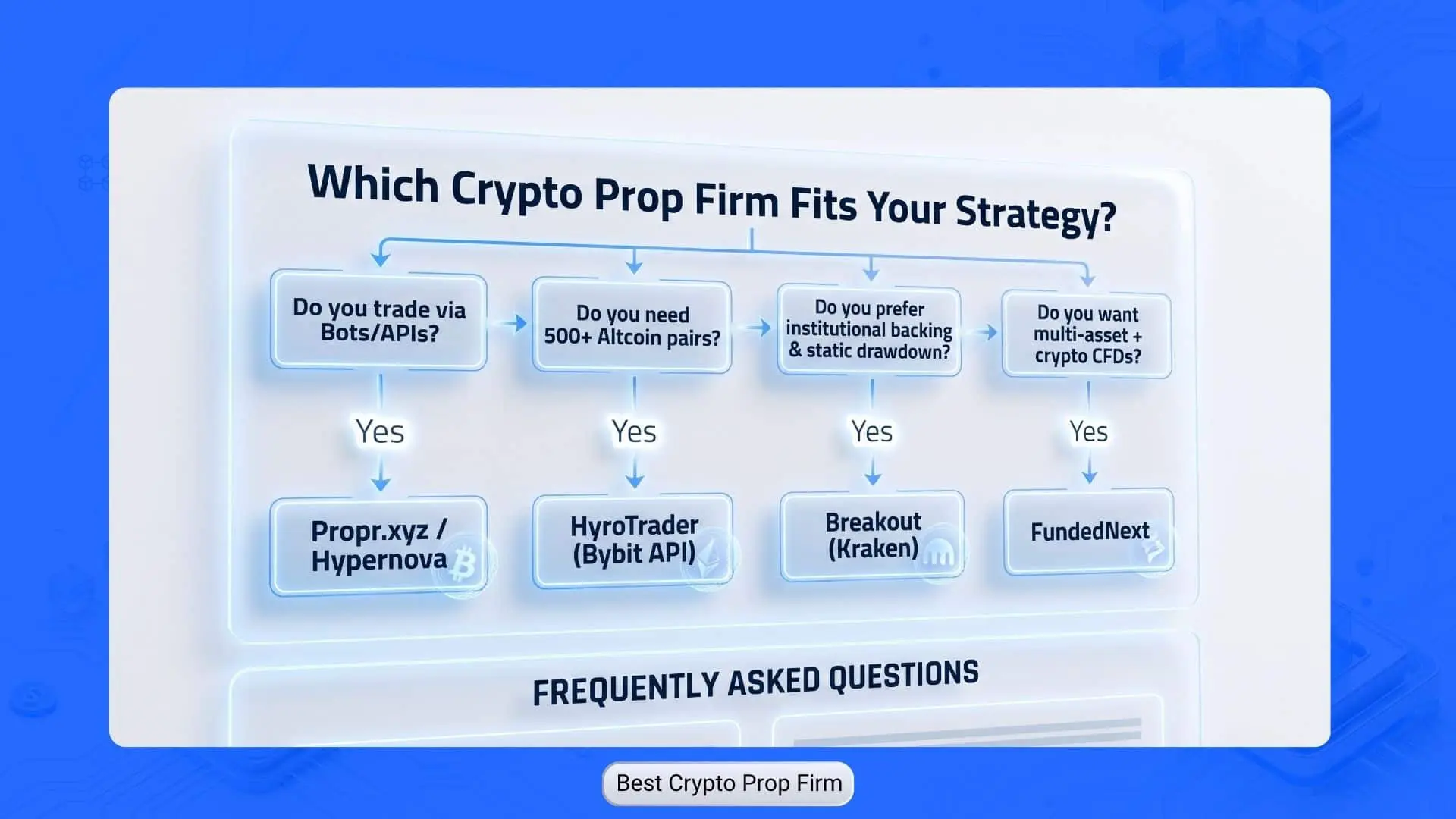
The firms in this list differ in how they provide market access, structure evaluations, manage risk, and process payouts. Some focus specifically on crypto perpetual futures, while others offer crypto alongside forex, commodities, indices, or other markets. Execution can also vary between exchange based infrastructure, proprietary platforms, and CFD style environments.
For that reason, the largest advertised account or highest profit split does not necessarily tell you how an account will work in practice. Traders should also consider the entry price, profit target, daily loss limit, maximum drawdown, leverage, trading restrictions, available markets, platform, execution conditions, and payout requirements.
The following sections compare these factors in more detail so you can evaluate each firm based on the trading conditions that matter most to your strategy.
Crypto Prop Firms Comparison
Crypto prop firms can look similar on the surface while offering significantly different account conditions. One firm may focus on exchange based perpetual futures, while another may provide crypto through a CFD style platform. Differences in market data, execution, leverage, drawdown calculations, and trading restrictions can therefore have a direct effect on the trading experience.
Pricing also needs to be considered alongside account conditions. A lower challenge fee may come with tighter drawdown limits or additional costs, while a higher profit split may have specific eligibility requirements. Comparing the full account structure gives a more useful picture than looking at any single advertised feature.
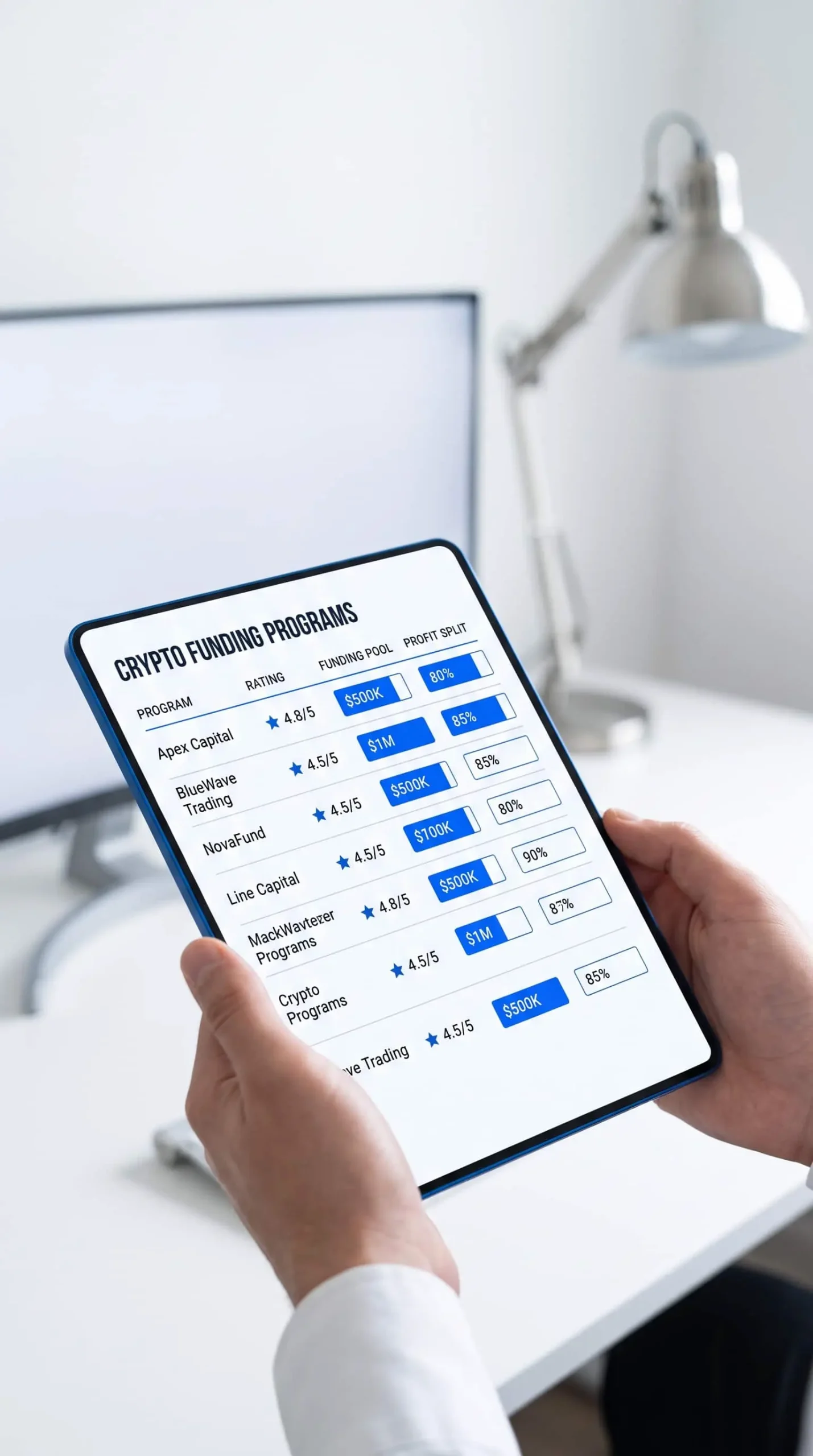
What We Compare
This guide compares crypto prop firms across the factors most relevant to traders:
- Pricing and account sizes — Entry fees, available account sizes, and additional costs.
- Evaluation rules — Profit targets, minimum trading days, time limits, and challenge requirements.
- Drawdown and risk limits — Daily loss limits, maximum drawdown, and static versus trailing drawdown.
- Leverage and margin — Maximum leverage, position sizing, and asset specific limits.
- Execution and market data — Pricing sources, spreads, slippage, and execution conditions.
- Trading platforms — Proprietary platforms, exchange based infrastructure, TradingView integrations, and other supported platforms.
- Available markets — Bitcoin, Ethereum, altcoins, memecoins, perpetual futures, and other supported assets.
- Trading restrictions — Rules affecting scalping, swing trading, automated trading, hedging, and other strategies.
- Profit splits and payouts — Standard and maximum profit splits, payout eligibility, timing, and payment methods.
- Account flexibility — Time limits, minimum trading days, consistency rules, and drawdown structure.
- Transparency and trust — Published rules, company information, payout evidence, and transparency around account conditions.
The importance of each factor depends on the trader’s strategy. A scalper may place greater emphasis on execution and trading costs, while a swing trader may care more about overnight rules and drawdown. Traders using bots may need to examine automation policies and API access, while those trading altcoins or memecoins may prioritize market availability and liquidity.
The sections below break down these factors by specific commercial use cases, including low cost accounts, instant funding, TradingView and Bybit access, spot and memecoin trading, crypto futures, flexible trading rules, trading styles, payouts, and account requirements.
Best Crypto Prop Firm Account Conditions
The conditions attached to a crypto prop firm account can matter more than the advertised account balance or headline profit split. Pricing, evaluation rules, drawdown limits, leverage, and payout terms all determine how an account can actually be traded. Comparing these conditions together gives traders a clearer view of what each crypto prop firm offers and whether its account structure fits their trading approach.
Pricing and Account Sizes
Account pricing is one of the first factors traders compare when looking for a crypto prop firm. Challenge fees can vary significantly between firms and account sizes, but the entry price alone does not show the full value of an account.
Account size should be considered alongside the drawdown and trading limits attached to it. Two firms may offer the same advertised balance but provide different amounts of usable risk based on their maximum drawdown, daily loss limit, and other restrictions.
It is also important to check whether the advertised price represents the total cost. Some firms may charge activation fees after passing an evaluation, while others may offer optional add ons, resets, or upgrades that increase the overall cost.
Available account sizes can also affect how traders approach risk. Smaller accounts may provide a lower cost way to access funded trading, while larger accounts may offer more capital but come with different pricing and account conditions.
For a meaningful comparison, traders should look at the account fee, available balance, drawdown allowance, additional costs, and the conditions attached to each account rather than comparing the headline price alone.
Challenge Rules
Challenge rules define what traders must accomplish before moving from an evaluation account to a funded account. Common requirements include a profit target, maximum drawdown, daily loss limit, minimum trading days, time limits, and the number of evaluation stages.
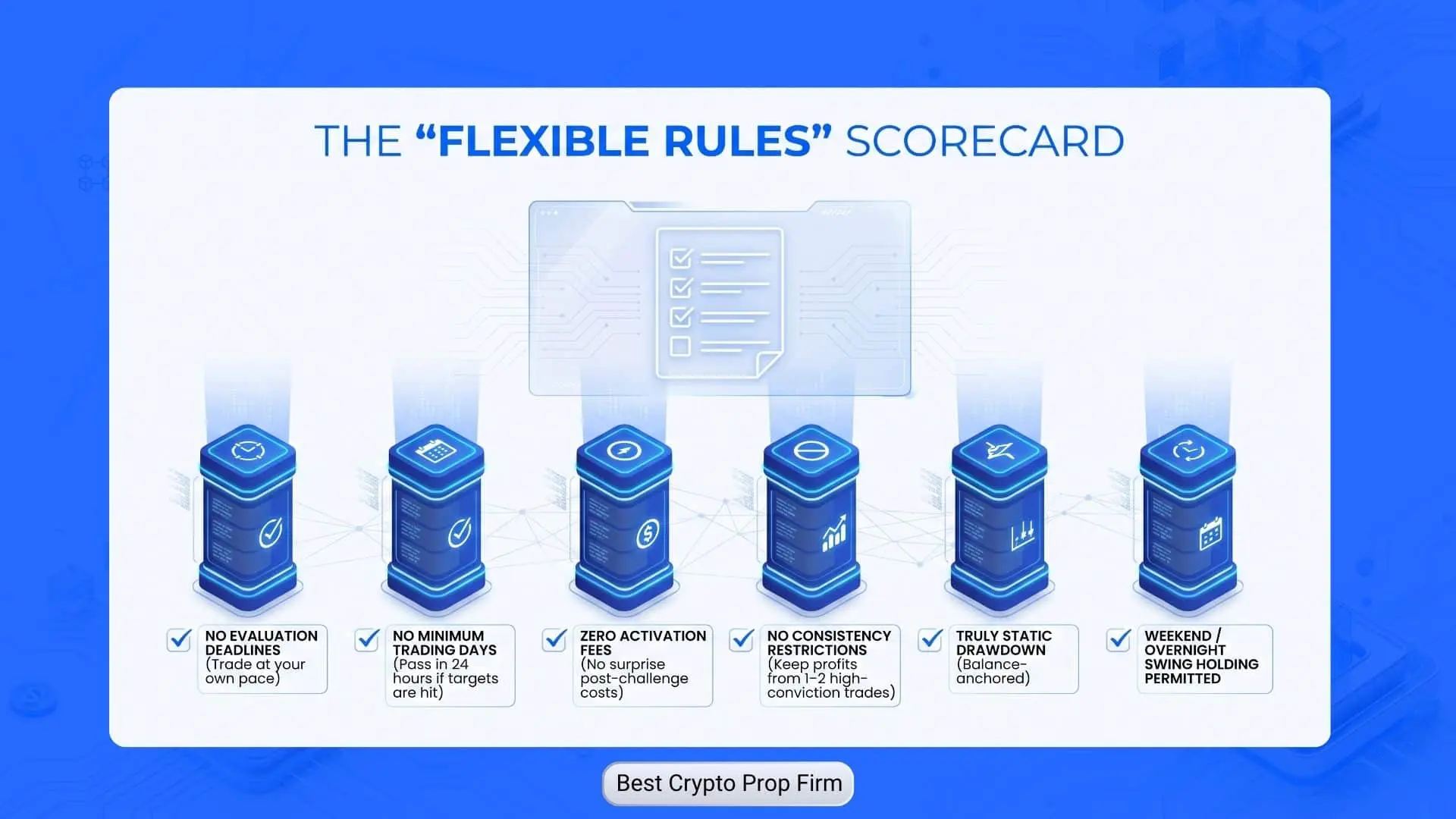
The structure can vary considerably between crypto prop firms. Some use a one step evaluation, while others require multiple stages. Some impose a deadline or minimum number of trading days, while others allow traders to complete the evaluation without a fixed time limit.
Trading restrictions are another important part of the challenge. Depending on the firm, rules may apply to hedging, automated trading, news trading, weekend positions, position sizes, or specific trading strategies.
These conditions should be considered in relation to how the trader normally operates. A short term trader may focus more on daily loss limits, leverage, and execution, while a swing trader may place greater importance on holding positions overnight or over weekends and having enough time to reach the profit target.
Rather than comparing profit targets alone, traders should review the complete set of evaluation rules and determine how each requirement affects their trading strategy.
Drawdown and Risk Limits
Drawdown rules determine how much an account can lose before the trader violates the firm’s risk conditions. They are among the most important account specifications because they define the practical risk allowance behind the advertised account size.
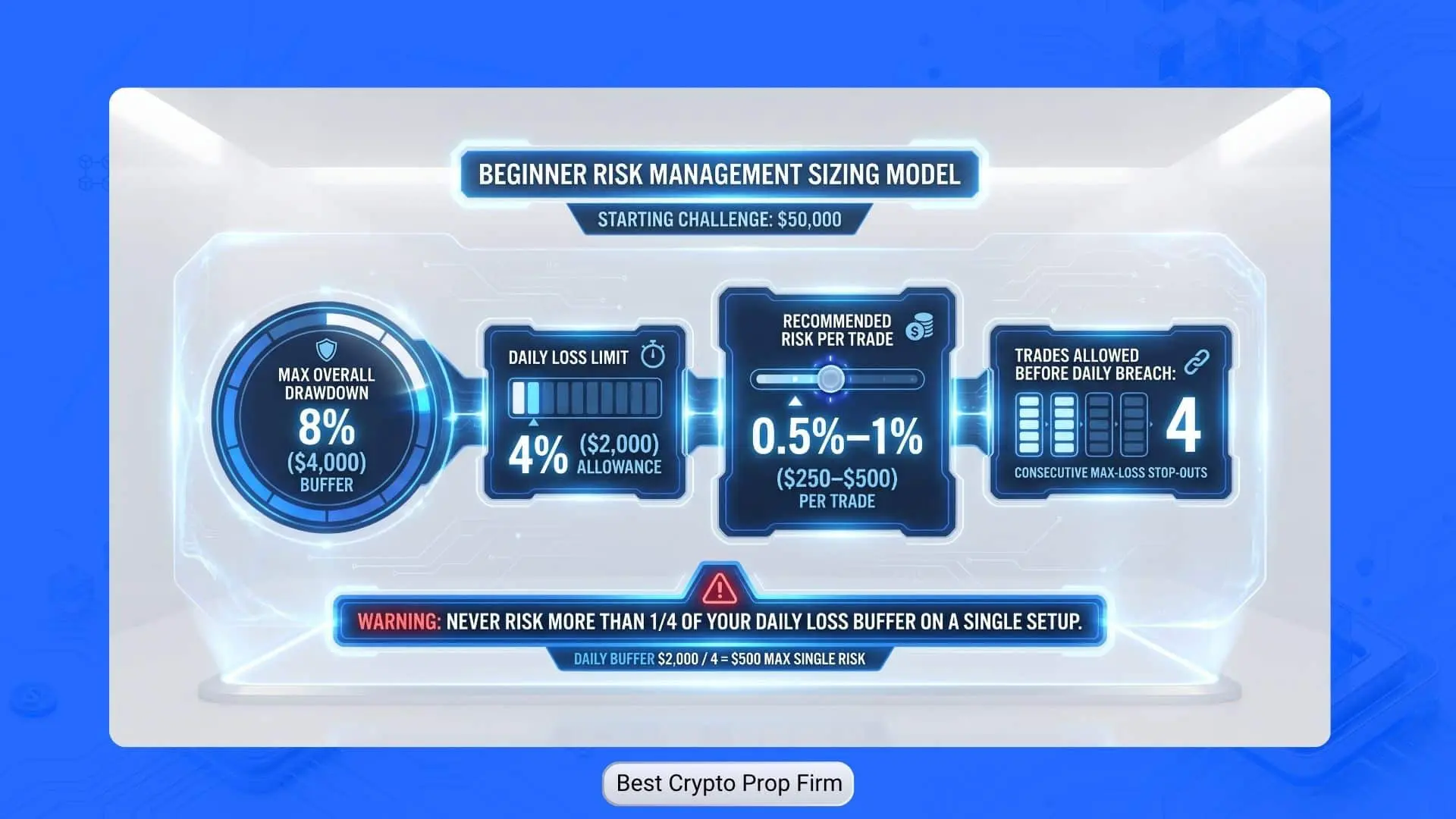
Daily loss limits restrict losses over a defined trading period, while maximum drawdown sets the overall loss threshold for the account. The calculation method can differ between firms, so the percentage shown in an account specification should not be viewed in isolation.
Static and trailing drawdown structures can also produce very different trading conditions. A static drawdown remains fixed relative to a defined starting balance, while a trailing drawdown can move as the account balance or equity increases. This can affect how traders manage profits and open positions after reaching a period of gains.
Traders should also check what counts toward a drawdown breach. Depending on the firm’s rules, unrealized losses, realized losses, commissions, swaps or other trading costs may be included in the calculation.
A useful comparison therefore goes beyond statements such as “5% maximum drawdown.” Traders should understand the starting threshold, whether it moves, how daily losses are calculated, and whether the same rules apply during the evaluation and funded stages.
Profit Splits and Payouts
Profit splits determine how trading profits are divided between the trader and the crypto prop firm after the account reaches the funded stage. While a higher percentage may appear attractive, the split should always be considered alongside the conditions attached to receiving a payout.
Payout requirements can include a minimum number of funded trading days, a minimum withdrawal amount, specific payout windows, or other eligibility conditions. Some firms allow frequent or on demand withdrawals, while others use fixed payout schedules.
The payment method is another part of the comparison. Crypto prop firms may offer stablecoin or cryptocurrency payouts, while others use traditional payment methods or third party providers. Processing times and withdrawal fees can also affect the practical value of the advertised profit split.
Traders should also check whether the rules change after the evaluation. Some firms may introduce different payout requirements, profit targets, or account restrictions once a trader reaches the funded stage.
For this reason, the most useful comparison is not simply the highest advertised profit split. Traders should consider the split together with payout eligibility, withdrawal limits, processing times, fees, and any conditions that apply before profits can be withdrawn.
Cheapest Crypto Prop Firm
Price is one of the first factors traders consider when comparing crypto prop firms, but identifying the cheapest option requires more than finding the lowest advertised challenge fee. A $20 account may look cheaper than a $50 account, for example, but the difference in account size, drawdown, trading conditions, payout terms, and additional fees can change the overall value of the offer.

The cheapest crypto prop firm should therefore be evaluated in the context of what the trader receives for the initial cost and what it costs to maintain access to the account. Comparing entry prices is a useful starting point, but the full cost structure provides a more meaningful basis for comparison.
Entry Price
The entry price is the upfront fee a trader pays to access a prop firm’s evaluation or funding program. Crypto prop firms can offer a wide range of account prices, often depending on the advertised account size and the type of program selected.
When comparing prices, it is useful to compare accounts with similar nominal sizes. A $25 fee for a $5,000 account is not directly comparable with a $50 fee for a $100,000 account simply because the second account costs more. The amount of drawdown available, profit target, leverage, and other conditions determine how much usable trading room comes with the advertised account.
Account pricing can also vary within the same firm. Different account models may have different evaluation stages, risk parameters, profit targets, or payout conditions. Optional add ons can further change the initial price, particularly when traders can purchase higher drawdown limits, additional flexibility, or other account features.
Traders should also check whether the advertised price represents the complete cost of entering the program. Activation fees, reset fees, platform charges, or other mandatory payments can make an apparently inexpensive account more expensive than its headline price suggests.
For this reason, a useful comparison of the cheapest crypto prop firms should consider both the absolute entry price and what that price actually provides. The lowest number on a pricing page is not automatically the lowest cost way to access a funded trading account.
Total Trading Cost
The total cost of a crypto prop firm account extends beyond the initial evaluation fee. Trading costs and account related charges can affect the economics of an account, particularly for traders who execute frequently or use strategies that depend on tight transaction costs.
Commissions and spreads are two of the most obvious costs. A firm with a low challenge fee but relatively high trading costs may not be the cheapest option for an active trader. The effect can be especially relevant for scalpers and other high frequency strategies, where transaction costs accumulate across a large number of trades.
Additional account fees should also be considered. Depending on the firm, traders may encounter activation charges, reset fees after a failed evaluation, optional rule upgrades, increased drawdown add ons, or other paid features. These costs do not necessarily make an account unsuitable, but they should be included when comparing the actual price of the program.
The relationship between price and drawdown is another useful measure. Consider two accounts with similar entry fees but different maximum drawdown allowances. The account with greater permitted loss may provide a different level of trading flexibility even though its advertised price is similar. Looking at the fee alongside the available risk allowance can therefore provide more context than price alone.
Payout conditions also affect the overall economics of an account. A high profit split may increase the amount a trader keeps after becoming funded, while withdrawal fees, payout limits, waiting periods, or additional eligibility requirements can affect how quickly profits can actually be accessed.
The same principle applies to account progression. If a firm offers scaling, traders can consider whether the account can grow without requiring repeated purchases or substantially higher fees. A low cost starting account may have a different long term cost structure from an account that provides a larger path to scale.
Ultimately, the cheapest crypto prop firm is determined by more than the lowest challenge price. Entry fee, account size, drawdown, trading costs, additional charges, and payout conditions should be considered together. Comparing these factors gives traders a clearer picture of what they are actually paying for and whether a low advertised price translates into a lower overall cost.
Best Instant Funding Crypto Prop Firms
Instant funding has become an important option for traders who want to access a funded trading account without completing a traditional evaluation first. Instead of requiring a trader to reach a profit target through a challenge, an instant funding program may provide access to a trading account from the beginning, subject to its own risk limits, fees, profit sharing terms, and trading restrictions.
However, instant funding programs are not structured identically. Some may offer immediate access but use tighter drawdown limits, different payout conditions, or higher upfront costs than traditional evaluations. Comparing the complete account structure is therefore important when looking for the best instant funding crypto prop firm.
Instant Funding vs Evaluation
The main difference between instant funding and a traditional evaluation is how the trader reaches the funded stage.
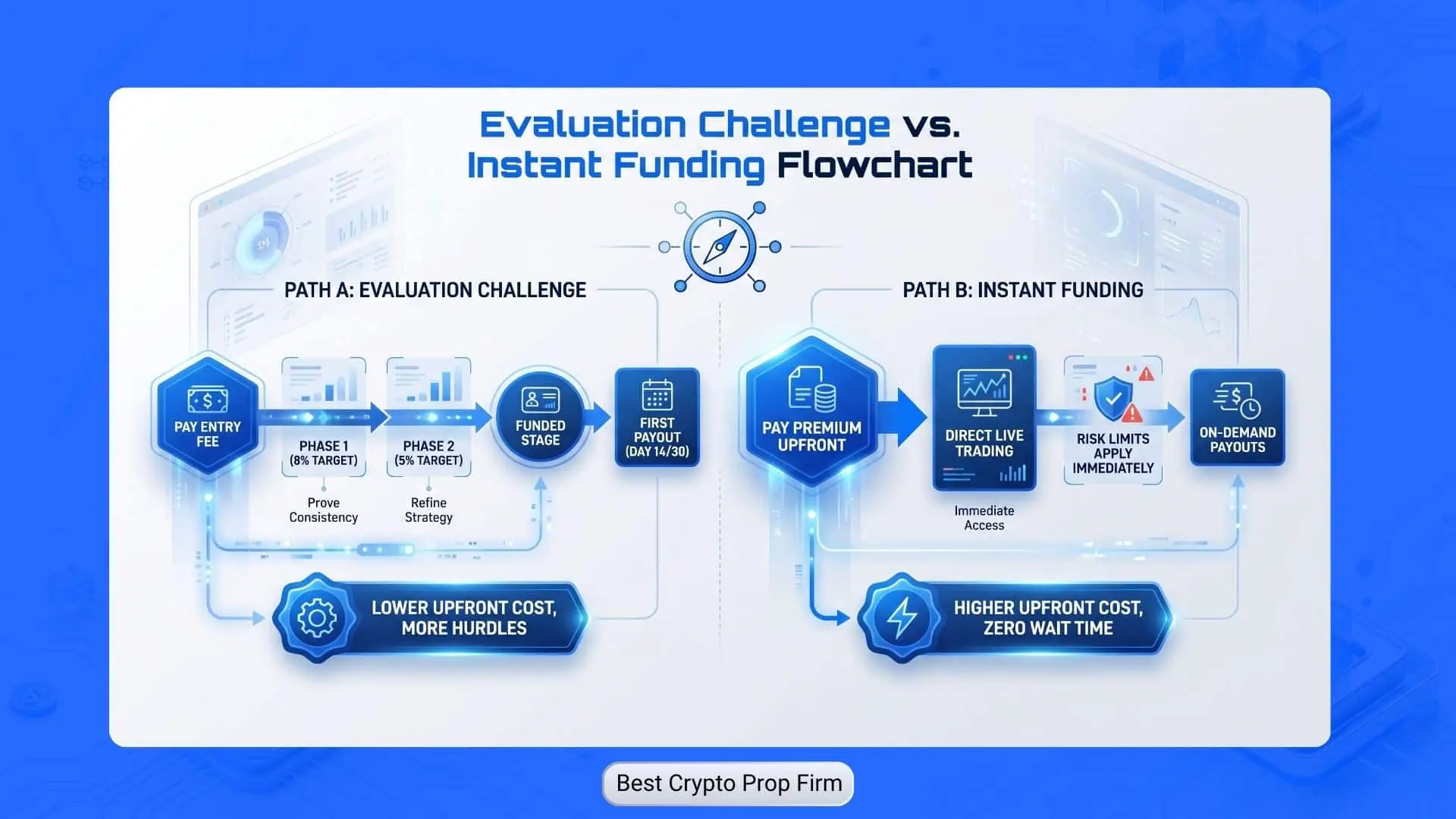
With a standard evaluation, a trader typically pays an initial fee and must meet predefined conditions before receiving access to a funded account. These conditions may include a profit target, daily loss limit, maximum drawdown, minimum trading days, or a specific evaluation period. Passing the evaluation can provide access to a funded account under a separate set of rules.
Instant funding removes or changes this qualification stage. Instead of first proving performance through a challenge, the trader may receive access to the account immediately after completing the purchase or registration requirements. This can make the model more straightforward for traders who do not want to trade toward a predefined evaluation target.
The trade off is that instant funding does not necessarily mean easier or cheaper access to trading capital. The program may have a different fee structure, lower drawdown allowance, different leverage, or more restrictive payout conditions. Some programs may also use a different profit split or require specific performance conditions before profits can be withdrawn.
The two models also create different types of trading pressure. An evaluation can place emphasis on reaching a target while staying within predefined loss limits. An instant funding account may remove the evaluation target but still impose strict risk parameters on the funded account itself.
For that reason, traders should compare the complete rules rather than assuming that instant funding is automatically more flexible. The right structure depends on whether the trader values immediate access, prefers a traditional challenge, or wants to avoid evaluation targets altogether.
What to Compare
When comparing instant funding crypto prop firms, the first consideration is the total cost of obtaining the account. Compare the upfront fee with the account’s advertised balance, drawdown allowance, leverage, and other conditions rather than evaluating the price on its own.
Drawdown is particularly important. An instant funding account may have a different maximum drawdown structure from a traditional evaluation. Check both the maximum drawdown and daily loss limit, as well as whether the limits are static, trailing, equity based, or calculated in another way.
Profit splits and payouts should also be examined carefully. Compare the percentage of profits traders can retain, when payouts become available, whether there are minimum withdrawal requirements, and how frequently profits can be withdrawn. A high profit split may have less practical value if significant restrictions apply to accessing those profits.
Leverage and trading costs can affect the account’s suitability for different strategies. Compare available leverage, commissions, spreads, and any other transaction related costs, particularly if the account is intended for active trading or scalping.
Trading restrictions are another important consideration. Check whether the firm allows overnight or weekend positions, hedging, automated trading, trading bots, news trading, and other strategies relevant to your approach. Instant access does not necessarily mean unrestricted trading.
Markets and platforms can also vary. Traders may want access to Bitcoin, Ethereum, altcoins, memecoins, spot markets, futures, or perpetual contracts, while platform preferences may include TradingView, web based terminals, or specific exchange integrations.
Finally, examine what happens if the account reaches its loss limit and whether the account can be reset or replaced. A low initial fee can become less attractive if repeated account purchases or additional charges are likely to be necessary.
The best instant funding crypto prop firm is therefore not simply the one that provides access the fastest. Upfront cost, drawdown, payouts, leverage, trading restrictions, available markets, and long term account conditions all need to be considered together.
Best Crypto Prop Firm TradingView
For traders who rely on TradingView for market analysis, charting, and technical setups, platform compatibility can be an important part of choosing a crypto prop firm. A firm may advertise TradingView support, but the actual trading experience can vary significantly depending on how the platform is integrated, where market data comes from, and how orders are executed.’
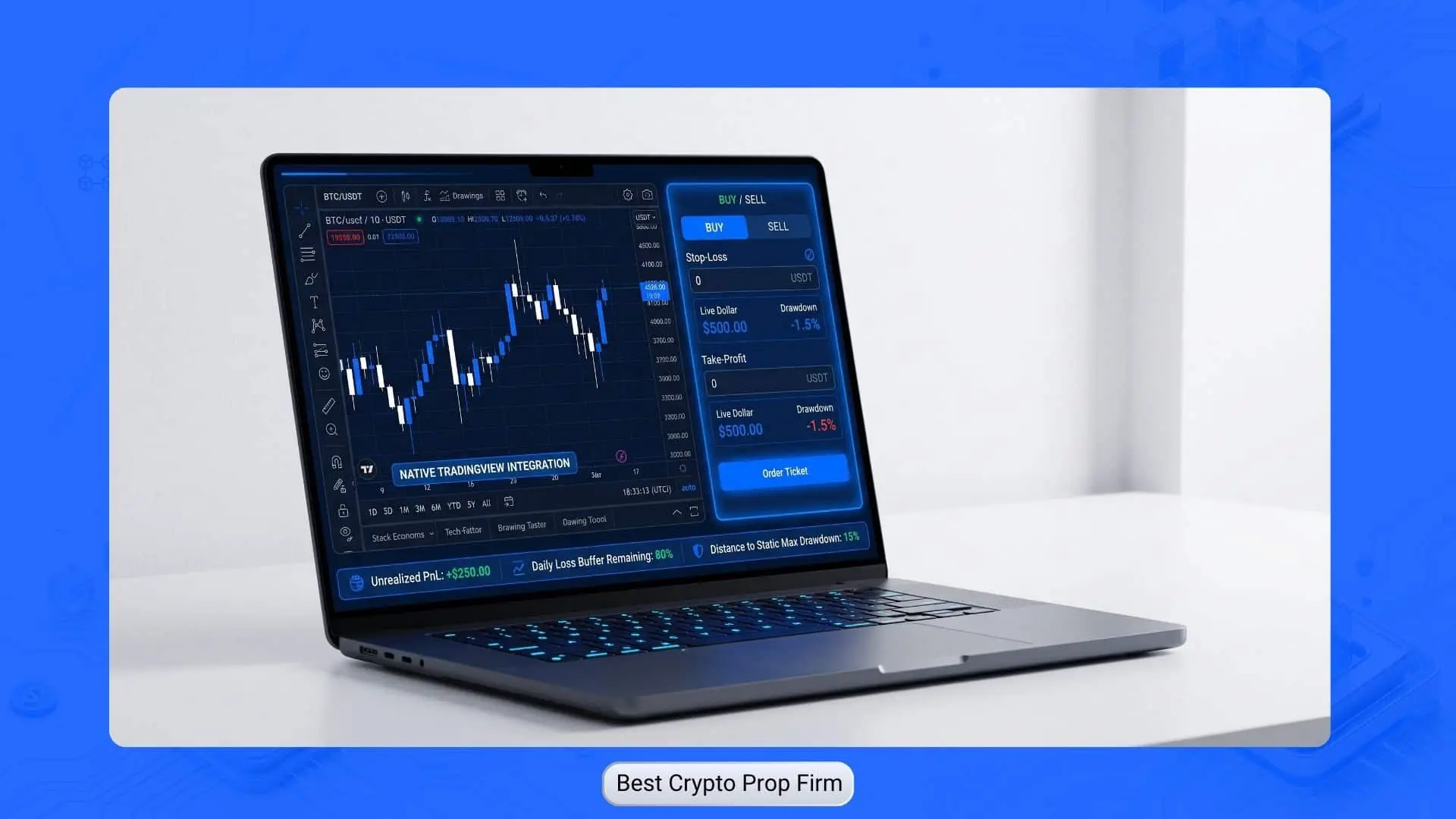
When comparing crypto prop firms with TradingView, it is useful to look beyond whether the TradingView interface is available. The quality of the integration, supported markets, pricing data, execution environment, and account rules can all affect how practical the setup is for active trading.
TradingView Integration and Charting
The first thing to check is how TradingView is integrated into the prop firm’s trading environment. Some firms offer TradingView as a native part of their platform, while others may provide it separately for analysis and require traders to execute positions through another terminal.
A more integrated setup can make the workflow simpler. Traders can analyze price action, apply indicators, mark support and resistance levels, and manage their setups without constantly switching between different platforms.
TradingView also provides a broad range of technical analysis tools, including indicators, drawing tools, multiple chart types, alerts, and customizable layouts. For traders who already use TradingView as their primary charting environment, having these tools available within or directly connected to the trading workflow can reduce unnecessary friction.
However, TradingView availability alone does not tell you how well the complete trading setup works. The underlying execution environment and account conditions still need to be evaluated.
TradingView Trading Experience
The trading experience matters just as much as charting functionality. A trader may have excellent charts but still face limitations when placing, modifying, or managing orders.
When comparing TradingView crypto prop firms, consider how easily you can move from analysis to execution. Important factors include order placement, stop loss and take profit management, position sizing, open position monitoring, and access to account information such as unrealized PnL and drawdown.
Execution speed can also matter for short term strategies. Scalpers and active day traders generally have different requirements from swing traders, so the same TradingView setup may not be equally suitable for every trading style.
It is also worth checking whether all account types have access to the same TradingView functionality. Some firms may offer platform access only on certain programs, markets, or account structures.
TradingView Market Data and Pricing
Another important consideration is the source of the market data displayed on TradingView. A TradingView interface does not automatically mean that every prop firm uses the same underlying price feed.
For crypto traders, the relationship between the chart data and the firm’s trading environment can be particularly important. If a trader bases entries and exits on TradingView prices, differences between the chart data and the execution environment may affect where orders are triggered or filled.
Exchange based market data can therefore be an important comparison point. Traders should check which exchange or market source the firm uses, whether the available pairs match the markets they intend to trade, and whether the displayed prices are consistent with the firm’s execution environment.
This becomes especially relevant for highly volatile assets, lower liquidity altcoins, and short term trading strategies where relatively small price differences can affect an entry, stop, or exit.
What to Compare in a TradingView Crypto Prop Firm
Before choosing a crypto prop firm with TradingView, compare the complete trading setup rather than treating platform access as a standalone feature.
Key factors include:
- Native or integrated TradingView access
- Source of market data and pricing
- Available cryptocurrency markets and trading pairs
- Order execution and order types
- Position and risk management tools
- Spreads and trading fees
- Leverage limits
- Daily loss and maximum drawdown rules
- Restrictions on trading strategies
- Payout conditions
- Account sizes and pricing
A TradingView based setup can be particularly useful for traders who already build their strategies around TradingView charts. But platform compatibility should still be evaluated alongside the firm’s trading rules, costs, markets, and payout structure.
The goal is not simply to find a crypto prop firm that mentions TradingView. It is to find a trading environment where TradingView, market data, execution, and account rules work together with the way you actually trade.
Best Crypto Prop Firm Bybit
For traders who use Bybit as a reference for crypto markets, choosing a prop firm with Bybit integration or Bybit based market data can make a significant difference to the trading experience. The key is to understand exactly what “Bybit support” means, because firms can use the exchange in different ways.
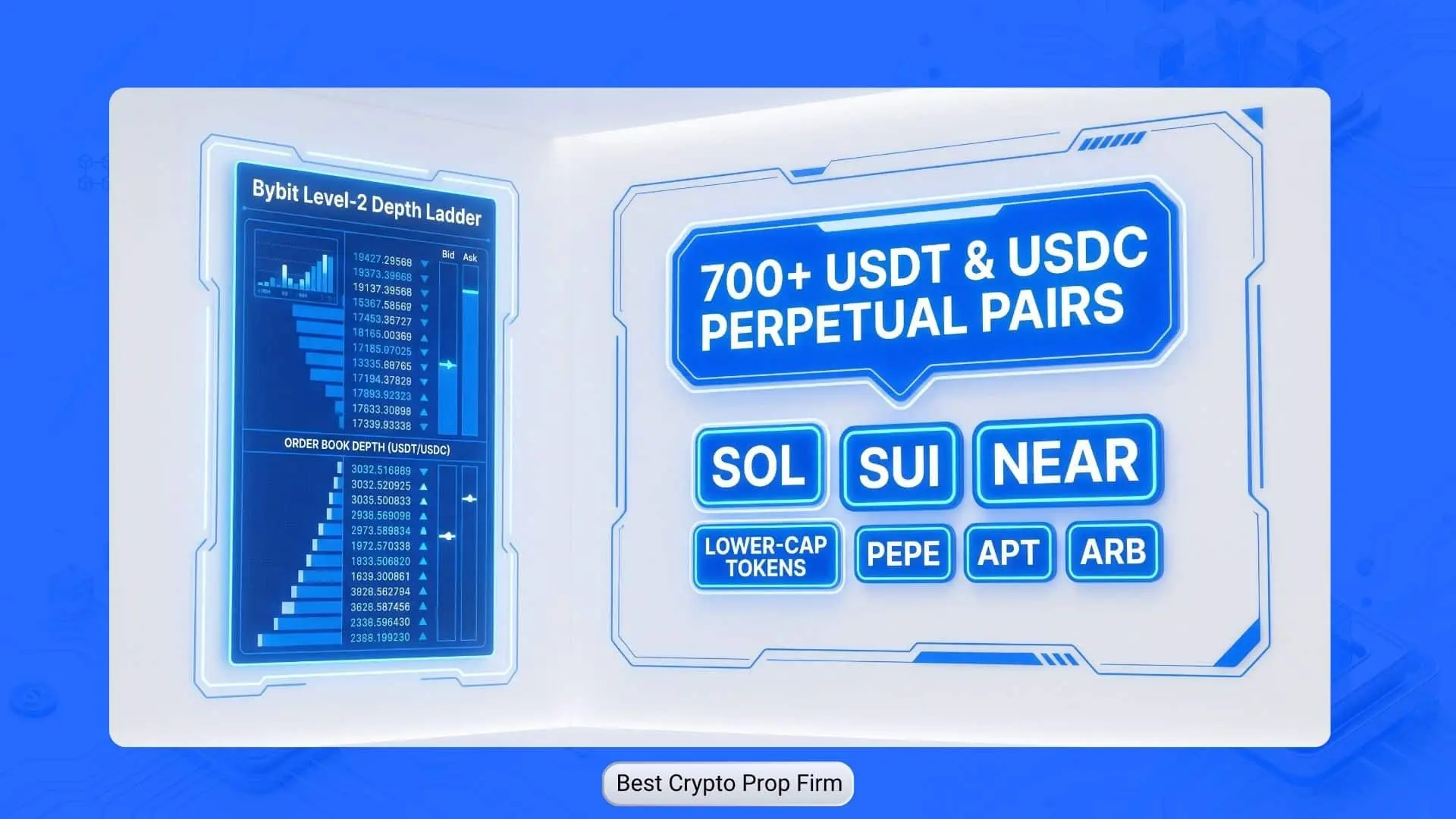
Some crypto prop firms use Bybit market data within their own trading platform, while others may connect traders to an external exchange or use Bybit primarily as a pricing reference. These setups can produce different experiences in terms of available markets, pricing, execution, and order management.
When comparing crypto prop firms with Bybit, traders should therefore look beyond the exchange name and examine how Bybit fits into the firm’s actual trading environment.
Bybit Market Data and Pricing
Market data is one of the most important factors when evaluating a Bybit crypto prop firm. Traders who analyze markets using Bybit prices generally want the prices shown on their charts to closely reflect the environment in which their trades are being executed.
This can be particularly important for short term strategies. A difference in price feeds can affect entries, stop loss levels, take profit orders, and other trading decisions, especially during periods of high volatility.
It is therefore useful to check whether a prop firm’s charts use direct Bybit market data, another exchange’s feed, or a proprietary or synthetic pricing source. The source of the data can influence how closely the trading environment reflects the market conditions traders see on Bybit.
Available Bybit Markets and Trading Pairs
Market availability is another major consideration. Bybit supports a wide range of crypto assets, but a prop firm’s available markets may represent only part of the exchange’s broader offering.
Traders should check whether the prop firm provides access to the specific assets and trading pairs they intend to trade. Bitcoin and Ethereum may be widely available, while smaller altcoins and newer tokens can have more limited support.
This matters even more for traders who specialize in altcoins or use strategies that require access to a broader selection of perpetual futures markets.
The number of available pairs is therefore less important than whether the firm’s market list actually matches the trader’s strategy.
Bybit Trading and Execution
The next consideration is how trades are executed. Using Bybit market data does not necessarily mean that trades are placed directly on the Bybit exchange.
A prop firm’s trading environment may provide Bybit based prices while handling order execution through its own simulated trading infrastructure. Traders should understand this distinction before comparing firms.
Important factors include supported order types, execution speed, slippage, position management, stop loss and take profit functionality, and how open positions are reflected in account PnL and drawdown.
For active traders, these details can be more relevant than the Bybit name itself. A familiar market feed is useful, but the complete execution workflow still needs to match the trader’s approach.
What to Compare in a Bybit Crypto Prop Firm
When comparing crypto prop firms with Bybit, consider the full relationship between the exchange data and the firm’s trading environment.
Key factors include:
- Bybit market data integration
- Source of displayed prices
- Available Bybit markets and trading pairs
- Spot or perpetual futures availability
- Order types and execution
- Slippage and trading costs
- Leverage and margin requirements
- Daily loss and maximum drawdown rules
- Trading restrictions
- Platform and charting tools
- Profit splits and payout conditions
- Account sizes and challenge pricing
A Bybit focused prop firm can be relevant for traders who want their prop trading environment to closely reflect the markets they already follow on Bybit. However, exchange integration should not be evaluated in isolation.
The most useful comparison is whether the market data, available pairs, execution environment, and account rules fit the way you plan to trade.
Best Crypto Prop Firm Binance
For traders specifically looking for a crypto prop firm connected to Binance, the important question is not simply whether a firm mentions Binance on its website. Traders should determine how Binance is used within the trading environment, whether the firm provides Binance market data or exchange connectivity, which markets are available, and how orders are executed.
Binance provides API connectivity for spot, margin, futures, and options trading, as well as real-time and historical market data. However, a crypto prop firm’s use of Binance-related data or infrastructure can differ significantly between platforms. Some firms may use exchange data for pricing, while others may provide actual exchange connectivity or route orders through an API.
Binance Market Access
The first factor to check is which Binance markets are actually available through the prop firm’s trading environment. Depending on the platform, this may include spot markets, perpetual futures, or other crypto instruments.
The number of available assets and trading pairs can also vary. A firm offering Binance-based market access may support only a selected group of assets rather than the full range available through Binance itself.
Traders should therefore check the specific symbols available on the firm’s platform and whether the markets they trade most frequently are supported. This is particularly important for traders who focus on altcoins or less-liquid pairs rather than major assets such as Bitcoin and Ethereum.
Market availability should also be considered alongside leverage, position limits, trading hours, and any restrictions applied by the prop firm.
Binance Trading Conditions
Access to Binance-related markets does not automatically mean that trading conditions are identical to trading directly on Binance. The prop firm’s account rules still determine how positions can be opened, managed, and closed.
Important conditions include leverage, maximum position size, margin requirements, drawdown limits, daily loss limits, and restrictions on specific trading strategies. The firm may also apply its own spreads, commissions, or other trading costs.
For futures traders, it is particularly important to understand whether the account uses Binance futures market data and execution or a simulated environment based on Binance prices. The distinction can affect how traders experience spreads, order execution, slippage, and liquidity.
The evaluation and funded stages should also be checked separately. A firm may use the same market data across both stages while applying different account rules or payout conditions after the trader becomes funded.
Binance Data and Execution
Market data and execution are two separate factors that should not be treated as the same thing.
A prop firm can use Binance market data for charts and pricing without sending a trader’s orders directly to Binance. Conversely, an API-connected trading environment may use exchange infrastructure for both pricing and order execution.
This distinction matters because the source of the price feed does not necessarily tell you how an order is executed. Traders should check whether the platform uses Binance data only, Binance API connectivity, another execution venue, or a simulated execution model.
For traders who rely on short-term strategies, these details can be especially important. Spreads, order-book depth, latency, slippage, and execution rules can have a greater practical impact than the number of supported trading pairs.
What to Compare in a Binance Crypto Prop Firm
When comparing crypto prop firms with Binance-related access, look at the complete trading setup rather than the exchange name alone:
- Market access — Which Binance spot or futures markets are available?
- Data source — Does the platform use Binance market data, another data source, or a proprietary feed?
- Execution model — Are orders connected to Binance through an API, executed elsewhere, or simulated?
- Trading costs — Check spreads, commissions, funding or other applicable costs.
- Leverage — Compare leverage limits across Bitcoin, Ethereum, altcoins, and other supported assets.
- Risk rules — Review daily loss limits, maximum drawdown, and position restrictions.
- Platform — Check how Binance-related markets are accessed and whether the platform supports the tools you use.
- Trading restrictions — Review rules for scalping, automated trading, hedging, news trading, and other strategies.
- Payout conditions — Compare profit splits, eligibility requirements, payout timing, and withdrawal methods.
- Funded-stage conditions — Confirm whether the same market access and execution model applies after passing the evaluation.
A Binance-focused comparison is therefore about more than finding a firm that lists Binance as a supported exchange or data source. The practical differences come from how Binance markets are integrated into the trading environment and how that integration works alongside the firm’s own rules, risk limits, execution conditions, and payout structure.
Best Crypto Prop Firm Spot
Spot trading can be an important consideration when choosing a crypto prop firm, especially for traders who prefer buying and selling cryptocurrencies without using perpetual futures or other leveraged derivatives. However, spot availability varies significantly between prop firms, and some firms focus almost entirely on futures based trading.
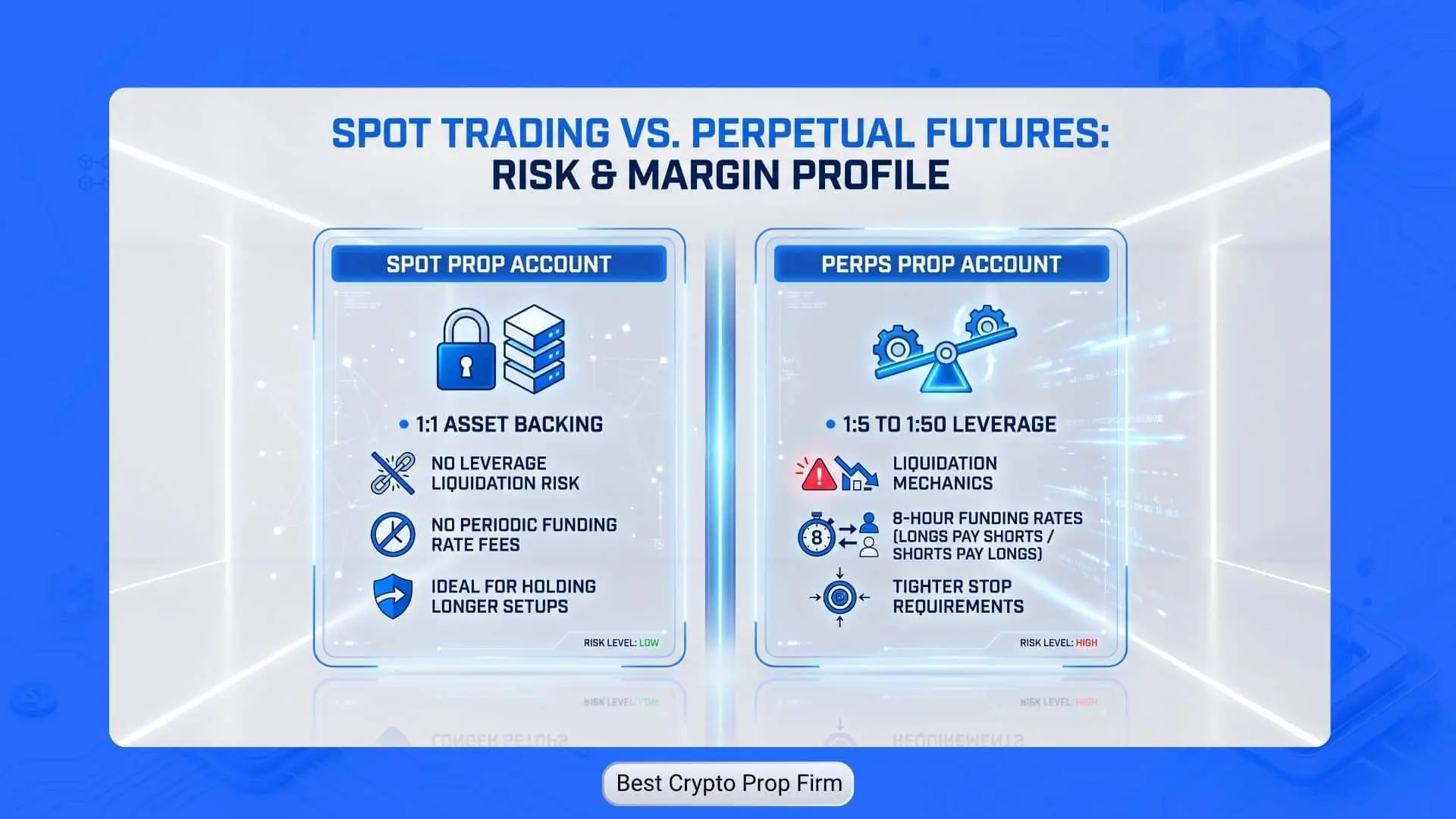
When comparing crypto prop firms for spot trading, look at more than the list of available assets. The trading platform, supported markets, fees, position rules, account structure, and payout conditions can all affect how suitable a firm is for a spot focused strategy.
Spot Trading Availability
The first step is to confirm that the prop firm actually supports spot trading. Many crypto prop firms are designed primarily around perpetual futures, meaning that the availability of Bitcoin, Ethereum, or other cryptocurrencies does not necessarily mean those assets can be traded on a spot basis.
Check which spot markets are available and whether the firm supports the specific assets and pairs you intend to trade. It is also worth checking whether spot trading is available across all account types or only on specific programs.
For traders who want to avoid leverage, spot availability can be a fundamental requirement rather than simply an additional platform feature.
Spot Markets and Trading Conditions
The range of available spot markets can vary considerably between firms. Some may focus on major cryptocurrencies, while others provide access to a broader selection of assets.
Trading conditions should also be compared carefully. Relevant factors include spreads, commissions, order types, execution, minimum position sizes, and any restrictions on holding positions.
The pricing source is another consideration. Traders should understand where the firm’s spot prices come from and whether the available market data reflects the exchange or market they normally use.
These details can become particularly important when trading less liquid assets, where spreads and execution conditions may have a larger effect on trading costs.
Spot Trading Rules
A firm’s account rules can affect spot traders differently from futures traders. For example, leverage may be less relevant to a spot strategy, while restrictions on holding positions, maximum exposure, overnight trading, or specific trading methods may be more important.
Drawdown rules also remain relevant. Even without leverage, a trader can still breach a firm’s daily loss or maximum drawdown limits depending on how the account is structured and how unrealized losses are calculated.
Before purchasing an account, check whether the firm’s standard trading rules apply equally to spot positions and whether there are additional restrictions specifically related to spot markets.
What to Compare in a Spot Crypto Prop Firm
When comparing crypto prop firms for spot trading, consider:
- Availability of spot markets
- Supported cryptocurrencies and trading pairs
- Spot versus perpetual futures access
- Market data and pricing source
- Trading fees and spreads
- Order types and execution
- Position and holding restrictions
- Leverage and margin requirements, where applicable
- Daily loss and maximum drawdown
- Profit targets and evaluation rules
- Profit splits and payout conditions
- Account sizes and pricing
Spot trading can offer a different trading structure from leveraged perpetual futures, so traders should first confirm that a firm’s account is genuinely compatible with their preferred market.
The right comparison is not simply which firm lists the most cryptocurrencies. It is whether the available spot markets, trading costs, execution conditions, and account rules support the strategy you intend to use.
Best Crypto Prop Firm for Memecoin Trading
Memecoin trading has become a distinct category within crypto markets, and traders looking to trade assets such as DOGE, SHIB, PEPE, and newer meme tokens may need different conditions from those offered by a traditional crypto prop firm.
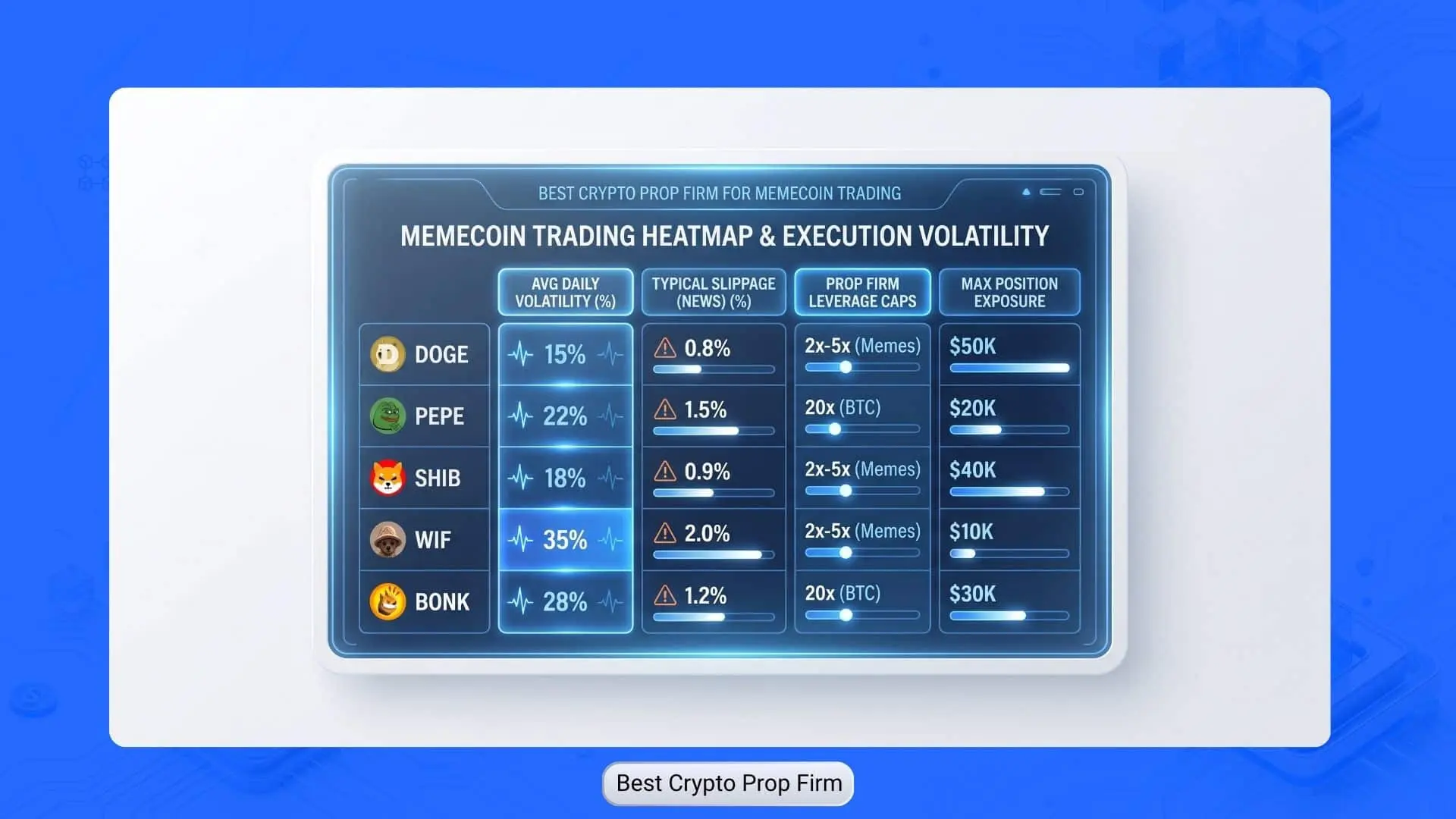
The main challenge is not simply finding a firm that lists memecoins. Market availability, pricing, liquidity, leverage, execution, drawdown rules, and trading restrictions can all have a significant impact on how practical a prop account is for memecoin strategies.
Memecoin Market Availability
The first factor to check is whether the prop firm actually supports the memecoins you want to trade. Some firms focus on major cryptocurrencies and offer only a limited selection of altcoins, while others provide access to a much broader range of markets.
The number of available assets can change over time, particularly as new memecoins are listed or removed from exchanges. Traders should therefore check the firm’s current market list rather than relying only on a general statement that it supports “hundreds of crypto assets.”
It is also important to distinguish between spot and perpetual futures markets. A memecoin may be available for spot trading but not as a perpetual contract, or the opposite may be true.
Liquidity, Spreads, and Execution
Memecoins can experience substantial changes in trading volume and liquidity. This makes execution conditions particularly relevant when comparing prop firms.
Spreads, slippage, order execution, and available order types can all affect the effective cost of entering and exiting a position. These factors may become more noticeable during periods of rapid price movement or when trading less liquid tokens.
The source of market data is also worth checking. Traders should understand whether prices come directly from an exchange, from another market data provider, or from a proprietary trading environment.
For short term memecoin strategies, the relationship between displayed prices and execution can be especially important because relatively small price differences can affect stops, entries, and exits.
Leverage and Risk Rules
Leverage can change the risk profile of memecoin trading significantly. A firm may offer high leverage across crypto markets, but the actual leverage available for memecoins may be lower than for major assets such as Bitcoin or Ethereum.
Drawdown rules are equally important. Daily loss limits and maximum drawdown can determine how much room a trader has when dealing with volatile markets.
Traders should also check whether the firm uses static or trailing drawdown, how unrealized PnL is treated, and whether there are additional exposure or position size restrictions.
For highly volatile assets, these rules can matter just as much as the advertised account size or leverage.
What to Compare in a Memecoin Crypto Prop Firm
When comparing crypto prop firms for memecoin trading, look at the complete trading environment:
- Available memecoins and trading pairs
- Spot and perpetual futures availability
- Market data source
- Liquidity and pricing conditions
- Spreads and trading fees
- Slippage and execution
- Leverage limits for memecoins
- Position size or exposure restrictions
- Daily loss and maximum drawdown
- Trading strategy restrictions
- Profit targets and evaluation rules
- Profit splits and payout conditions
- Account pricing and available account sizes
A prop firm that supports a large number of cryptocurrencies is not necessarily designed around memecoin trading. The important question is whether the specific markets you want to trade are available under trading conditions that fit your strategy.
For memecoin traders, the comparison should therefore focus on market selection, execution, trading costs, leverage, and risk rules, rather than simply the number of cryptocurrencies listed by the firm.
Best Crypto Prop Firm for Crypto Futures
Crypto futures are a core part of the prop trading market, particularly for traders who want to trade Bitcoin, Ethereum, altcoins, and other cryptocurrencies through leveraged derivatives. Most crypto prop firms focus heavily on perpetual futures, but the available markets, leverage, margin requirements, and risk rules can differ significantly from one firm to another.
When comparing a crypto prop firm for futures trading, the key is to look at how the firm’s futures environment fits your trading strategy rather than focusing on leverage or account size alone.
Perpetual Futures
Perpetual futures are widely used in crypto prop trading because they allow traders to take long or short positions without an expiration date. This can make them suitable for a range of trading styles, from short term strategies to positions held over longer periods.
However, not every prop firm offers the same selection of perpetual futures markets. Some focus primarily on major assets such as Bitcoin and Ethereum, while others provide a wider selection of altcoin and memecoin perpetuals.
The available trading pairs should therefore be one of the first things to compare. Traders should also check the source of market data, supported order types, trading fees, spreads, and execution conditions.
Position management is another consideration. A futures prop account may have rules governing position size, maximum exposure, overnight positions, or specific trading strategies. These restrictions can affect how effectively a trader can use perpetual futures even when the desired markets are available.
Leverage and Margin Rules
Leverage is one of the most visible differences between crypto futures prop firms, but a higher leverage figure does not necessarily mean a trader can or should use larger positions.
Leverage determines the margin required to open a position, while the firm’s risk rules determine how much loss the account can sustain. Daily loss limits, maximum drawdown, liquidation mechanics, and position size restrictions can therefore be just as important as the headline leverage offered.
Leverage may also vary by asset. A firm might offer different limits for Bitcoin and Ethereum compared with smaller altcoins or memecoins because of differences in volatility and liquidity.
Margin rules should be reviewed alongside leverage. Check whether the firm imposes maximum margin usage, maximum position sizes, or other exposure limits that could restrict how much capital can be deployed in a single trade.
When comparing futures prop firms, consider:
- Maximum leverage by asset
- Margin requirements
- Maximum position size
- Exposure or margin caps
- Daily loss limits
- Maximum drawdown
- Static or trailing drawdown
- Available perpetual futures markets
- Trading fees and spreads
- Execution and slippage
- Overnight and holding restrictions
For futures traders, the useful comparison is therefore broader than simply finding the highest leverage. The combination of available perpetual markets, leverage, margin rules, execution conditions, and account risk limits determines how the trading environment actually works.
Best Crypto Prop Firm With Flexible Trading Rules
Trading rules can have a major impact on how practical a crypto prop account is for different strategies. A firm may offer a competitive price, large account sizes, or a high profit split, but restrictive evaluation deadlines, minimum trading day requirements, consistency rules, or complex drawdown mechanics can significantly affect how traders use the account.
Flexible trading rules give traders more control over when they trade, how they manage positions, and how they approach an evaluation. This can be particularly important for traders who are selective about their setups, use swing strategies, trade volatile crypto markets, or rely on systematic approaches.
The most useful way to compare flexible crypto prop firms is to examine each rule separately. No single feature determines whether an account is suitable, but the combination of several flexible conditions can make a significant difference.
No Time Limit
A no time limit crypto prop firm does not require traders to complete an evaluation within a fixed number of calendar days. This removes one common source of pressure during the evaluation process and allows traders to wait for setups that fit their strategy.
Evaluation Time Limits
A fixed evaluation deadline can affect how traders approach a challenge. If an account requires a trader to reach a specific profit target within a limited number of days, the trader may have to balance normal risk management against the need to make progress before the deadline expires.
This can be particularly relevant when market conditions are slow or when a strategy generates relatively few trading opportunities. A trader who normally waits for high quality setups may be less comfortable with an evaluation that requires frequent activity.
When comparing prop firms, check whether the time limit applies to the entire evaluation, whether weekends count, and whether the firm offers extensions or resets when the deadline is reached.
The absence of a time limit does not mean that an evaluation has no other requirements. Profit targets, drawdown limits, prohibited strategies, and other account rules can still apply.
Trading Without a Deadline
Trading without a deadline allows traders to focus on their normal process rather than trying to fit their strategy into a predetermined schedule.
For example, a swing trader may need several days to find an appropriate entry and allow a position to develop. A selective day trader may also prefer to skip sessions where market conditions do not meet the strategy’s criteria.
A no time limit structure can therefore reduce the incentive to overtrade simply because the evaluation clock is running.
However, traders should still consider whether the firm imposes inactivity rules. A firm can advertise no time limit while maintaining separate requirements related to account inactivity, so the exact terms should always be checked.
No Minimum Trading Days
A crypto prop firm with no minimum trading day requirement does not require traders to trade on a predetermined number of separate days before completing an evaluation or progressing to the next stage.
This can be useful for traders whose strategies do not produce opportunities every day or for those who reach the required profit target quickly.
Minimum Trading Day Requirements
Minimum trading day rules can affect how quickly an evaluation can actually be completed. Even if a trader reaches the required profit target early, the account may remain incomplete until the required number of trading days has been recorded.
For some traders, this is not a major issue. Others may prefer a structure where performance, rather than the number of calendar sessions traded, determines when an evaluation is completed.
The exact definition of a “trading day” should also be checked. Some firms may define it as any day on which a position is opened, while others may require a minimum amount of activity or a qualifying trade.
Completing an Evaluation Quickly
Without a minimum trading day requirement, a trader who reaches the profit target while staying within all risk limits may be able to complete the evaluation without artificially extending the process.
This can be particularly relevant to traders who specialize in high conviction setups. If the strategy produces its required return in a small number of sessions, forcing additional trades can introduce unnecessary risk.
The combination of no minimum trading days and no time limit can provide even greater flexibility because traders are neither required to trade for a minimum number of days nor pressured to finish within a deadline.
No Activation Fee
An activation fee is an additional charge that some prop firms require after a trader passes an evaluation before the funded account is activated.
A firm without an activation fee can make the total cost of progressing from evaluation to funded trading easier to understand.
What Is an Activation Fee?
An activation fee is separate from the initial challenge or evaluation price. A trader may pay an entry fee to start an account and then face another mandatory payment after passing the evaluation.
This means the advertised account price does not always represent the complete cost of reaching the funded stage.
When comparing firms, traders should check whether the account has:
- An initial evaluation fee
- A post pass activation fee
- Reset fees
- Optional add ons
- Platform fees
- Data or subscription charges
- Other mandatory payments
The absence of an activation fee does not by itself determine whether an account offers better value. It simply removes one potential cost from the overall pricing structure.
Total Cost After Passing
The most useful cost comparison looks at what the trader is required to pay from the initial purchase through funded account activation.
For example, two firms may have similar entry prices, but one may require an additional activation payment after passing while the other does not. Comparing only the advertised challenge price would therefore give an incomplete picture.
Traders should also check whether additional payments are required to access higher profit splits, larger accounts, extended drawdown, or other features.
A transparent fee structure makes it easier to calculate the actual cost of reaching the funded stage before purchasing an account.
No Consistency Rules
Consistency rules can place restrictions on how a trader generates profits during an evaluation or funded stage. A firm without such a rule gives traders greater freedom to have uneven daily or trade by trade performance, provided they remain within the firm’s other requirements.
Consistency Requirements
A consistency rule can take different forms. For example, a firm may limit how much of the total profit can come from a single trading day or require profits to be distributed across multiple sessions.
The exact calculation matters because “consistency rule” does not have one universal definition across the prop firm industry.
Traders should check whether the requirement applies during the evaluation, after funding, or at the time of requesting a payout. It is also important to understand whether the calculation is based on daily profit, individual trades, or another performance measure.
Profit Distribution Rules
Without a consistency requirement, traders generally have more flexibility in how their profits are distributed across their trading activity.
This can be relevant to strategies that naturally produce uneven results. A trader may experience several small or flat sessions followed by a larger profitable trade when a high conviction setup appears.
A consistency rule can make that type of performance more difficult to manage if a large winning day represents too much of the account’s total profit.
However, the absence of a consistency rule does not remove the firm’s other risk controls. Traders still need to comply with profit targets, drawdown limits, daily loss rules, and any restrictions on trading strategies.
Static Drawdown
Static drawdown establishes a fixed maximum loss threshold rather than continuously moving the threshold as the account reaches new highs.
For traders, one of the main advantages is predictability. The risk boundary can remain easier to calculate throughout the account’s development.
How Static Drawdown Works
Suppose a $100,000 account has a 6% static maximum drawdown. If the firm’s rules define drawdown against the starting balance, the breach threshold would generally remain at $94,000.
If the account subsequently increases to $105,000, the threshold would still be based on the original $100,000 reference point under a standard static model.
The exact calculation can vary between firms, however. Traders should check whether drawdown is measured using balance, equity, or another method and whether unrealized PnL affects the calculation.
Daily loss limits may also operate separately from maximum drawdown, so both rules need to be considered.
Static vs Trailing Drawdown
Static and trailing drawdown can produce very different risk management environments.
With static drawdown, the maximum loss threshold remains fixed according to the firm’s stated reference point. With trailing drawdown, the threshold can move as the account reaches new highs.
For example, a trailing threshold may rise after a profitable trade, reducing the amount of room between the account’s current value and the drawdown limit. The exact behavior depends on whether the firm trails equity, balance, or another value.
Static drawdown can therefore make the account’s maximum loss boundary easier to predict, while trailing drawdown requires traders to monitor how the threshold changes as the account becomes profitable.
Neither model should be evaluated independently from the firm’s other risk rules. The daily loss limit, position limits, leverage, and drawdown calculation all affect the actual risk available to the trader.
No Trailing Drawdown
A crypto prop firm with no trailing drawdown keeps the maximum drawdown threshold from continuously moving upward as the account reaches new highs, assuming the firm’s rules use a genuinely static model.
This can be particularly relevant after an account becomes profitable.
How Trailing Drawdown Works
Under a trailing drawdown model, the maximum loss threshold can increase as the account reaches new equity or balance highs.
For example, if an account begins with a defined drawdown threshold and then reaches a new high, the firm’s calculation may move that threshold upward. Depending on the rules, the threshold may continue following the account until a particular point or may remain at a fixed level after a specified condition is reached.
The details vary considerably between firms. Some trail real time equity, while others calculate the threshold from balance or at specific points in the trading process.
This is why traders should not assume that two firms offering the same percentage drawdown provide the same amount of usable risk.
Why Fixed Drawdown Matters
A fixed drawdown threshold can make risk planning more straightforward because the trader knows that the maximum loss boundary is not continually moving with every new account high.
This can be useful when developing position sizing rules. Traders can calculate the distance to the drawdown limit and structure individual trade risk around that fixed boundary.
It can also matter when protecting profits. With a static threshold, building a profit buffer can increase the distance between the current account value and the breach level, assuming no other rule changes that relationship.
Traders should still review the firm’s daily loss rule separately. A static maximum drawdown does not necessarily mean that daily losses are also static or unrestricted.
High Leverage
High leverage is often used as a selling point by crypto prop firms, particularly for perpetual futures. It can allow traders to control larger positions while committing less margin to each position.
However, the headline leverage number does not tell the full story.
Leverage by Asset
Leverage limits can vary between cryptocurrencies. A firm may offer higher leverage for Bitcoin and Ethereum while applying lower limits to smaller altcoins or memecoins.
This is generally relevant because different assets have different levels of volatility and liquidity. Traders should therefore look at the leverage available for the specific markets they intend to trade rather than comparing only the firm’s maximum advertised leverage.
Other restrictions may also apply. A firm can offer high leverage while limiting position sizes, margin usage, or total exposure.
When comparing firms, check:
- Leverage available for each asset
- Spot versus futures leverage
- Maximum position size
- Maximum margin usage
- Exposure limits
- Daily loss limits
- Maximum drawdown
Leverage and Position Size
Leverage and position size are related, but they are not the same thing.
Higher leverage reduces the margin required to open a position, but it does not mean that a trader should automatically increase position size. Position sizing should still be determined by the strategy’s risk parameters and the account’s drawdown limits.
For example, a trader may have access to high leverage but choose to use only a small portion of the available exposure. This can leave more room within the account’s risk limits while still allowing the trader to execute the strategy efficiently.
The relationship between leverage, margin, position size, and drawdown is therefore more important than the leverage figure itself.
When comparing high leverage crypto prop firms, look at the complete structure rather than the maximum number advertised. A flexible trading environment should provide enough leverage for the intended strategy without forcing traders into unnecessarily high risk.
Ultimately, flexible trading rules are valuable because they give traders more control over the way they approach an evaluation and manage a funded account. No time limit, no minimum trading days, no activation fee, no consistency rules, static drawdown, no trailing drawdown, and appropriate leverage can each remove a different restriction. The most suitable combination depends on the trader’s strategy, risk tolerance, and preferred way of managing an account.
Best Crypto Prop Firm for Different Trading Styles
Different trading styles can require very different conditions from a crypto prop firm. A setup that works well for an active scalper may not be suitable for a swing trader, while traders using algorithms or trading bots may need platform and strategy permissions that manual traders do not.
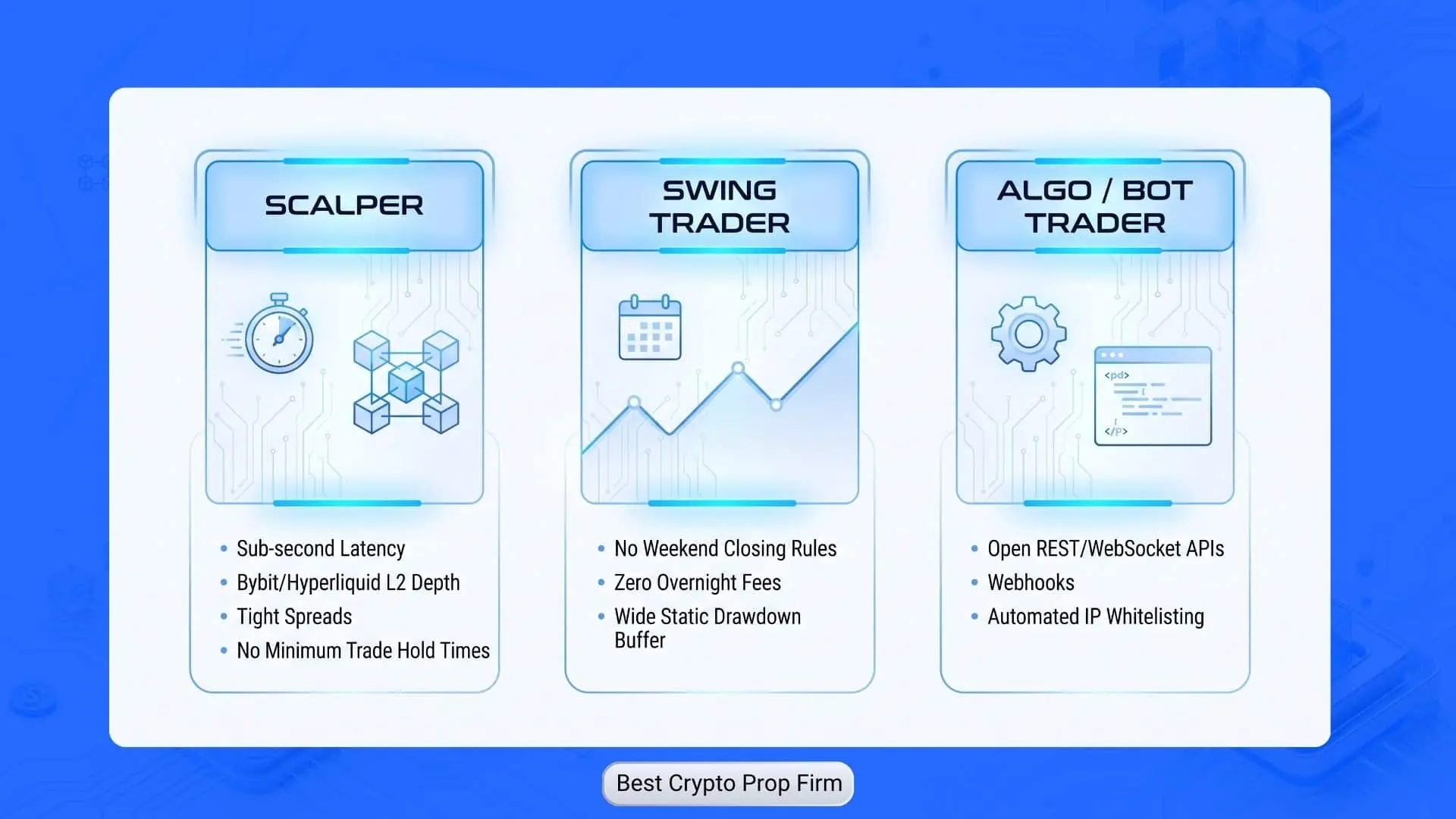
For this reason, choosing a crypto prop firm based only on account size, pricing, or profit split can overlook important practical restrictions. Trading frequency, holding periods, execution, leverage, drawdown mechanics, and permitted strategies should all be considered in relation to how you actually trade.
Day Trading and Scalping
Day traders and scalpers typically need a trading environment that supports frequent entries and exits without unnecessary restrictions. Execution quality, spreads, commissions, order types, and platform responsiveness can therefore be particularly important.
Execution and Trading Costs
Trading costs can have a greater effect on short term strategies because a larger number of trades means that commissions and spreads accumulate over time. Slippage can also become more significant when positions are opened and closed frequently, particularly during periods of high market volatility.
When comparing crypto prop firms, traders should look beyond the advertised account price and examine the actual trading costs associated with their strategy. A firm with a lower entry fee may not necessarily provide the same trading conditions as one with higher upfront pricing.
Important factors include:
- Spreads and commissions
- Slippage
- Order execution speed
- Available order types
- Market and limit order conditions
- Platform responsiveness
Scalping and Trading Restrictions
Prop firm rules can have a direct effect on whether a scalping strategy is practical. Some firms may restrict certain forms of high frequency trading, impose minimum holding periods, limit trade frequency, or prohibit specific execution methods.
Traders should also check restrictions around news trading, automated execution, and other strategies that may overlap with short term trading. Rules should be reviewed carefully rather than assuming that a firm permits every form of scalping simply because short term trading is advertised as allowed.
Leverage and Drawdown
Leverage and drawdown limits should be considered together. A day trader may open several positions during a single session, meaning that daily loss limits and maximum exposure can affect how much flexibility the strategy has.
A higher leverage limit does not automatically make an account more suitable for day trading. What matters is whether the available leverage, position limits, daily loss threshold, and maximum drawdown provide enough room for the strategy without encouraging excessive risk.
When comparing a crypto prop firm for day trading and scalping, consider:
- Trading fees and spreads
- Execution and slippage
- Available order types
- Leverage and position limits
- Daily loss limits
- Maximum drawdown
- Scalping restrictions
- Minimum holding periods
- News trading restrictions
- Platform performance
A suitable day trading account should allow the trader to execute the strategy without unnecessary restrictions while providing enough risk capacity for normal short term market fluctuations.
Swing Trading
Swing traders generally hold positions for longer periods, making overnight and extended holding conditions particularly important when choosing a crypto prop firm.
Unlike a strategy that opens and closes positions within the same session, swing trading can require positions to remain open through multiple market sessions. Traders should therefore examine the firm’s holding rules before choosing an account.
Overnight and Weekend Trading
Crypto markets operate continuously, but a prop firm’s rules may still place restrictions on how long positions can remain open. Some firms may restrict overnight or weekend positions, while others may allow traders to maintain positions without these limitations.
For swing traders, these rules can materially affect strategy execution. A setup that requires several days to develop may not be compatible with a firm that requires positions to be closed within a specific period.
Traders should check:
- Whether overnight positions are allowed
- Whether weekend positions are permitted
- Maximum position duration
- Position closing requirements
- Restrictions around major market events
Drawdown and Position Duration
Drawdown mechanics can have a different impact on swing strategies because positions may temporarily move against the trader before reaching their intended target.
The distance between the entry price, stop loss level, and firm’s drawdown threshold therefore needs to be considered carefully. Static and trailing drawdown rules can produce different outcomes for a strategy that requires larger temporary fluctuations before a position becomes profitable.
A swing trader should compare the firm’s drawdown rules with the normal volatility and expected holding period of the strategy rather than looking at the maximum drawdown percentage alone.
Evaluation Time Limits
Evaluation time limits can also matter to swing traders. A strategy that produces only a few high quality setups may not fit comfortably within a short evaluation deadline or a minimum trading day requirement.
Firms with no time limit can provide more flexibility for strategies that depend on specific market conditions rather than frequent trading opportunities. However, the absence of a deadline should still be considered alongside profit targets, drawdown rules, and other evaluation conditions.
When comparing a crypto prop firm for swing trading, consider:
- Overnight holding rules
- Weekend trading restrictions
- Maximum position duration
- Static versus trailing drawdown
- Daily loss calculations
- Leverage and position size
- Available markets
- Trading fees and funding related costs
- News and event restrictions
- Evaluation time limits
The key consideration is whether the firm’s rules allow positions to develop according to the strategy rather than forcing the trader to close or modify positions because of account restrictions.
Algorithmic Trading and Trading Bots
Algorithmic traders and users of trading bots have another set of requirements. A prop firm may support manual trading while restricting automated systems, APIs, expert advisors, or other forms of automated execution.
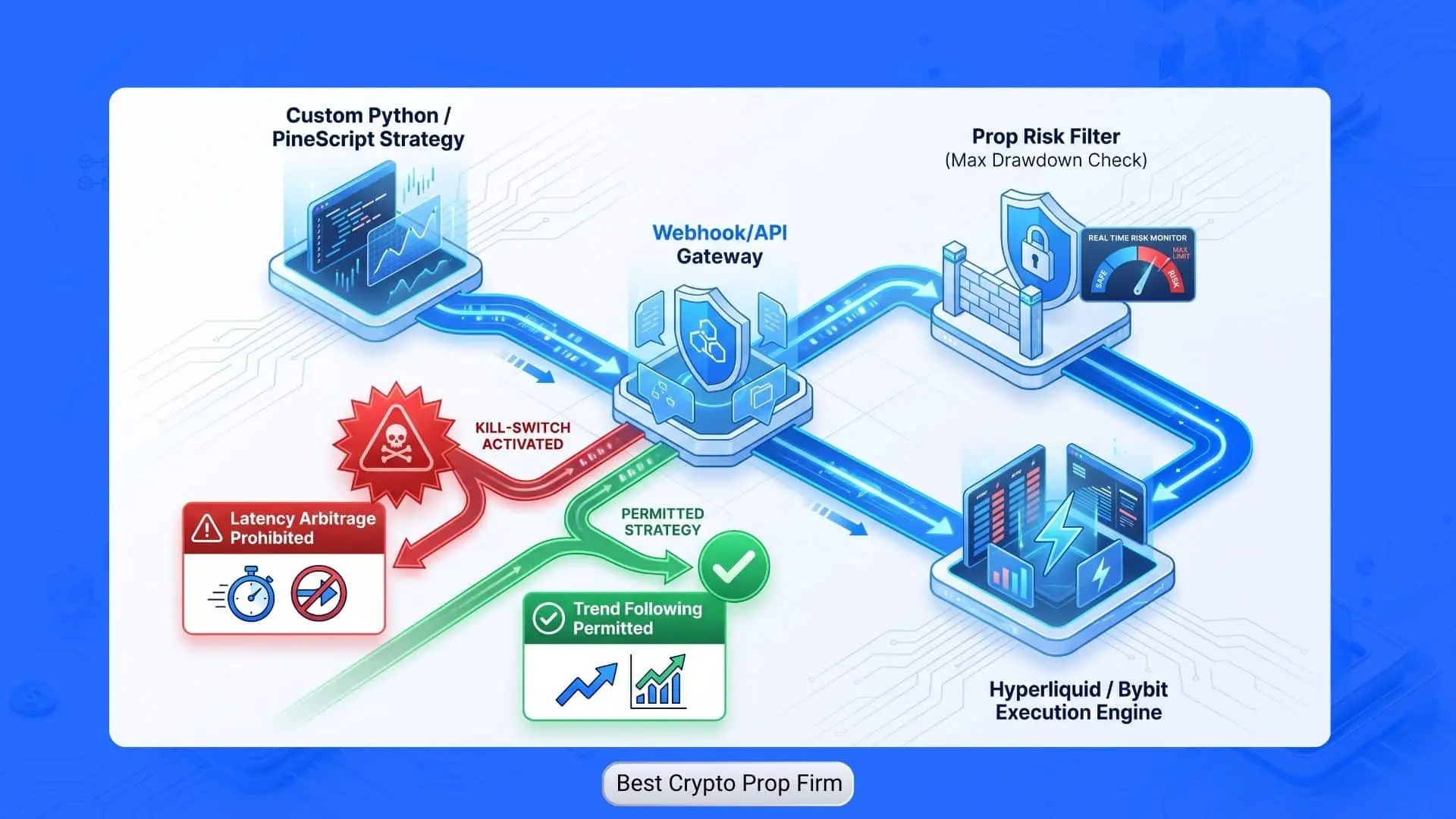
The important distinction is between simply allowing automation and supporting the specific type of automation a trader intends to use.
Automated Trading Policies
Before choosing a crypto prop firm for algorithmic trading, traders should verify exactly which automated strategies are permitted.
Terms such as “bots allowed” can have different meanings. A firm may allow automated execution while prohibiting strategies that exploit latency, pricing discrepancies, platform specific behavior, or other forms of market exploitation.
Traders should review the firm’s rules for:
- Trading bots
- Automated strategies
- Expert advisors
- API based execution
- Copy trading
- Arbitrage
- High frequency strategies
- News based automation
The relevant question is not simply whether bots are allowed, but whether the specific strategy complies with the firm’s trading rules.
APIs, Platforms, and Connectivity
Infrastructure and execution are also important for algorithmic trading. Automated systems depend on consistent order handling, supported order types, stable connections, and predictable market data.
If the trading environment behaves differently from the system used during strategy development or testing, actual performance can differ from expectations. Differences in market data, execution, spreads, latency, or available order types can affect automated strategies even when the underlying logic remains unchanged.
When comparing firms, traders should therefore examine:
- Supported platforms
- API availability
- Platform connectivity
- Market data sources
- Supported order types
- Execution conditions
- Connection stability
These factors can be particularly important for strategies that depend on precise entries, exits, or rapid order execution.
Automation and Risk Controls
Risk rules remain important for automated systems as well. A bot can execute trades much faster than a manual trader, meaning that a programming error, unexpected market condition, or malfunction can potentially affect an account quickly.
Daily loss limits, maximum drawdown, position limits, leverage restrictions, and other risk controls should therefore be understood before deploying an automated strategy.
Traders should also consider whether the firm’s restrictions are compatible with the bot’s normal trading behavior. For example, a strategy that routinely opens multiple positions or uses rapid entries may conflict with restrictions that would have little effect on a conventional manual strategy.
For algorithmic traders, the relevant comparison is therefore broader than whether bots are permitted. The firm’s automation policy, execution environment, market data, platform connectivity, and risk rules should all be compatible with the specific system being used.
Different trading styles require different prop firm conditions. Day traders may prioritize execution and trading costs, swing traders may focus on holding and drawdown rules, while algorithmic traders need clear automation policies and reliable execution infrastructure.
Comparing these conditions against the actual strategy is more useful than choosing an account based only on headline features such as account size, leverage, or profit split.
Best Crypto Prop Firm for Different Crypto Assets
The range of cryptocurrencies available can be an important factor when comparing crypto prop firms. Some firms focus primarily on major assets such as Bitcoin and Ethereum, while others provide access to a much broader selection of altcoins.
A large asset list, however, does not automatically mean that every market is equally useful for trading. Traders should consider the specific cryptocurrencies available, whether they are offered as spot or perpetual markets, and the trading conditions attached to them.
The right comparison depends on the assets your strategy actually requires rather than simply the total number of cryptocurrencies advertised by a firm.
Bitcoin and Ethereum
Bitcoin and Ethereum are among the most commonly supported cryptocurrencies in prop trading. Their high market activity and broad availability make them core markets for many crypto trading strategies.
When comparing firms for Bitcoin and Ethereum trading, traders should look beyond whether these assets are listed. Leverage, spreads, commissions, execution, position limits, and drawdown rules can all affect the practical trading environment.
Leverage is particularly important for traders using perpetual futures. A firm may offer different leverage limits for Bitcoin and Ethereum than it does for smaller cryptocurrencies. Traders should therefore check the leverage available specifically for the assets they intend to trade rather than relying on a firm’s maximum headline figure.
Market data and pricing are also worth examining. If a trader uses a particular exchange or platform as the primary reference for Bitcoin and Ethereum prices, differences in market data can affect entries, exits, and stop loss levels.
For major asset traders, useful comparison points include:
- Bitcoin and Ethereum availability
- Spot and perpetual futures markets
- Leverage limits
- Trading fees and spreads
- Market data source
- Execution and slippage
- Position size restrictions
- Daily loss and maximum drawdown
- Overnight and weekend rules
- Available order types
Because Bitcoin and Ethereum are supported by many crypto prop firms, the differences between firms often come down to trading conditions and account rules rather than basic market availability.
Altcoins
Altcoin availability can create a much wider difference between crypto prop firms. While most firms provide access to major cryptocurrencies, the number and type of altcoins available can vary considerably.
For traders who specialize in altcoins, the first consideration is whether the specific assets and trading pairs required by the strategy are supported. A firm may advertise hundreds of cryptocurrencies but still lack particular markets that a trader relies on.
Trading conditions can also differ across assets. Smaller altcoins may have wider spreads, lower liquidity, or different leverage limits than Bitcoin and Ethereum. Some firms may also apply asset specific position or exposure restrictions.
The market data source is another important factor. Traders should check whether altcoin prices are based on a major exchange, another market data provider, or a proprietary pricing environment. This can become more relevant when trading volatile or less liquid assets.
The availability of perpetual futures is also worth checking separately from spot markets. An altcoin may be available for one market type but not the other, so traders should confirm exactly how the asset can be traded.
When comparing crypto prop firms for altcoin trading, consider:
- Number and range of supported altcoins
- Specific trading pairs available
- Spot versus perpetual futures access
- Asset specific leverage
- Spreads and commissions
- Liquidity and execution
- Market data source
- Position and exposure limits
- Drawdown and daily loss rules
- Trading restrictions
A broad selection of altcoins can be valuable for traders whose strategies depend on market rotation, relative strength, or opportunities outside the largest cryptocurrencies. But the number of listed assets should always be considered alongside their actual trading conditions.
Ultimately, the useful question is not simply which crypto prop firm offers the most cryptocurrencies. It is whether the firm provides the assets you trade, in the market type you need, with trading conditions and risk rules that fit your strategy.
Best Crypto Prop Firm for Payouts
Payout conditions are one of the most important factors to compare when choosing a crypto prop firm. The advertised profit split or account size only tells part of the story. What matters in practice is how quickly traders become eligible for a payout, how often they can withdraw profits, what conditions apply to each request, and how the payment is delivered.
Crypto prop firms can have very different payout structures. Some offer fixed payout schedules, while others allow eligible traders to request profits on demand. Some process payments within a defined timeframe, while others may require additional funded trading days or account reviews before approving a withdrawal.
When comparing crypto prop firms for payouts, evaluate the entire process from becoming eligible to receiving the funds.
Fast Payouts
Fast payouts can be an important consideration for traders who do not want profits to remain locked in a funded account for an extended period. However, the speed of a payout depends on more than the firm’s advertised processing time.
Payout Processing Time
Payout processing time refers to how long the prop firm takes to review and process a withdrawal request after it has been submitted.
Firms may advertise processing in hours, one business day, several business days, or another defined period. These timeframes should be distinguished from the time required for the payment to reach the trader after the firm approves it.
For crypto payouts, blockchain confirmation can add another part to the process depending on the network being used. For other payment methods, processing and settlement times can vary differently.
When comparing payout speed, look for:
- Stated processing timeframe
- Whether processing is measured in hours or business days
- Review requirements before approval
- Payment delivery time after approval
- Different processing times for first and subsequent payouts
- Any payout fees
A firm that advertises fast payouts should therefore be evaluated based on the complete timeline, not simply the shortest processing time mentioned on its website.
First Payout Requirements
The first payout can have different requirements from later withdrawals. A prop firm may require a trader to complete a minimum number of funded trading days, reach a minimum profit level, or satisfy additional account conditions before the first payout request is allowed.
Some firms may also require identity verification or other compliance checks before processing the first withdrawal.
These requirements can significantly affect how quickly a trader can actually receive profits. For example, a firm may process approved payouts within a few hours but still require several funded trading days before the first request can be submitted.
Before purchasing an account, check:
- Minimum funded trading days
- Minimum profit requirement
- First payout waiting period
- Verification requirements
- Minimum withdrawal amount
- Any restrictions after requesting a payout
The distinction between payout processing speed and payout eligibility is important. A fast processing time does not necessarily mean a fast first payout.
On Demand Payouts
On demand payouts allow eligible traders to request profits when they become available rather than waiting for a fixed weekly, biweekly, or monthly payout date.
This can provide more control over when profits are withdrawn, but “on demand” does not necessarily mean that profits can be withdrawn immediately after every profitable trade.
Payout Eligibility
Payout eligibility determines when a trader is actually allowed to submit a withdrawal request.
A firm may require a minimum number of funded trading days, a minimum profit balance, a minimum withdrawal amount, or other conditions before a payout becomes available.
Traders should also check whether a payout request changes the account’s available drawdown or affects the amount of capital that can remain in the account.
For example, withdrawing most of the available profit may leave a smaller buffer above the account’s drawdown threshold. The payout policy and risk model should therefore be considered together.
A clear payout policy should explain exactly:
- When a trader becomes eligible
- Whether a minimum profit is required
- Whether funded trading days are required
- Whether there is a minimum withdrawal amount
- Whether eligibility resets after each payout
Understanding these conditions prevents the common mistake of assuming that “on demand” means unrestricted withdrawals.
Withdrawal Frequency
Withdrawal frequency refers to how often eligible traders can request profits.
Some firms may allow frequent requests once the trader meets the relevant conditions, while others may impose fixed payout windows or waiting periods between withdrawals.
For traders who prefer to regularly remove profits from the account, this can be an important difference between otherwise similar prop firms.
When comparing withdrawal frequency, consider whether the firm allows:
- Multiple withdrawals during a month
- Consecutive payout requests
- Payouts immediately after becoming eligible
- Flexible withdrawal dates
- Separate rules for the first and subsequent payouts
The practical value of an on demand payout structure therefore depends on both eligibility and frequency. A firm may use the term “on demand” while still applying meaningful restrictions to when requests can be submitted.
On Chain Payouts
On chain payouts are particularly relevant to crypto prop firms because they allow profits to be transferred using cryptocurrency and a blockchain network.
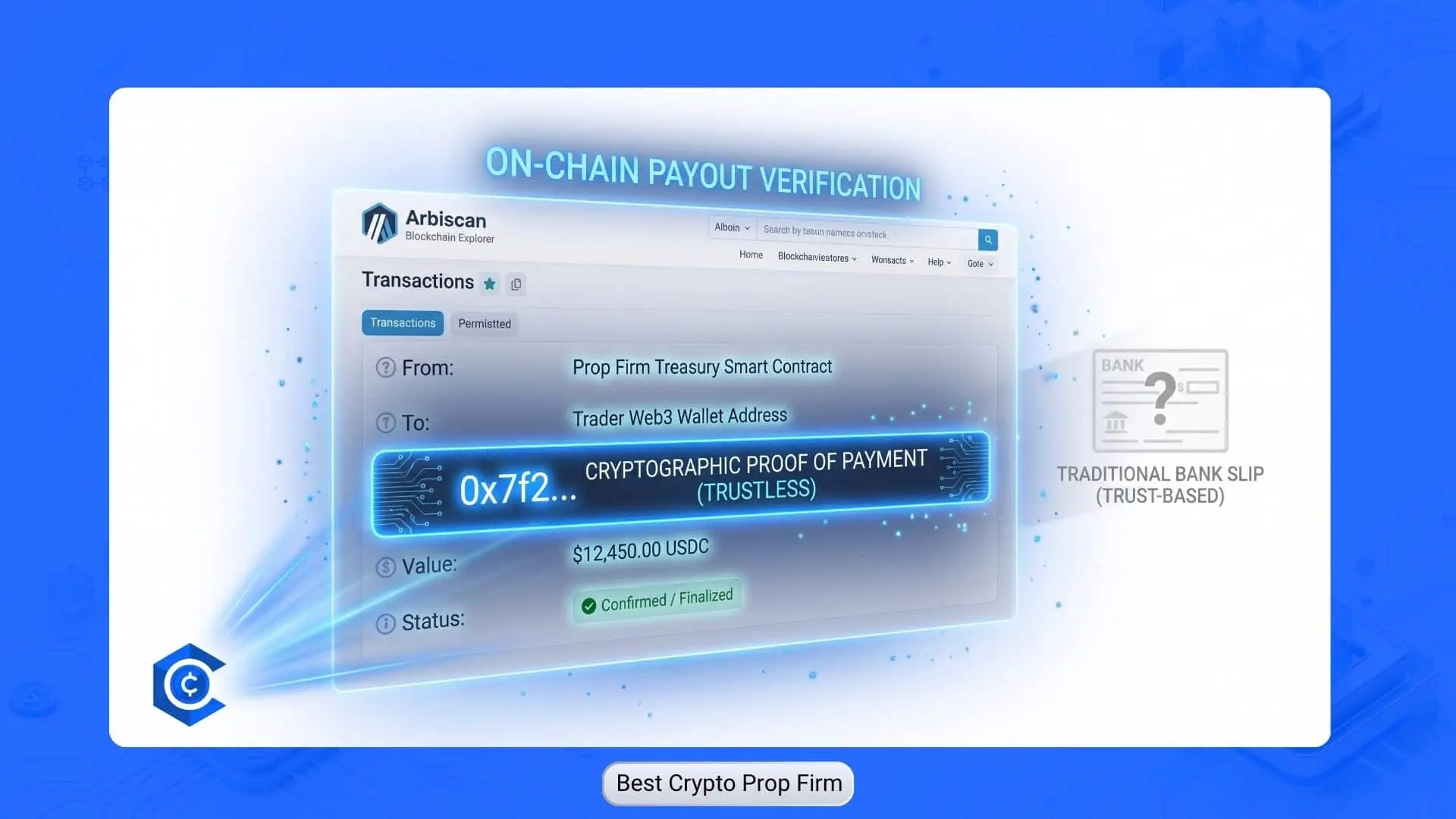
Instead of receiving a traditional bank payment, a trader may receive a supported stablecoin or cryptocurrency directly to a compatible wallet.
Supported Networks
The blockchain network used for a payout can affect transaction costs, processing speed, and wallet compatibility.
For example, a firm may support a particular stablecoin on Ethereum, Arbitrum, another network, or several networks. Traders need to confirm that the network supported by the prop firm is also supported by their receiving wallet.
This is particularly important because sending a cryptocurrency through an incompatible network can create significant problems.
When comparing on chain payout options, check:
- Supported cryptocurrencies
- Supported blockchain networks
- Receiving wallet requirements
- Minimum withdrawal amounts
- Network fees
- Whether the firm covers transaction fees
- Whether the payout network can be selected by the trader
The payment method should therefore be evaluated as part of the firm’s overall payout infrastructure rather than simply described as “crypto payouts.”
Blockchain Transaction Records
One advantage of an on chain payout is that the transaction can potentially be verified on a public blockchain.
After a payment is sent, the transaction hash can generally be used to locate the transaction on an appropriate blockchain explorer. Depending on the network, the record can show information such as the sending address, receiving address, amount, timestamp, and transaction status.
This creates a different type of transparency from a screenshot or testimonial because the transaction exists as a public blockchain record.
However, a transaction record does not by itself prove every claim made by a prop firm. It can verify that a particular blockchain transfer occurred, but it does not necessarily establish the firm’s overall payout reliability, current rules, or future ability to process withdrawals.
High Profit Splits
Profit split determines how much of the eligible trading profit is allocated to the trader. It is one of the most visible payout features advertised by prop firms, but it should be evaluated alongside the conditions attached to receiving that profit.
Default vs Maximum Profit Split
A firm may advertise a maximum profit split that is higher than the percentage available under its standard account.
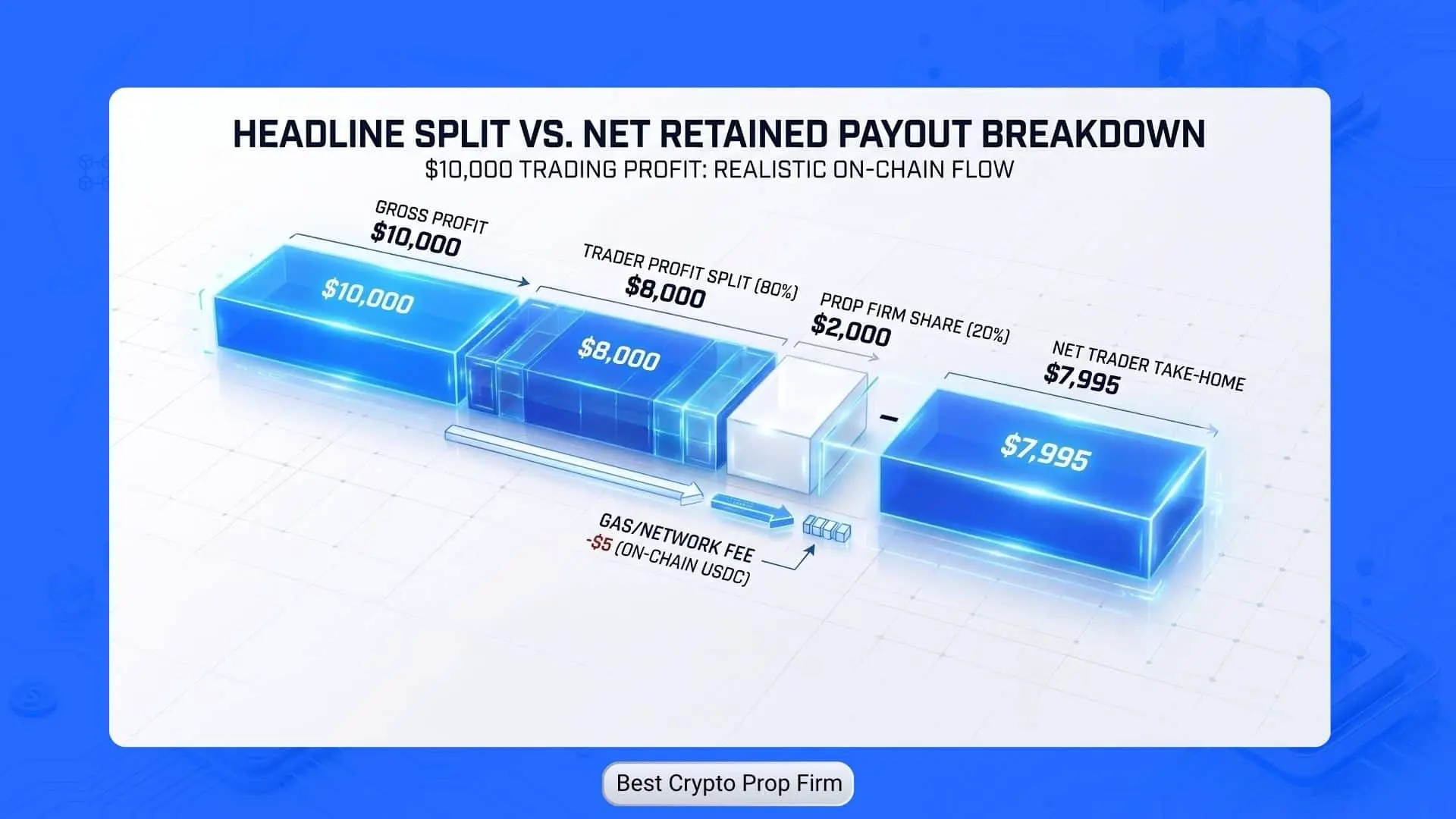
For example, a prop firm might offer a default split and then provide a higher percentage through account upgrades, scaling, performance milestones, or optional add ons.
This distinction matters when comparing firms. The maximum advertised percentage is not necessarily the percentage a new trader receives from the first payout.
Traders should therefore compare:
- Default profit split
- Maximum profit split
- When the higher split becomes available
- Whether the split changes after scaling
- Whether an add on is required
- Whether different account types have different splits
The most useful comparison is the profit split that actually applies to the account being considered and the conditions required to reach a higher percentage.
Payout Conditions and Restrictions
A high profit split can lose some of its practical value if significant restrictions apply to receiving the payout.
Traders should check whether the firm imposes minimum profit requirements, payout caps, minimum trading days, consistency rules, withdrawal fees, or other conditions.
The timing of the payout also matters. A trader receiving 90% of profits under restrictive withdrawal conditions may have a very different experience from a trader receiving a similar percentage under a more flexible payout policy.
Payout conditions should therefore be evaluated together with the profit split.
A useful comparison should answer:
- How much of the profit does the trader receive?
- When does the trader become eligible?
- Is there a minimum withdrawal?
- Is there a payout cap?
- Are there consistency requirements?
- Are there withdrawal fees?
- Does the profit split change over time?
This provides a more realistic picture than comparing profit split percentages alone.
Verifiable Payouts
Payout transparency can help traders assess how clearly a prop firm documents its withdrawal process and whether claims about payouts can be independently checked.
No single type of payout evidence proves that a firm will provide the same experience to every trader, but verifiable records can provide useful information when combined with published payout terms and other evidence.
Payout Proof
Payout proof can take several forms, including blockchain transaction records, transaction hashes, payment confirmations, or documented payout histories.
For crypto firms using on chain payments, a transaction hash is particularly useful because it can potentially be checked independently on a blockchain explorer.
Screenshots and testimonials can also provide context, but they are less independently verifiable. A screenshot may show that someone received a payment, but it does not necessarily establish the circumstances, date, account conditions, or whether the same conditions remain available today.
When reviewing payout evidence, consider:
- Whether the transaction can be independently verified
- Whether the payout date is clear
- Whether the payment method is identifiable
- Whether the evidence matches the firm’s stated payout policy
- Whether multiple sources of evidence are available
Payout proof should therefore be treated as one part of a broader due diligence process.
How to Verify Crypto Payouts
When a prop firm provides an on chain transaction hash, traders can use the relevant blockchain explorer to check the transaction.
The basic process is straightforward: identify the blockchain network, enter the transaction hash into an appropriate explorer, and review the transaction details. Depending on the network, the record may show the amount transferred, sending and receiving addresses, timestamp, and confirmation status.
Traders should make sure the network matches the transaction. A transaction on one blockchain cannot be verified through an explorer designed for another network.
It is also useful to compare the transaction with the firm’s stated payout information where available. The amount, currency, date, and receiving wallet should be consistent with the available documentation.
However, verification should not stop at individual transactions. Traders should also review the firm’s current payout rules, eligibility requirements, profit split, withdrawal limits, and any restrictions that could affect future payouts.
Ultimately, payout quality is about more than receiving a high percentage of trading profits. A meaningful comparison considers payout speed, first payout requirements, eligibility, withdrawal frequency, payment networks, profit splits, and the availability of verifiable payment records.
For crypto traders, a transparent payout structure makes it easier to understand exactly when profits can be withdrawn, how much the trader receives, what costs may apply, and how the payment can be verified.
Best Crypto Prop Firm for Beginners
Choosing a crypto prop firm as a beginner involves more than finding the lowest account price. New traders may benefit from straightforward rules, manageable account sizes, clear evaluation conditions, and trading platforms that are easy to understand.
Complex restrictions can make it harder to determine why an account failed or whether the trading strategy actually fits the firm’s rules. For this reason, beginners should compare the overall trading environment, including pricing, drawdown, profit targets, minimum trading requirements, leverage, and payout conditions.
Simple Rules and Evaluation Conditions
Clear and predictable rules can make a significant difference for traders who are using a prop firm for the first time. An account with fewer restrictions may be easier to understand and manage than one with multiple conditions that affect when and how trades can be placed.
Profit Targets and Evaluation Rules
Beginners should understand the profit target, drawdown limits, daily loss rules, and any minimum trading requirements before purchasing an account.
A lower profit target may reduce the amount of return required to complete an evaluation, but the target should always be considered alongside the account’s drawdown and other restrictions. Similarly, a firm with no minimum trading days or no time limit may provide more flexibility for traders who do not trade every day.
Important evaluation conditions to compare include:
- Profit target
- Daily loss limit
- Maximum drawdown
- Minimum trading days
- Time limits
- Consistency requirements
- Position restrictions
- News trading rules
The goal is not simply to find the easiest looking rules, but to find conditions that are understandable and compatible with the trader’s approach.
Trading Restrictions and Flexibility
Trading restrictions can be especially important for beginners because unfamiliar rules can lead to accidental violations.
Before choosing an account, traders should check whether the firm restricts scalping, overnight positions, weekend trading, hedging, automated trading, or specific trading strategies.
A firm with clearly documented rules can make it easier for a new trader to understand what is permitted before placing trades. Transparent rules can also reduce the risk of discovering an important restriction only after purchasing an account.
Risk Rules and Drawdown
Beginners should pay close attention to how drawdown is calculated rather than focusing only on the percentage shown in the account description.
Static drawdown, trailing drawdown, daily loss limits, and other risk rules can affect an account differently. Understanding when these limits are calculated and what causes a violation is essential before trading.
Leverage should also be viewed as a trading condition rather than an advantage by itself. Higher leverage can increase available position size, but it can also make risk limits easier to reach if positions are oversized.
Starting Account Sizes
Starting account size is another important consideration for beginners. A smaller account can reduce the initial cost of entering an evaluation, while larger accounts may provide more nominal trading capital but often require a higher upfront fee.
Entry Price and Account Size
The advertised account size does not tell the full story. Beginners should compare the purchase price with the account’s drawdown allowance, profit target, leverage, and other trading conditions.
For example, two firms may advertise similar account sizes while providing different drawdown limits or evaluation requirements. Comparing only the headline account size can therefore create an incomplete picture of the account’s actual trading conditions.
Useful factors to compare include:
- Starting account price
- Nominal account size
- Maximum drawdown
- Daily loss limit
- Profit target
- Profit split
- Evaluation requirements
- Payout conditions
Account Size and Risk Management
A larger account is not necessarily more suitable for a beginner. The relevant question is whether the account’s rules and risk limits are appropriate for the trader’s strategy and experience level.
Beginners should understand how much room the account provides before reaching its daily or maximum loss threshold. An account with a larger advertised balance can still have relatively tight effective risk limits.
Starting with an account size that is easy to understand and manage can make it simpler to focus on the firm’s rules and the trader’s own risk process.
When comparing crypto prop firms for beginners, the most relevant factors include:
- Clear and simple trading rules
- Manageable account sizes
- Transparent drawdown calculations
- Reasonable evaluation conditions
- Clear payout requirements
- Accessible trading platforms
- Well documented restrictions
- Responsive customer support
The right beginner focused crypto prop firm is ultimately one whose rules, account structure, and trading conditions are easy to understand and compatible with the trader’s approach. Comparing the full account structure rather than choosing based only on price or advertised account size can provide a clearer basis for evaluating different firms.
Best Crypto Prop Firm for Experienced Traders
Experienced traders may have different priorities when comparing crypto prop firms. Instead of focusing primarily on simple rules or small starting accounts, they may place more importance on execution, leverage, market access, trading flexibility, drawdown structure, automation, and the ability to scale an account over time.
A firm that works for a beginner may not provide the trading conditions required by a more established strategy. Experienced traders should therefore compare the specific rules and infrastructure that affect how their existing approach can be executed.
Advanced Trading Conditions
Experienced traders often have established strategies and risk management processes, making specific trading conditions more important than headline account features.
Execution and Trading Infrastructure
Execution conditions can become particularly relevant when a strategy depends on precise entries, frequent trading, or specific order types. Traders should compare spreads, commissions, slippage, execution speed, available order types, and the platform used by the firm.
Market data can also matter when the trading strategy depends on accurate pricing or specific exchange based markets. Differences between a firm’s market data and the data used to develop or test a strategy can affect execution and performance.
Leverage and Position Limits
Leverage can provide greater flexibility in position sizing, but experienced traders should evaluate it alongside drawdown and margin rules.
A firm may advertise high leverage while imposing other restrictions on maximum position size, margin usage, or exposure. These conditions can be more relevant to an experienced trader than the headline leverage figure itself.
When comparing firms, consider:
- Leverage by asset
- Position size limits
- Margin requirements
- Maximum exposure
- Daily loss limits
- Maximum drawdown
- Hedging restrictions
Trading Strategy Restrictions
Experienced traders may also use strategies that require more specific permissions, including scalping, swing trading, algorithmic execution, copy trading, or other advanced approaches.
The firm’s trading rules should therefore be checked against the actual strategy rather than assumed to be compatible. Restrictions on holding periods, news trading, automated execution, arbitrage, or other techniques can materially affect how an established strategy is implemented.
Account Scaling
For traders who consistently meet a firm’s requirements, scaling conditions can become an important part of the comparison.
Scaling Plans and Account Growth
Scaling programs differ between firms. Some may increase account size after specific performance periods, while others may use fixed milestones or additional requirements.
Traders should compare:
- Scaling frequency
- Required performance
- Time between scaling opportunities
- Maximum account size
- Additional conditions for larger accounts
- Whether profit splits change as the account scales
The maximum advertised account size is less important than understanding how a trader can actually progress toward it.
Multiple Accounts and Capital Allocation
Experienced traders may also consider whether a firm allows multiple accounts and how its rules apply across them.
If multiple accounts are permitted, traders should check whether there are restrictions on copying trades, managing correlated positions, or using the same strategy across accounts. These conditions can affect how an experienced trader allocates risk and manages a larger overall trading operation.
The most relevant crypto prop firm for an experienced trader depends on the strategy and the trading conditions required to execute it. Execution, leverage, drawdown, market access, strategy restrictions, and scaling can all become more important as trading requirements become more sophisticated.
Rather than choosing a firm based on account size or profit split alone, experienced traders should compare the rules and infrastructure against the specific strategy they already use.
Best Crypto Prop Firm for US Traders
US traders comparing crypto prop firms should look beyond account pricing and check whether a firm accepts traders from the United States, what verification requirements apply, and which trading products are available to US residents. Trading conditions can also differ significantly between firms, particularly for leverage, perpetual futures, spot markets, and restricted assets.

Crypto Prop Firms That Accept US Traders
Not every crypto prop firm accepts traders from the United States. Before purchasing an account, check the firm’s current country restrictions and terms of service. US eligibility can also depend on the firm’s business model, product structure, and the state or jurisdiction where the trader resides.
Trading Conditions for US Traders
US traders should compare the same core conditions as other traders, including evaluation fees, profit targets, daily loss limits, maximum drawdown, leverage, trading restrictions, and payout rules. For crypto focused firms, it is also important to check whether the firm offers perpetual futures, spot markets, or other crypto products that match the trader’s strategy.
Payouts and Verification
KYC and identity verification may be required before traders can access funded accounts or request payouts. Check which documents are required, whether US residents can use the available payout methods, and whether the firm provides clear records or transaction evidence for cryptocurrency payouts.
Best Crypto Prop Firm for Canadian Traders
Canadian traders should compare crypto prop firms based on availability in Canada, account costs, trading conditions, and payout requirements. In addition to the standard evaluation rules, traders should verify whether the firm accepts Canadian residents and whether any country specific restrictions apply to the products or services they offer. Crypto participation in Canada has grown substantially, with the Ontario Securities Commission reporting that 25% of surveyed Canadians owned crypto assets or crypto funds in its latest survey.
Crypto Prop Firms That Accept Canadian Traders
Country eligibility should be checked before purchasing an account because prop firms can change their restricted country lists. Canadian traders should also confirm whether the firm’s terms apply consistently across all provinces and whether additional identity or residency verification is required.
Trading Conditions for Canadian Traders
Compare evaluation fees, account sizes, profit targets, drawdown rules, leverage, trading restrictions, available crypto markets, and platform support. Traders who focus on perpetual futures, spot markets, or specific assets should verify that those markets are actually available to Canadian residents rather than assuming that the firm’s global market list applies everywhere.
Payouts and Verification
Canadian traders should review the firm’s payout eligibility requirements, profit split, withdrawal frequency, supported payment methods, and KYC process. If payouts are made through cryptocurrency, on chain transaction records can provide an additional way to verify completed payments. Always check the firm’s current payout terms before opening an account.
Crypto Prop Firm Comparison Criteria
Comparing crypto prop firms requires more than looking at account prices or advertised funding amounts. Different firms can use very different evaluation rules, drawdown structures, trading conditions, and payout requirements, making it important to assess the full account structure before choosing a firm.
The most useful comparison criteria include fees and pricing, profit targets, drawdown, leverage, trading costs, payout conditions, and the platforms and markets available.
Fees and Pricing
The entry price is usually the first thing traders compare, but it does not necessarily represent the full cost of a crypto prop firm account.
Account Fees
Traders should compare the price of similar account sizes and evaluation structures rather than comparing advertised prices in isolation. A lower priced account may have different drawdown limits, profit targets, or restrictions that affect the overall trading conditions.
Relevant pricing factors include:
- Evaluation fee
- Account size
- One step versus multi step evaluations
- Activation fees
- Reset or retry fees
- Optional add ons
- Refund conditions
The goal is to understand what the trader actually pays and what is included with that purchase.
Total Cost
The full cost can extend beyond the initial evaluation fee. Activation charges, optional risk add ons, resets, and other account related fees can change the effective cost of completing and maintaining an account.
Comparing the total potential cost gives traders a clearer picture than using the advertised entry price alone.
Profit Targets
Profit targets determine how much profit a trader needs to generate during an evaluation or challenge before becoming eligible for the next stage.
Evaluation Profit Target
A lower target may require less nominal profit to complete an evaluation, but the target should always be considered alongside the drawdown available to reach it.
For example, a 10% target means something different depending on whether the account has a 5% or 10% maximum drawdown. The relationship between the target and the permitted loss can therefore be more informative than the target percentage by itself.
Profit Target and Trading Strategy
The evaluation target should also be considered in relation to the trader’s normal strategy. Strategies that generate fewer but larger opportunities may interact differently with a target than strategies that produce frequent smaller gains.
Traders should compare the target with:
- Maximum drawdown
- Daily loss limit
- Minimum trading days
- Time limit
- Consistency requirements
- Trading restrictions
Drawdown
Drawdown is one of the most important criteria when comparing crypto prop firms because it determines how much account loss is permitted before a rule violation occurs.
Static and Trailing Drawdown
Firms may use static drawdown, trailing drawdown, or other calculation methods. These structures can affect strategies differently depending on whether the account balance needs room to fluctuate after reaching a profit.
Traders should determine exactly where the drawdown threshold is calculated and whether it moves as the account balance changes.
Daily Loss Limits
Daily loss limits are separate from maximum drawdown in many prop firm structures. A trader may remain above the overall drawdown threshold while still violating a daily loss rule.
The calculation method is therefore important. Traders should check whether unrealized losses, commissions, swaps or funding related costs, and other account activity are included in the daily calculation.
Leverage
Leverage determines how much market exposure can be controlled relative to the account’s available margin.
Leverage by Asset
Crypto prop firms may use different leverage limits for Bitcoin, Ethereum, altcoins, memecoins, or other markets. A single headline leverage figure may therefore not represent the conditions available across the entire platform.
Traders should compare leverage by asset rather than relying only on the maximum number advertised by a firm.
Leverage and Position Size
Higher leverage can allow larger positions with the same amount of margin, but it does not increase the account’s drawdown allowance.
Position size, leverage, margin requirements, and risk limits should therefore be evaluated together. A firm with lower leverage may still provide sufficient flexibility for a particular strategy, while a higher leverage limit may be unnecessary for another.
Trading Costs
Trading costs can have a significant effect on the practical value of a crypto prop firm account, particularly for strategies that trade frequently.
Spreads and Commissions
Spreads and commissions directly affect the cost of entering and exiting positions. Traders should compare how these costs apply to the markets and trading volume relevant to their strategy.
A low evaluation fee does not compensate for unfavorable trading costs if those costs materially affect strategy performance.
Slippage and Execution
Slippage occurs when an order is executed at a different price from the expected price. It can become particularly relevant during volatile conditions or when trading less liquid markets.
Execution quality, order types, market liquidity, and the firm’s pricing or market data source should therefore be considered alongside advertised fees.
Payout Conditions
Profit splits and payout policies can significantly affect the amount a trader can ultimately withdraw.
Profit Splits
Traders should compare both the standard and maximum advertised profit split. Some firms may offer higher splits only after specific milestones or through optional account features.
The percentage alone does not show the complete payout structure. Eligibility requirements, minimum trading periods, withdrawal limits, and other conditions can affect how the split works in practice.
Payout Timing and Eligibility
A firm may advertise fast or on demand payouts while still requiring traders to meet specific conditions before making a withdrawal.
Important factors include:
- First payout requirements
- Minimum funded trading days
- Payout frequency
- Processing time
- Minimum withdrawal amount
- Withdrawal methods
- Network availability
- Payout restrictions
A clear payout policy allows traders to understand when and how profits can actually be withdrawn.
Platforms and Markets
The trading platform and available markets determine how a trader can execute a strategy after purchasing an account.
Trading Platforms
Different firms may offer proprietary platforms, third party platforms, TradingView integrations, or other trading interfaces.
Traders should compare the platform’s charting tools, order types, execution environment, automation support, and overall compatibility with their trading approach.
Available Crypto Markets
Market availability can vary significantly between firms. One platform may focus primarily on major cryptocurrencies, while another may provide a broader selection of altcoins, memecoins, perpetual futures, or spot markets.
The relevant comparison depends on what the trader actually trades. A large asset count is not necessarily useful if the specific markets required by the strategy are unavailable.
When comparing a crypto prop firm, these criteria should be considered together rather than in isolation. Price, profit target, drawdown, leverage, trading costs, payouts, platforms, and market access all affect the practical conditions of an account.
A structured comparison makes it easier to identify meaningful differences between firms and determine which account conditions are compatible with a particular trading strategy.
How to Choose the Best Crypto Prop Firm
Choosing a crypto prop firm starts with identifying the trading conditions that matter most to your strategy. Account size and advertised profit splits can be useful starting points, but they do not show the full structure of an account.
Before purchasing an evaluation or funded account, compare the firm’s rules, total costs, trading restrictions, payout conditions, platforms, markets, and track record. The goal is to find an account whose conditions match how you actually trade.
Match the Rules to Your Strategy
A prop firm’s rules should fit the way you trade rather than forcing you to change a proven strategy to meet account restrictions.
Consider your typical holding period, trading frequency, position size, leverage requirements, and preferred markets. A scalper may need different conditions from a swing trader, while algorithmic traders may require specific permissions for bots or API execution.
Pay particular attention to:
- Time limits
- Minimum trading days
- Daily loss limits
- Maximum drawdown
- Leverage
- Holding restrictions
- News trading rules
- Automated trading policies
- Hedging restrictions
A firm can offer attractive headline features while still being unsuitable for a strategy because of one specific trading restriction.
Compare the Full Cost
The advertised account price is only one part of the cost. Traders should consider all fees that may apply from the initial purchase through evaluation and payout.
Compare the evaluation fee, account size, activation fees, optional add ons, reset costs, and any other charges that affect the total amount paid.
Trading costs should also be included. Spreads, commissions, slippage, and other execution related costs can become significant depending on the strategy and trading frequency.
A useful comparison therefore looks at the relationship between price, drawdown, trading costs, and account conditions rather than simply choosing the lowest advertised fee.
Check Trading Restrictions
Trading restrictions can have a direct effect on whether an account works for a particular strategy.
Before purchasing, review the firm’s rules for scalping, overnight and weekend positions, news trading, automated trading, copy trading, arbitrage, hedging, and position sizing.
It is also important to check whether restrictions apply during the evaluation only or continue after reaching a funded stage. Some firms may use different conditions at different stages of the account.
Reading the complete trading rules before purchasing can help prevent avoidable violations later.
Review Payout Conditions
A high advertised profit split does not necessarily mean profits can be withdrawn immediately. Payout eligibility and timing depend on the firm’s specific conditions.
Check:
- First payout requirements
- Minimum funded trading days
- Payout frequency
- Processing time
- Minimum withdrawal amount
- Profit split
- Withdrawal methods
- Supported networks
- Any payout restrictions or consistency requirements
Traders should also distinguish between the time required to become eligible for a payout and the time required for the firm to process the withdrawal. These are separate parts of the payout process.
Verify the Firm Before Buying
Before paying for an account, traders should verify the information presented by the firm and look beyond its marketing claims.
Start by reviewing the official rules, pricing, terms, payout policy, supported platforms, and available markets. Then look for independent information such as user reviews, payout evidence, trading community discussions, and established third party comparison sources.
It is also useful to check whether the firm’s current website and documentation consistently describe the same rules. Prop firm conditions can change, so outdated reviews may not accurately represent the account being offered today.
Finally, make sure you understand what type of trading environment the firm provides and what happens at each stage of the account. Clear information about evaluations, simulated trading, funded stages, payouts, and restrictions can help you assess the account before committing money.
Choosing a crypto prop firm is ultimately a comparison of trading conditions rather than a search for a single headline feature. Matching the rules to your strategy, calculating the full cost, checking restrictions, reviewing payouts, and verifying the firm can provide a more complete basis for comparing available accounts.
Best Crypto Prop Firm vs Other Trading Models
Crypto prop firms are one way to access a structured trading environment, but they are not the only option available to traders. Forex prop firms, futures prop firms, crypto exchanges, and trading with personal capital all provide different combinations of market access, capital requirements, trading rules, and risk exposure.
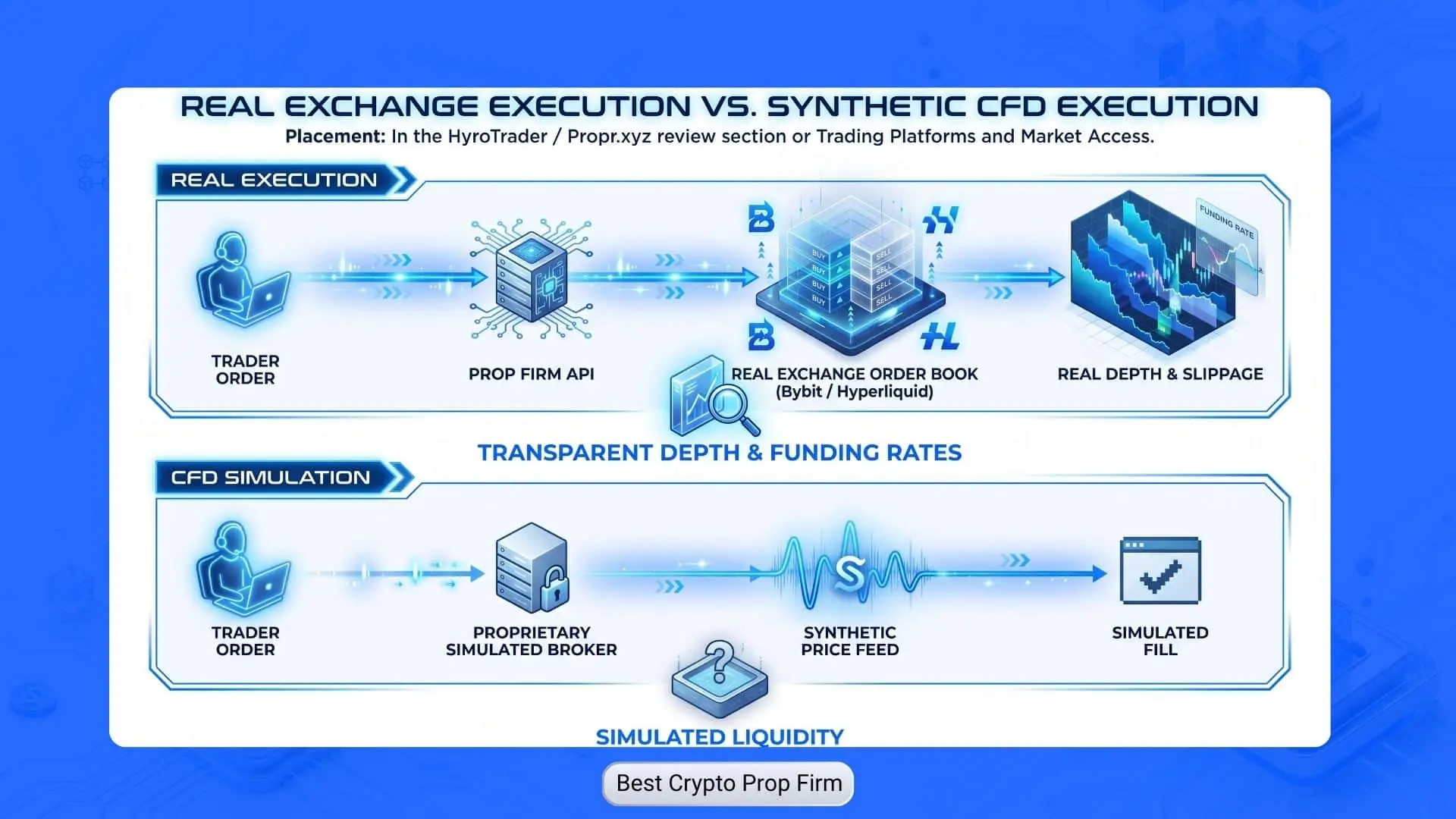
Comparing these models can help traders understand how a crypto prop firm differs from other ways of participating in financial markets. The most important differences include the markets available, account structure, trading restrictions, capital requirements, costs, and how profits and losses are handled.
Crypto Prop Firm vs Forex Prop Firm
Crypto and forex prop firms can have similar evaluation structures, but the markets and trading conditions can be significantly different.
Markets and Trading Conditions
A crypto prop firm generally focuses on cryptocurrency markets, which may include Bitcoin, Ethereum, altcoins, memecoins, perpetual futures, and in some cases spot markets. Forex prop firms primarily provide access to currency pairs such as EUR/USD, GBP/USD, and USD/JPY.
The difference in market structure can affect trading conditions. Crypto markets operate continuously throughout the week, while traditional forex markets generally follow a five day trading schedule.
Crypto traders may also encounter different volatility, liquidity conditions, funding mechanisms, and market data sources compared with major forex pairs.
When comparing the two models, traders should examine:
- Available markets and assets
- Trading hours
- Leverage by asset
- Spreads and commissions
- Market liquidity
- Overnight and weekend rules
- News trading restrictions
- Drawdown structure
- Available trading platforms
A trader who already specializes in cryptocurrency may therefore prioritize market selection and crypto specific execution conditions, while a forex trader may place greater importance on currency pair coverage and forex trading infrastructure.
Rules and Account Structure
Both crypto and forex prop firms can use evaluations, profit targets, drawdown limits, and funded account stages, but the specific rules can differ substantially between firms.
For example, one firm may use a static maximum drawdown, while another may use a trailing threshold. Minimum trading days, consistency requirements, time limits, and leverage restrictions can also vary.
The account structure should therefore be compared independently from the asset class. Two firms offering similarly sized accounts may provide very different trading conditions.
For traders choosing between crypto and forex prop firms, the relevant question is whether the available markets and account rules match the strategy being used.
Crypto Prop Firm vs Futures Prop Firm
Crypto prop firms and futures prop firms can both provide leveraged trading environments, but the underlying markets and contract structures are different.
Contracts and Market Access
Crypto prop firms may provide cryptocurrency spot markets or perpetual futures, depending on the firm’s platform and account structure. Futures prop firms typically focus on exchange traded futures contracts covering markets such as equity indexes, commodities, interest rates, currencies, or other futures products.
This distinction affects how positions are sized and managed. Crypto perpetuals generally do not have a traditional contract expiration date, while many exchange traded futures contracts have defined contract specifications and expiration cycles.
Market access is therefore an important comparison point. Traders should check whether the firm supports the specific instruments required by their strategy rather than comparing only the account balance.
Leverage and Risk Rules
Leverage, margin, and drawdown rules can work differently across crypto and futures prop firms.
Crypto prop firms may specify leverage separately for major cryptocurrencies, altcoins, and other assets. Futures firms may instead define trading conditions through contract specifications, margin requirements, and limits on the number of contracts or positions.
The firm’s drawdown model is also important. Traders should determine whether the account uses static or trailing drawdown, how daily loss is calculated, and whether unrealized profits or losses affect the relevant thresholds.
Other factors to compare include:
- Maximum position size
- Margin requirements
- Leverage or contract exposure
- Daily loss limits
- Maximum drawdown
- Market hours
- Contract specifications
- Trading fees
- Platform and data feed conditions
A futures trader considering a crypto prop firm should therefore compare the actual instruments and risk mechanics rather than assuming that similarly advertised account sizes provide equivalent trading capacity.
Crypto Prop Firm vs Trading Your Own Capital
Trading through a crypto prop firm and trading with personal capital involve fundamentally different approaches to funding and risk.
Capital and Risk
When trading personal capital, the trader provides the money used for trading and generally bears the resulting trading losses directly. A crypto prop firm account may instead require an evaluation fee or another form of account payment while providing a defined account structure and risk limits.
This can change the amount of personal capital required to access a particular trading environment. However, a prop firm account also comes with rules that do not normally apply when trading a personal account.
These may include:
- Profit targets
- Daily loss limits
- Maximum drawdown
- Trading restrictions
- Minimum trading days
- Payout conditions
- Position limits
- Strategy restrictions
With a personal trading account, the trader generally has greater control over the account’s trading decisions, subject to the exchange or broker’s own requirements. With a prop firm, the trader must operate within the firm’s account rules.
Costs and Profit Potential
The cost structure is also different.
Trading personal capital may involve exchange fees, spreads, funding costs, commissions, and other trading expenses, but there is generally no prop firm evaluation fee or profit split associated with the account itself.
A prop firm may require an upfront fee and then allocate a percentage of trading profits to the trader under its payout structure. The trader’s potential withdrawal is therefore determined not only by trading performance but also by the firm’s profit split and payout rules.
The comparison should include:
- Initial capital required
- Evaluation or account fees
- Trading costs
- Maximum permitted loss
- Profit split
- Withdrawal conditions
- Account restrictions
- Control over trading capital
Neither account structure should be evaluated solely by comparing the nominal account balance. The relevant difference is how much personal capital is required, what rules apply, and how trading profits and losses are handled.
Crypto Prop Firm vs Crypto Exchange
A crypto prop firm and a crypto exchange may both provide access to cryptocurrency markets, but they serve different purposes and operate under different account structures.
Account Ownership and Trading Capital
On a conventional crypto exchange, traders generally deposit their own funds and use those funds to buy, sell, or trade supported cryptocurrency products.
A crypto prop firm account follows a different structure. Depending on the firm’s model, traders may complete an evaluation or access a specific trading program under defined account rules rather than simply depositing personal trading capital into an exchange account.
This distinction affects the trader’s control over funds and account activity. Exchange users generally determine how much of their own capital to deposit and how to deploy it, while prop firm traders operate within the firm’s account structure and risk parameters.
Traders should also understand whether a prop firm’s trading environment is simulated or otherwise structured differently from a conventional exchange account. The firm’s terms should clearly explain the nature of the account and how trading activity and payouts are handled.
Trading Conditions and Restrictions
Crypto exchanges typically provide direct access to their supported markets under the exchange’s trading rules. Prop firms may add another layer of account specific restrictions.
These can include profit targets, maximum drawdown, daily loss limits, leverage restrictions, holding rules, consistency requirements, or limitations on certain strategies.
When comparing the two models, consider:
- Available cryptocurrencies
- Spot and perpetual futures access
- Leverage
- Trading fees
- Spreads and execution
- Market data source
- Position limits
- Trading restrictions
- Withdrawal conditions
- Account ownership and fund structure
An exchange can therefore provide a more direct trading environment for someone using personal capital, while a crypto prop firm provides a structured account model with its own evaluation, risk, and payout conditions.
Choosing Between Different Trading Models
The differences between these trading models largely come down to market access, capital requirements, account control, trading rules, and cost structure.
A crypto prop firm may appeal to traders specifically looking for a structured crypto trading account with defined risk limits and access to a larger nominal account size. Forex and futures prop firms may be more relevant to traders whose strategies depend on those respective markets.
Trading personal capital provides a different account structure, with the trader directly supplying the capital and generally having greater control over how it is used. A crypto exchange provides the infrastructure for trading cryptocurrency markets with deposited funds, subject to the exchange’s own terms and requirements.
Before choosing a model, compare the specific markets you trade, the capital you are prepared to commit, the restrictions you are willing to accept, the trading costs involved, and how profits can be withdrawn. The account structure matters as much as the advertised trading capital when comparing different ways to trade.
Crypto Prop Firm Reviews and Trust
Reviews and trust signals are important when comparing crypto prop firms because the advertised account conditions do not always tell the complete story. Traders should look beyond pricing, account size, and profit splits to understand how a firm operates, how clearly it publishes its rules, and what other traders report about their experience.
Independent reviews, payout evidence, company information, trading rules, and user feedback can all provide useful context. However, individual reviews and screenshots should also be evaluated carefully rather than treated as conclusive evidence on their own.
How to Check if a Crypto Prop Firm Is Legit
Before purchasing an account, traders should verify the firm’s basic information and understand exactly what is being offered.
Company Information and Transparency
Start by checking whether the firm clearly identifies the company behind the service and provides accessible information about its terms, rules, fees, and account structure.
Important information to review includes:
- Company or operator information
- Terms and conditions
- Evaluation rules
- Trading restrictions
- Pricing and refund policies
- Payout terms
- Privacy and support information
- Contact methods
A lack of clear documentation can make it harder to determine what conditions actually apply to an account.
Trading and Payout Terms
The firm’s trading rules should clearly explain how profit targets, daily loss limits, maximum drawdown, leverage, and other restrictions are calculated.
Payout terms deserve the same level of attention. Traders should understand when they become eligible for a withdrawal, how profits are calculated, which payment methods are supported, and whether additional conditions apply.
The information presented during checkout should also be consistent with the firm’s public documentation. If important conditions appear only in scattered pages or differ between the marketing material and the official rules, traders should investigate the discrepancy before purchasing.
Reviews and Payout Proof
Reviews can provide useful information about a firm’s customer experience, platform, rules, and payout process, but different sources provide different types of evidence.
Independent Reviews
Third party reviews can help identify recurring feedback that may not appear on a firm’s own website. Traders can compare reviews across multiple sources rather than relying on a single rating or testimonial.
Useful sources may include:
- Independent prop firm review websites
- Trading communities
- Public discussion forums
- Review platforms
- Detailed trader experiences
The date of a review is also important. Prop firm rules, platforms, pricing, and payout policies can change, so older reviews may describe conditions that are no longer available.
Payout Proof
Payout screenshots, transaction records, and trader submitted evidence can provide additional information about whether withdrawals have reportedly occurred.
Crypto payouts can sometimes be independently checked when a public blockchain transaction hash is available. A transaction record can confirm that a transfer occurred on a particular network and provide details such as the transaction status and transferred amount.
However, a single successful payout does not establish that every trader will have the same experience. Payout evidence should therefore be considered alongside the firm’s current terms, independent reviews, and other available information.
Risks and Red Flags
Even when a prop firm has positive reviews, traders should understand the risks associated with purchasing an account.
Changing Rules and Conditions
Prop firm conditions can change over time. Pricing, drawdown rules, leverage, payout requirements, supported markets, and trading restrictions may all be updated.
Traders should therefore review the current terms before purchasing rather than relying exclusively on an older comparison or review.
It can also be useful to save or document the rules that applied when an account was purchased, particularly when the firm provides detailed account specific conditions.
Marketing Claims and Unrealistic Promises
Marketing claims should be separated from verifiable account conditions.
Claims about exceptionally high profits, extremely easy evaluations, guaranteed outcomes, or unusually favorable payouts should be examined against the firm’s actual rules and terms.
The same principle applies to reviews. Testimonials and promotional screenshots may provide examples of individual experiences, but they do not necessarily represent the experience of every trader.
Lack of Transparency
A lack of clear information can make comparison more difficult. Traders should pay particular attention when important details about fees, drawdown calculations, payout eligibility, trading restrictions, or account conditions are difficult to find or inconsistently described.
The objective is not to judge a firm based on a single review or marketing claim. Instead, traders can build a clearer picture by comparing multiple sources and verifying important information directly against the firm’s current documentation.
When reviewing a crypto prop firm, consider the company information, current trading rules, pricing, payout terms, independent reviews, and available payout evidence together. No individual review, rating, or transaction screenshot provides a complete picture on its own.
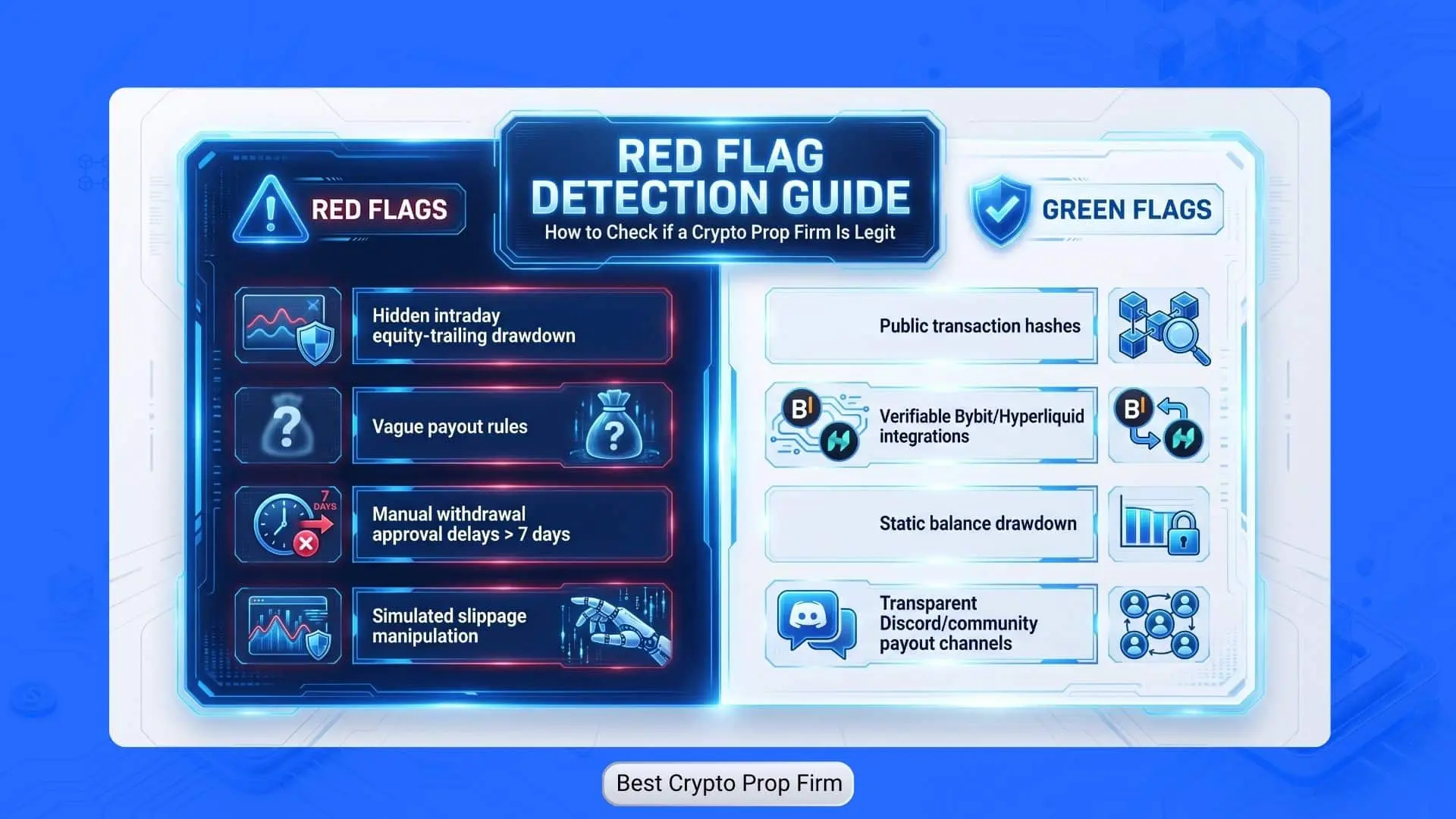
A structured review process can help traders distinguish between advertised features and the actual conditions that apply to the account before they commit money.
Frequently Asked Questions About Crypto Prop Firms
What Is the Best Crypto Prop Firm?
The best crypto prop firm depends on your trading strategy, budget, preferred markets, and the rules you are comfortable with. Compare account pricing, profit targets, drawdown limits, leverage, trading platforms, available crypto markets, trading restrictions, and payout conditions rather than relying on the advertised account size or evaluation price alone.
What Is the Cheapest Crypto Prop Firm?
The cheapest crypto prop firm is not necessarily the one with the lowest advertised entry price. The total cost can also include activation fees, add ons, resets, and other account charges. When comparing low cost crypto prop firms, consider the initial fee alongside the account rules, drawdown limits, profit targets, and payout conditions.
What Is the Best Crypto Prop Firm for Beginners?
A crypto prop firm may be easier for beginners to evaluate when its rules are clearly explained and its trading conditions are straightforward. Beginners should pay particular attention to the profit target, daily loss limit, maximum drawdown, minimum trading days, time limits, trading restrictions, and total account cost before choosing an evaluation.
Which Crypto Prop Firms Offer Instant Funding?
Instant funding crypto prop firms provide access to a trading account without requiring traders to complete a traditional evaluation first. However, instant funding models can have different fees, drawdown rules, profit splits, and payout conditions. Compare the complete account structure rather than treating instant access alone as the main advantage.
What Is the Best Crypto Prop Firm With TradingView?
The right TradingView crypto prop firm depends on how TradingView is integrated into the trading environment. Some firms offer TradingView based charting, while others provide a direct trading interface or connect TradingView with external market data. Check whether you can trade directly through the platform, which data source is used, and which crypto markets are available.
What Is the Best Crypto Prop Firm With Bybit?
Crypto prop firms associated with Bybit market data or pricing can differ in how that data is integrated into their trading platforms. When comparing them, check the source of market prices, available Bybit listed markets, execution conditions, spreads, and whether Bybit is used for market data, execution, or both. The exact relationship and trading setup should be verified from the firm’s documentation.
Which Crypto Prop Firms Allow Spot Trading?
Not every crypto prop firm supports spot trading. Many focus primarily on perpetual futures or other derivatives. If spot trading is important, check whether the firm offers actual spot markets, which assets are available, whether leverage is offered, and whether spot positions are subject to the same evaluation and risk rules as other markets.
Which Crypto Prop Firms Allow Memecoin Trading?
Memecoin availability varies between crypto prop firms. Traders should check the firm’s current market list to confirm which memecoins can be traded and whether those markets have different leverage, position size, spread, or risk conditions. Because memecoin liquidity can vary significantly, execution and trading costs can also be important factors when comparing firms.
What Should You Look for in a Crypto Prop Firm?
Key factors include account pricing, account size, profit targets, daily loss limits, maximum drawdown, leverage, trading restrictions, available markets, platform support, profit splits, payout requirements, and payout timing. It is also important to review the firm’s company information, terms, and independent reputation before purchasing an account.
Are Crypto Prop Firms Legit?
Crypto prop firms operate under different business models and levels of transparency, so legitimacy should be evaluated individually. Check the firm’s company information, published terms, evaluation and payout rules, independent reviews, trading conditions, and available payout evidence. Be cautious when important conditions are unclear or marketing claims are not supported by verifiable information.
How Much Does a Crypto Prop Firm Cost?
The cost of a crypto prop firm account varies by account size and funding model. Traditional evaluations generally charge an upfront fee, while some firms offer instant funding or other account structures with different pricing. Compare the initial fee with activation charges, add ons, resets, and other potential costs to understand the total price.
How Do Crypto Prop Firm Payouts Work?
Crypto prop firm payouts generally occur after a trader meets the firm’s funded account eligibility requirements. The firm may specify a minimum number of trading or funded days, a profit split, payout frequency, minimum withdrawal amount, and supported payment methods. Some firms also provide on chain transaction records that allow crypto payouts to be independently verified.